
Armes de réussites massives - Blogs Intelligence économique. Comment voulez-vous comprendre sans savoir ?
Les débats qui nous entourent dans cette année électorale foisonnent d’hypothèses ou d’affirmations, de questions et de préoccupations auxquelles répondent des propositions et des solutions sans que l’on sache si ceux qui parlent savent de quoi ils parlent. Cela ne veut pas dire qu’ils sont ignorants, mais qu’à défaut de « simplexité », la complexité des sujets à traiter ne s’accommodent pas de jugements péremptoires. Il existe aujourd’hui de ces questions largement mises sur la place publique qui pourraient être cités comme cas d’école. Www.ege.fr/download/msie_100720.pdf. Culture Eats Strategy For Lunch. Get on a Southwest flight to anywhere, buy shoes from Zappos.com, pants from Nordstrom, groceries from Whole Foods, anything from Costco, a Starbucks espresso, or a Double-Double from In N' Out, and you'll get a taste of these brands’ vibrant cultures.

Culture is a balanced blend of human psychology, attitudes, actions, and beliefs that combined create either pleasure or pain, serious momentum or miserable stagnation. A strong culture flourishes with a clear set of values and norms that actively guide the way a company operates. Employees are actively and passionately engaged in the business, operating from a sense of confidence and empowerment rather than navigating their days through miserably extensive procedures and mind-numbing bureaucracy.
Performance-oriented cultures possess statistically better financial growth, with high employee involvement, strong internal communication, and an acceptance of a healthy level of risk-taking in order to achieve new levels of innovation. 12 Brawny Business Intelligence Products For SMBs. Business intelligence isn't just for the big boys anymore.
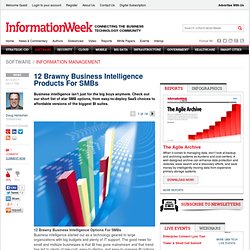
Check out our short list of star SMB options, from easy-to-deploy SaaS choices to affordable versions of the biggest BI suites. 1 of 14 12 Brawny Business Intelligence Options For SMBsBusiness intelligence started out as a technology geared to large organizations with big budgets and plenty of IT support. SOCIETE.COM : L'information gratuite sur les entreprises du Registre du Commerce.
How to put your money where your strategy is - McKinsey Quarterly - Strategy - Growth. Picture two global companies, each operating a range of different businesses.
Breaking strategic inertia: Tips from two leaders - McKinsey Quarterly - Strategy - Growth. Frameworks abound for developing corporate strategy.
But there’s no textbook or theory that explains how to deliver on that strategy by shifting capital, talent, and other scarce resources from one part of a business to another. One reason is that the moves each organization must make at any point in time are unique. Another is that different senior executives have different roles to play. But that’s not to say companies can’t learn from one another—in fact, understanding the broad range of reallocation challenges faced by different executives sheds valuable light on common pitfalls and the decision-making processes for sidestepping them. The social side of strategy - McKinsey Quarterly - Strategy - Strategy in Practice.
In 2009, Wikimedia launched a special wiki—one dedicated to the organization’s own strategy.
Over the next two years, more than 1,000 volunteers generated some 900 proposals for the company’s future direction and then categorized, rationalized, and formed task forces to elaborate on them. The result was a coherent strategic plan detailing a set of beliefs, priorities, and related commitments that together engendered among participants a deep sense of dedication to Wikimedia’s future. Through the launch of several special projects and the continued work of self-organizing teams dedicated to specific proposals, the vision laid out in the strategic plan is now unfolding. Wikimedia’s effort to crowdsource its strategy probably sounds like an outlier—after all, the company’s very existence rests on collaborative content creation.
Our objective in this article isn’t to present a definitive road map for opening up the strategy process; it’s simply too early for one to exist. Closer to home. Les organigrammes des plus grandes entreprises mondiales - TheOfficialBoard. How multinationals can attract the talent they need - McKinsey Quarterly - Organization - Talent.
Global organizations appear to be well armed in the war for talent.
They can tap sources of suitably qualified people around the world and attract them with stimulating jobs in different countries, the promise of powerful positions early on, and a share of the rewards earned by deploying world-class people to build global businesses. However, these traditional sources of strength are coming under pressure from intensifying competition for talent in emerging markets. Talent in emerging economies is scarce, expensive, and hard to retain. In China, for example, barely two million local managers have the managerial and English-language skills multinationals need. One leading bank reports paying top people in Brazil, China, and India almost double what it pays their peers in the United Kingdom.
How can global organizations best renew and redeploy their strengths to address these challenges? Organizing for an emerging world - McKinsey Quarterly - Organization - Strategic Organization. As global organizations expand, they get more complicated and difficult to manage.
For evidence, look no further than the interviews and surveys we recently conducted with 300 executives at 17 major global companies. Fewer than half of the respondents believed that their organizations’ structure created clear accountabilities, and many suggested that globalization brings, as one put it, “cumulative degrees of complexity.” However, our research and experience in the field suggest that even complex organizations can be improved to give employees around the world the mix of control, support, and autonomy they need to do their jobs well. Top 10 Civilizations That Mysteriously Disappeared. Throughout our history, most civilizations have either met a slow demise or were wiped out by natural disasters or invasion.
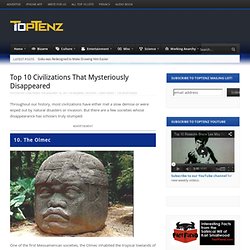
But there are a few societies whose disappearance has scholars truly stumped: 10. The Olmec One of the first Mesoamerican societies, the Olmec inhabited the tropical lowlands of south-central Mexico. The first signs of the Olmec are around 1400 BC in the city of San Lorenzo, the main Olmec settlement which was supported by two other centers, Tenochtitlan and Potrero Nuevo.
Where did they go? Strategy Analytics: Market and Research Consulting. Portail:Management. Problèmes pour faire un don?
| Autres façons de donner | Foire aux questions | En donnant, vous acceptez notre politique de confidentialité du donateur. La Fondation Wikimédia est une organisation à but non lucratif, exonérée de taxes aux États-Unis.By donating, you are agreeing to our donor privacy policy and to sharing your information with the Wikimedia Foundation and its service providers in the U.S. and elsewhere. The Wikimedia Foundation is a nonprofit, tax-exempt organization.En faisant ce don, vous acceptez notre politique de confidentialité en matière de donation ainsi que de partager vos données personnelles avec la Fondation Wikimédia et ses prestataires de services situés aux Etats-Unis et ailleurs.
*Les versements périodiques seront débités par la Fondation Wikimédia jusqu‘à ce que vous nous indiquiez d‘arrêter. Nous vous enverrons un reçu par courriel pour chaque paiement, qui inclura un lien vers des instructions faciles d’annulation. Stratégie d'entreprise. Un article de Wikipédia, l'encyclopédie libre. Stratégie d'entreprise.