
School Designs Home Page. Elementary School. By Ellen Larson Vaughan, Steven Winter Associates, Inc.Updated by Judy Marks, NCEF Director Last updated: 03-17-2011 Overview Elementary School buildings are the setting for the first four to eight years of a child's formal education, a period of structured schooling that is compulsory in most countries.
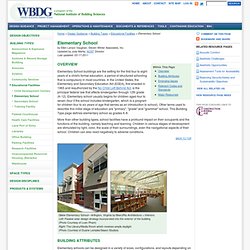
In the United States, the Elementary and Secondary Education Act (ESEA), first enacted in 1965 and reauthorized by the No Child Left Behind Act, is the principal federal law that affects kindergarten through 12th grade (K-12). Designing For All Children. The following article will be featured in the web-based online accessibility training course for architects that is being developed by The American Institute of Architects (AIA) in collaboration with the U.S.
Architectural & Transportation Barriers Compliance Board (Access Board) that is responsible for developing guidelines for the implementation of the Americans With Disabilities Act (ADA). The online course is expected to be up and running in October 1999. by Vicki L. Scolarisation des élèves à besoins éducatifs particuliers. Child with Asperger's syndrome 'flourishes' at Town and Country School, mom says - BALedger.com: Education. Of the seven kids in the classroom that day, only two sat at their desks.
Another two stood at their desks, one was in the back of the room with the teacher's aide and one walked around the classroom as he talked to his teacher. Accessing full articles on BALedger.com requires a Digital Subscription, only $1.00 for 7 days. Click the "Subscribe" button below to get started. Existing print subscribers, click HERE to request access. Click HERE to read our FAQ. Our Analysis. Enrolment policy. Scoil na Croise Naofa Mahon.
Enrolment Policy “We Welcome, We Encourage, We Learn” This policy is set out in accordance with the provisions of the Education Act 1998. The Board of Management trusts that by so doing parents will be assisted in relation to enrolment matters. Disabled children and young people - Facts and Figures. The information on this page is taken from the Children with Disability Needs Assessment produced by Herefordshire Public Services in 2010, which can be downloaded from the resource box at the bottom of the page.
Introduction There is a lack of data at both national and local level on the numbers and characteristics of disabled children and their use of local services. Education Act 1996. Une école évolutive invite la nature en milieu urbain (diaporama) A l’heure où l’on voit fleurir des chantiers de cités universitaires, hôtels ou encore des chapelles en conteneurs, pas moins de 706 étudiants en architecture de 17 pays se sont essayés à créer une école à partir d’une autre structure modulaire : le module Algeco.

L’industriel a remis jeudi les prix de la troisième édition de son concours, Architecture(s) élémentaire(s), sous le thème de «l’école évolutive». Il s’agissait de concevoir, en zone urbaine, un projet d’école moderne à partir d’un module industrialisé Algeco de la gamme Progress, sur l’une des deux parcelles proposées en Ile-de-France, de 27.339 m2 et 1.864 m2. Le tout en R+2 maximum. Le jury a décerné, parmi les 110 projets présentés, trois prix ainsi que deux mentions spéciales. Designing for disabled children and SEN. Designing for disabled children and children with special educational needs means putting these children at the very heart of the design and build process, right from inception.
This will help ensure not only access and participation but also inspirational school environments. A recent publication from the Department for Children, Schools and Families (DCSF) draws together guidance on designing ‘inclusive’ school environments. It stresses that there is a wide range of special educational need and no one design solution to support these children. So it’s vital that approaches are developed carefully, in close consultation with stakeholders from the word go.
Only by talking to teachers, specialists, parents, carers and the children themselves – and incorporating their expertise and experience - can a good quality, detailed brief be developed, which will help turn bricks and mortar into an inspiring, ‘inclusive’ school environment that matches the needs of the communities it serves. Success For Kids With Hearing Loss » Classroom Acoustics – Design Requirements for Schools.
Click here for information on perceiving speech under classroom listening conditions.

Classroom Acoustics and ANSI Standard S12.60:Every day, thousands of students across the country are unable to understand 25 to 30 percent of what’s said in their classroom. Excessive noise and reverberation in a classroom interferes with a student’s ability to clearly hear their teacher. Before reviewing the new standard, it’s important to be familiar with the attributes of sound found in the classroom that affect a student’s ability to hear and learn.
Home.
Educateur/caretakers. At a glance: Mauritius - Real lives. Real lives Education for Development… A Primary Teacher's Experience.

Search Results. Ministry of Gender Equality, Child Development and Family Welfare. Social benefits granted to disabled persons. Ile Maurice Lux* Belle Mare (ex Hotel Beau Rivage Naiade) 5* - Cote Est - hotel 5 étoiles - Reservation Lux* Belle Mare ( ex Naiade Beau Rivage) 5* Ile Maurice. Custom Search. Plowden Report 1967 - Volume 1 Part 5 Chapter 21. Complex Child Magazine. Unlocking Speech and Language. Deafness and the User Experience. How many times have you been asked this question: if you had to choose, which would you prefer to be: deaf or blind?
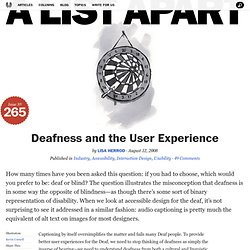
The question illustrates the misconception that deafness is in some way the opposite of blindness—as though there’s some sort of binary representation of disability. When we look at accessible design for the deaf, it’s not surprising to see it addressed in a similar fashion: audio captioning is pretty much the equivalent of alt text on images for most designers. Captioning by itself oversimplifies the matter and fails many Deaf people. To provide better user experiences for the Deaf, we need to stop thinking of deafness as simply the inverse of hearing—we need to understand deafness from both a cultural and linguistic perspective.
Moreover, to enhance the online user experience for the deaf, we must understand how deafness influences web accessibility. Learning Disability Wales - Creating a Wales that values and includes every child and adult with a learning disability. Especially for Parents. Parenting is no easy feat. When you parent a child with special challenges, such as ADHD, the odds can at times seem insurmountable. As with all healthcare issues, information is power. We hope this section arms you, the parent, with the information that will empower you as you navigate the sometimes rough terrain of raising a child with this neurobiological disorder. For Parents - Learning Disabilities Association of America. Parents are often baffled by the problems presented by a child with learning disabilities. Often this “invisible disability” does not become obvious until a child reaches school age.
Even then, difficulties may be subtle and hard to recognize. Here you will find a wealth of information on understanding learning disabilities, negotiating the special education process, and helping your child and yourself. Students with Intellectual Disabilities: A Resource Guide for Teachers - BC Ministry of Education - Special Education. Education. The goal of all education is to prepare students to participate in society, and for most people, vision is fundamental to learning. But what happens when a child has a visual impairment? Limitations on the ability to receive information from the world around us can have far-reaching effects, including an impact on a child's ability to understand concepts, learn language, move about freely with confidence, and develop in a variety of ways.
For this reason, the families and teachers of children with visual impairments use alternative means and strategies for teaching them to read, write, interact socially, and perform various daily tasks. Currently, nearly 94,000 children in the United States who are blind or visually impaired are being helped by some form of special education. These students are an extremely diverse group ranging from infants to young adults through age 21. Le développement de l'enfant ... BuiLD YouR WiLD SeLF. Teasing, People Say the Craziest Things, BandAides and Blackboards. "I have cystic fibrosis, and sometimes I cough a lot. Here's what happens when I get in line at school. the kids in front of me walk real fast, and the kids behind me walk real slow.
PLAYSKOOL Play Skills Slide Show - Demos. Child Care, Head Start & Children's Learning Facility Experience. Child Care, Head Start & Children's Learning Projects Experience Our early childhood educational and learning-based project experience includes Growing Green Child Care Kenosha, WI Provided schematic drawings and building layout for a new 11,600 square foot “green” child care center. Although the building is not L.E.E.D. certified, we specified healthy building materials and healthy furniture/props. How A Child Develops - Develop Skills. Child development stages. 5, 6, 7, 8, 9, 10 Year Old Child Development - Developmental Stages - Parenting. Child Development Milestone Chart: What To Expect From Birth To 6 Years. Autism Speaks, Video Glossary. Learn the Signs. Act Early. Milestones - NCBDDD. Benefits For Children With Disabilities. U.S. Education : Disabilities. A Guide to Disability Rights Laws. La scolarisation des élèves handicapés - Ministère de l'éducation nationale.
La loi du 11 février 2005 pour l’égalité des droits et des chances, la participation de la citoyenneté des personnes handicapées a permis des avancées majeures dans la politique de scolarisation des élèves en situation de handicap. Le service public d’éducation doit veiller à l’inclusion scolaire de tous les enfants, sans aucune distinction. Une approche nouvelle est consacrée : quels que soient les besoins particuliers de l’élève, c’est à l’école de s’assurer que l’environnement est adapté à sa scolarité. Depuis 2006, le nombre d’élèves en situation de handicap scolarisés en milieu ordinaire a plus que doublé. Drasspaca - Les établissements et services spécialisés pour enfants et adolescents handicapés. Results for 'special needs' Special educational needs (SEN) - The Department for Education.
Special Educational Needs and Disability Act 2001. Legislation.gov.uk The National Archives Search Legislation Advanced Search.