
Tutorials. Get Started on Flipboard Welcome to Flipboard, your personal magazine.
Here are tips on how to get started. You can watch our quick video tutorial, or read more below. 1. Download Flipboard Available for free in the App Store, Google Play, Windows Store, Blackberry World, Amazon App Store and Nook App Store. 2. When you launch Flipboard for the first time, swipe past the “Welcome to Flipboard” screen. On the next page, tap to subscribe to different topics from Tech and News to Style and Film. 3. After setting up your Flipboard, you will arrive at the Table of Contents—the “front page” that houses all your favorite content. 4. Explore the Content Guide for hundreds of recommendations for what to read, look at, or listen to.
Subscribe to what you love to customize your Flipboard. 5. Add your social networks to quickly browse newsfeeds from that network. 6. It’s easy to share the amazing content you come across on Flipboard. Creating Your Own Magazines. Top 10 Tools for Content Curation. By now you must have heard of the term ‘Content Curation’ and may be wondering what it’s all about.
Well Content Curation is a process of discovering, gathering and cataloging interesting content around a topic and share for a common benefit. When you hear Content Curation, think of it as a museum with similar items displayed for people to look at. Content Curation is all about gathering items of importance and interest and sharing them for other people to see, for example during the SOPA war a lot of people wrote so many things which most of them lacked the right information and data. Your Google Plus Network Is More Powerful Than You Know.
Appendix 2: Functional requirements for an open peer review system. By Peter Brantley Basics ¶ 2 Any open peer review (OPR) system will present a set of compromises in design and functionality.
Difficulties arise not only in technical capability but also in the heterogeneous nature of workflow preferences across a wide range of scholarly communities, with varying choices for participation, editorial function, and publication goals. ¶ 3 In any consideration of appropriate choices for software implementation, it is critical to distinguish between and prioritize different functions for the software platform; persona administration; and workflow management. ¶ 4 Examples of persona administrative options include support for reviewer profile attributes (anonymous or authenticated); management of reputation metrics; identity management for authors, editors, and reviewers; and the ability to manage user accounts for privileges, inappropriate behavior, and other purposes.
Mechanics ¶ 10 Being wise about where failure is permitted is a critical component of design. Recent articles module helps Facebook users discover stories about topics they’re interested in. Recent articles module helps Facebook users discover stories about topics they’re interested in Some Facebook users are seeing a new “recent articles” module that highlights news stories related to a page that a user has Liked. A Facebook spokesperson tells us, “This unit is a test of a new kind of News Feed story that makes it easier to find content that you might be interested in.” The unit pulls from a range of sources and includes popular links that are being shared on the social network.
The articles do not have to be from social reader applications and they do not have to have been posted by a page the user is connected to. Instead it lets users know about articles they might not have seen already but would be interested in based on their page Likes. The module is similar to the “most shared articles” feature we found Facebook testing last month. Thanks to Tom Waddington for the tip and the screenshot. Sponsored Post Hands-On Social Media Training for Beginners. BibSoup. Hitlantis Rethinks Music Discovery With ‘Sea of Bubbles’ Finnish entrepreneur Timo Poijärvi wants to change the way we discover music with Hitlantis — a visually impressive rethink of the traditional box of search results.
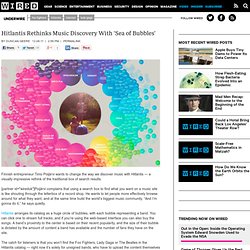
[partner id="wireduk"]Poijärvi complains that using a search box to find what you want on a music site is like shouting through the letterbox of a record shop. He wants to let people more effectively browse around for what they want, and at the same time build the world’s biggest music community. “And I’m gonna do it,” he says quietly. Hitlantis arranges its catalog as a huge circle of bubbles, with each bubble representing a band.
You can click one to stream full tracks, and if you’re using the web-based interface you can also buy the songs. Safe Browsing Tool. Home. Pinterest / Home. Trending. It. Today. Smashwords - Ebooks from independent authors and publishers. Spam clogging Amazon's Kindle self-publishing. Cofi: A Java-Based Collaborative Filtering Library. FriendFeed. Artist A Day - Exposing you to new art and artists everyday. Users.cis.fiu.edu/~lzhen001/activities/KDD_USB_key_2010/docs/p233.pdf.