
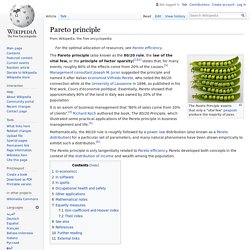
Pareto principle. The Pareto Principle asserts that only a "vital few" peapods produce the majority of peas.
The Pareto principle (also known as the 80/20 rule, the law of the vital few, or the principle of factor sparsity)[1][2] states that, for many events, roughly 80% of the effects come from 20% of the causes.[3] Management consultant Joseph M. Juran suggested the principle and named it after Italian economist Vilfredo Pareto, who noted the 80/20 connection while at the University of Lausanne in 1896, as published in his first work, Cours d'économie politique.
Essentially, Pareto showed that approximately 80% of the land in Italy was owned by 20% of the population. It is an axiom of business management that "80% of sales come from 20% of clients".[4] Richard Koch authored the book, The 80/20 Principle, which illustrated some practical applications of the Pareto principle in business management and life.[5] The Pareto principle is only tangentially related to Pareto efficiency. Wonder How To » How To Videos & How-To Articles.