
Wix.com Torah-Truths created by eddi25 based on Classic Consulting. Holy Holy Holy Lord God Almighty .. [Agnus Dei] GODREALNAME. The Ancient Web - the Ancient World's Great Civilizations. AdLIT > In Perspective Magazine > A Little Latin and . . . a Lot of English. Feature by Rick M.

Newton and Evangeline Newton Consider this: In the fifth grade alone, our students will meet about 10,000 new words as they read. Sixty percent of those words will have recognizable Greek, Latin, or Anglo-Saxon word parts (Nagy et al., 1989). About 4,000 of the 10,000 words will be derivatives of familiar words (compound words and words with prefixes and suffixes). "But, Miss Cassell, we don't want to translate Julius Caesar's Gallic Wars on Fridays! " Mandatory foreign language study in University City public schools actually began in the eighth grade. All the foreign language classes met at the same time: Monday, Wednesday, and Friday, 2:00-3:00 in the afternoon. But Miss Elaine Cassell, our brand-new Latin teacher with an MA from Stanford University, was intent on making us complete her favorite selections from Julius Caesar by the end of the year so that she could send us to high school fully prepared for Cicero.
Even Miss Cassell got into the game. How Do We Begin? British Eighteenth-Century Chemical Terms - TOC. The Incompleat Chymist: Being an Essay on the Eighteenth-Century Chemist in His Laboratory, with a Dictionary of Obsolete Chemical Terms of the Period Jon EklundSmithsonian Studies in History and Technology, Number 33Smithsonian Institute PressWashington, DC, 1975 You may wish to consult Carmen Giunta's Glossary of Archaic Chemical Terms for additional information.
Introduction to the Dictionary Just as Samuel Johnson pointed out that no dictionary of a living language can be perfect, so it must be argued that no dictionary for a living historical discipline will initially be complete or free from errors. The purpose of our dictionary is to make it easier for students to become acquainted with an esoteric and often confused nomenclature in order to more clearly interpret the technical activities of eighteenth-century chemists. Learn Latin - Download Textkit's Latin grammar and reading textbooks. Dead Sea Scrolls. The name Baal: meaning, origin and etymology. Godchecker.com - Your Guide To The Gods. A Nazarene Looks at the Book of Mormon Part 1 - Nazarene Space.
By James Scott Trimm The Book of Mormon makes a major mistake from a Nazarene standpoint.
The Book of Mormon does not represent the teachings of the Bible, but instead presents the teachings Protestant Christians have BELIEVED are in the Bible. Although the Book of Mormon, unlike the Bible, presents a continuous story line running from "Old Testament Times" through into "New Testament Times"; the Book of Mormon is still clearly dividable into "Old Testament" and "New Testament" portions. Now in its "Old Testament Portion" the Book of Mormon teaches exactly what Christians WISH they could find in the "Old Testament" portion of the Bible. Antiquities of the Jews. By Flavius Josephus This work was translated by William Whiston and edited by the folks at Sage Software, who offer these works, as well as hundreds of ancient and modern authors, on CD from (I am not associated with Sage Software, but left the plug for their CD in place because it is from their production of the text that my work here is based.)
HTML conversion was performed from RTF and Microsoft Word sources locally. Preface Book I Containing The Interval Of Three Thousand Eight Hundred And Thirty-Three Years. Chapter 1. Roman Gods and Goddesses. Roman Gods and Goddesses In the beginning Roman gods were considered divine manifestations, faceless, formless, and powerful.
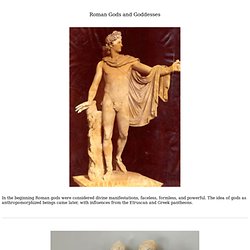
The idea of gods as anthropomorphized beings came later, with influences from the Etruscan and Greek pantheons. The Romans worshipped a main pantheon of 12 Gods called Dii Consentes: six gods and six goddesses: Jupiter, Juno, Minerva, Vesta, Ceres, Diana, Venus, Mars, Mercurius, Neptunus, Volcanus, and Apollo. 12 Around 1 Geometry of Creation Roman and Greek God Comparisons Greek Gods and Goddesses Gods with Wings, especially those with chariots, denote Ancient Aliens as mythological gods and goddesses. Family tree of the Greek gods. Key: The essential Olympians' names are given in bold font.
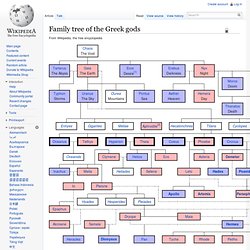
See also List of Greek mythological figures Notes External links Media related to Family trees of Greek mythology at Wikimedia Commons. Essenes, Essene Teachings and Essene Theology. YHWH The personal Name of the Creator. YAH'S WATCHMAN. Podcast - Passion for Truth Ministries. Days Of Noah. THE NATSARIM DOCUMENTARY.