
Sebastian Ramseid
Moodstream™ by Getty Images. Western Philosophy. FPI and Freedom House joint event: "Toward a Democratic Russia"
List of unsolved problems in physics. Some of the major unsolved problems in physics are theoretical, meaning that existing theories seem incapable of explaining a certain observed phenomenon or experimental result.
The others are experimental, meaning that there is a difficulty in creating an experiment to test a proposed theory or investigate a phenomenon in greater detail. Unsolved problems by subfield[edit] The following is a list of unsolved problems grouped into broad area of physics.[1] Cosmology, and general relativity[edit] Cosmic inflation Is the theory of cosmic inflation correct, and if so, what are the details of this epoch? Horizon problem Electroweak Horizon Problem Why aren't there obvious large-scale discontinuities in the electroweak vacuum, if distant parts of the observable universe were causally separate when the electroweak epoch ended? Future of the universe Is the universe heading towards a Big Freeze, a Big Rip, a Big Crunch or a Big Bounce? Gravitational wave. Marvin Minsky: Mind As Society (excerpt) - Thinking Allowed DVD w/ Jeffrey Mishlove. The Magic of Consciousness.
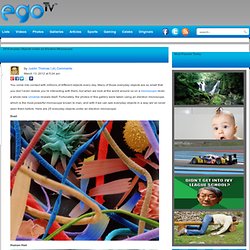
Free online speed reading software. Free Astronomy Books. Free online speed reading software. Everyday Objects Under Electron Microscope. <div style="display:none"><img src=" ID>&oid=<Offer ID>" /></div> EgoTV 25 Everyday Objects Under an Electron Microscope digg March 13, 2012 at 5:24 am You come into contact with millions of different objects every day.
The Coming Technological Singularity. ==================================================================== The Coming Technological Singularity: How to Survive in the Post-Human Era Vernor Vinge Department of Mathematical Sciences San Diego State University (c) 1993 by Vernor Vinge (Verbatim copying/translation and distribution of this entire article is permitted in any medium, provided this notice is preserved.)
This article was for the VISION-21 Symposium sponsored by NASA Lewis Research Center and the Ohio Aerospace Institute, March 30-31, 1993. 77 Brain Hacks to Learn Faster, Deeper, and Better. Source: Online Education Database If someone granted you one wish, what do you imagine you would want out of life that you haven't gotten yet?
The brain’s silent majority - 2009 FALL. When you have no clue, call it glue.

“Glia,” the Greek word for glue, was the name the pathologist Rudolph Virchow gave, back in 1856, to the gelatinous substance that forms the bulk of the brain. And it stuck. These days, scientists use it to denote the matter that accounts for 90 percent of the brain’s cells and more than half its volume — but, like the late comic Rodney Dangerfield, “can’t get no respect.” Neurons, the “talented tenth” of the human brain that hog the lion’s share of brain scientists’ attention, are indeed a work of evolutionary art. Singularity Institute Interview with Stephen Omohundro, AI Researcher. Untitled. WHY PEOPLE THINK COMPUTERS CAN'T Marvin Minsky, MIT First published in AI Magazine, vol. 3 no. 4, Fall 1982.
Reprinted in Technology Review, Nov/Dec 1983, and in The Computer Culture, (Donnelly, Ed.) Associated Univ. How to Trick Your Brain for Happiness. This month, we feature videos of a Greater Good presentation by Rick Hanson, the best-selling author and trailblazing psychologist.
In this excerpt from his talk, Dr. Hanson explains how we can take advantage of the brain’s natural “plasticity”—it’s ability to change shape over time. gobyg There’s this great line by Ani Tenzin Palmo, an English woman who spent 12 years in a cave in Tibet: “We do not know what a thought is, yet we’re thinking them all the time.” It’s true. In recent years, though, we have started to better understand the neural bases of states like happiness, gratitude, resilience, love, compassion, and so forth.
Popular Science - A Nerd’s Guide to Reading. A Brilliant List of Science Books for People Who Want Their Minds Blown. 'Magic mushroom' drug may improve personality. In new research that will almost certainly create controversy, scientists working with the hallucinogen psilocybin -- the active ingredient found in "magic mushrooms" -- have found that a single dose of the drug prompted an enduring but positive personality change in almost 60 percent of patients.
Specifically, tests involving a small group of patients in a strictly controlled and monitored clinical setting revealed that, more often than not, one round of psilocybin exposure successfully boosted an individual's sense of "openness. " What's more, the apparent shift in what is deemed to be a key aspect of personality did not dissipate after exposure, lasting at least a year and sometimes longer. "Now this finding is really quite fascinating," said study author Roland R. Griffiths, a professor in the departments of psychiatry and neuroscience at Johns Hopkins University School of Medicine in Baltimore. Griffiths said it's possible psilocybin could have therapeutic uses. Dr. Instinct - The easiest way to learn a musical instrument. GoFlow - World's First tDCS Kit. Top 5 Videos Of Alan Watts. Beyond Belief: Science, Reason, Religion & Survival.
BEYOND BELIEF DVDs are now available! Purchase them here. Just 40 years after a famous TIME magazine cover asked "Is God Dead? " Richard Feynman Lecture 4 Part 1/7: Problems in QED and The Standard Model of Particle Physics. The Vega Science Trust - Richard Feynman - Science Videos. Chosen by the New Scientist - best on-line videos 2007.

A set of four priceless archival science video recordings from the University of Auckland (New Zealand) of the outstanding Nobel prize-winning physicist Richard Feynman - arguably the greatest science lecturer ever. Although the recording is of modest technical quality the exceptional personal style and unique delivery shine through. Feynman gives us not just a lesson in basic physics but also a deep insight into the scientific mind of a 20th century genius analyzing the approach of the 17th century genius Newton. The Quantum Physics of Free Will. Free Will Is as Real as Baseball. A handful of musings about free will have been popping up in my blog reader of late.
Jerry Coyne has been discussing the issue with Eric MacDonald in a series of posts (further links therein). Russell Blackford writes a long post that he promises isn’t the post he will eventually write, David Eagleman has an article in the Atlantic, and Zach Weiner also chimes in. So we have a biologist studying theology, an ex-Anglican priest turned agnostic, a philosopher and neuroscientist both of whom write science fiction, and a webcartoonist studying physics. Ethical Questions Surround “Electrical Thinking Cap” That Improves Mental Functions. Child using transcranial direct current stimulation What if a drug could improve learning and cognition and had no untoward medical consequences? Wouldn’t it be justified to make it widely available?
A group of scientists concluded three years ago that it would be. No such drug exists, but the question arises anew because of a brain-stimulation technique that appears on paper to fit the bill. The technology, transcranial direct-current stimulation, involves applying weak electrical currents to the scalp through electrodes. 25 Greatest Science Books of All Time. Read an essay on the greatest science books by Nobel laureate Kary B. Mullis. 1. and 2. Get Better at Math by Disrupting Your Brain.
We tend to believe that our brains work as well as they can. Thus, we assume that if you are good at math, it means that your brain is superior to the brains of those who find math more challenging. Amping Up Brain Function: Transcranial Stimulation Shows Promise in Speeding Up Learning. WASHINGTON, D.C. —One of the most difficult tasks to teach Air Force pilots who guide unmanned attack drones is how to pick out targets in complex radar images. Pilot training is currently one of the biggest bottlenecks in deploying these new, deadly weapons.
So Air Force researchers were delighted recently to learn that they could cut training time in half by delivering a mild electrical current (two milliamperes of direct current for 30 minutes) to pilot's brains during training sessions on video simulators. The current is delivered through EEG (electroencephalographic) electrodes placed on the scalp. Biomedical engineer Andy McKinley and colleagues at the Air Force Research Laboratory at Wright–Patterson Air Force Base, reported their finding on this so-called transcranial direct current stimulation (TDCS) here at the Society for Neuroscience annual meeting on November 13. Build an Electronic Brain Stimulator - Science, Technology & Computers. TEDx Brussels 2010 - Tan Le - The God Helmet. Shiva Neural System for "God Helmet" sessions. The Moral Foundations of Politics. Edge : Conversations on the edge of human knowledge.
China’s Unstoppable Billion. The most important global trend is the emergence of a great people from millennia of despotic rule, says Gordon Chang. The Chinese people, in short, are the world’s unstoppable force. By Gordon Chang for The Diplomat January 05, 2012. Brain scan: Seer of the mirror world. Technology: Print me a Stradivarius. 3D printing: The printed world. 20 Books to Read in 2012 - By Margaret Slattery. The Best International Relations Masters Programs. Justice and the Moral Limits of Markets. Terence McKenna ~ TV Is A Drug. Using the new Positive Psychology. Readings in Positive Psychology. Search results for "charles bukowski" (showing 21-40 of 502 quotes) Search results for "charles bukowski" (showing 1-20 of 502 quotes) Meddelanden. Killing the Buddha. Nothingness: Why nothing matters - physics-math - 24 November 2011.
Pearltrees videos.