
Flexin' Out: Flexible Bid Strategies for AdWords Ballers. By Michael Bartholow / September 8, 2015 Paid Search Many AdWords account are trapped in the No Flex Zone.

Sidenote: No Flex Zone is an awesome hip-hop song, so you’ve got that going for you (Play loudly while reading this post please, headphones recommended). What you’re missing, however, is a method to mix-and-match bidding types for keywords that can function across campaigns or ad groups. Think of Flexible Bid Strategies as living above your general account structure. Find them by clicking Shared Library in the left hand curtain of AdWords. The general workflow for Flexible Bid Strategy setup looks like this: Free AJAX Event Listener for Google Tag Manager. Real-Time Data Validation with Google Tag Assistant Recordings. Domino’s Increases Monthly Revenue by 6% With Google Analytics Premium and Google Tag Manager. Domino’s is one of the world’s leading pizza purveyors, having delivered 76 million pizzas only in the UK and Ireland in 2014.
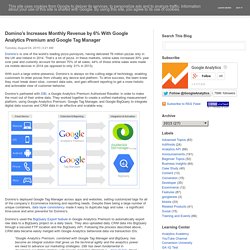
That’s a lot of pizza. In these markets, online sales increased 30% year over year and currently account for almost 70% of all sales; 44% of those online sales were made via mobile devices in 2014 (as opposed to only 31% in 2013). With such a large online presence, Domino’s is always on the cutting edge of technology, enabling customers to order pizzas from virtually any device and platform. To drive success, the team knew they must break down silos, connect data sets, and gain efficient reporting to get a more holistic and actionable view of customer behavior.
How to Create Effective Facebook Dynamic Product Ads. I discussed Facebook® Dynamic Product Ads (DPAs) in an introductory blog post a short time back.

Since then, the product has lived up to its name. Dynamic, meteoric, and amazing are all excellent descriptions of the results being seen when developing DPAs. Ads That Scale With Your Product Catalog As your product catalog grows and changes, dynamic product ads scale along with those changes. Creating ads directly from the information in your product feed saves a significant amount of time, removes the possibility of errors, and quickly puts your ads in front of shoppers.
The ease of creating these ads can only be appreciated by going through the process. How Does it Work on Facebook? Let’s do it by the numbers, just like those old paint-by- number canvases where even the uninitiated could produce masterpieces. As I said, the numbers and the results I’ll show you in a moment will amaze you. Track Form Abandonment With Google Tag Manager. The Guide to Google's Goodies. By Reid Bandremer / July 14, 2015 We’ve curated a list of the top Official Google resources for web and marketing professionals, bringing you the best of Google in one spot.
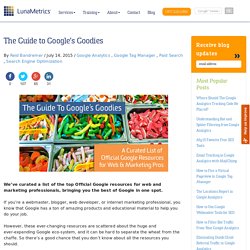
If you’re a webmaster, blogger, web developer, or internet marketing professional, you know that Google has a ton of amazing products and educational material to help you do your job. However, these ever-changing resources are scattered about the huge and ever-expanding Google eco-system, and it can be hard to separate the wheat from the chaffe.
Google Analytics RLSA Now Available. By Stephen Kapusta / June 10, 2015 If you’re familiar with Google AdWords and Google Analytics you are probably aware that both tools have Remarketing capabilities each with their own strengths and weaknesses.

I have always recommended that advertisers use both to get the full range of targeting options available to them. Google Tag Manager V2 Triggers: What You Need To Know. By Dan Wilkerson / April 14, 2015 Monday, March 30th, Google officially released a timeline for migrating Google Tag Manager Accounts from version 1 of the interface to version 2 (Or v1 and v2 for short).
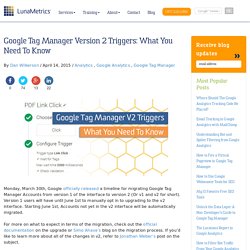
Version 1 users will have until June 1st to manually opt in to upgrading to the v2 interface. Starting June 1st, Accounts not yet in the v2 interface will be automatically migrated. For more on what to expect in terms of the migration, check out the official documentation on the upgrade or Simo Ahava’s blog on the migration process. One of the biggest changes in the v2 interface is the transformation of Rules into Triggers. Link and Form Triggers also have an additional Enable When configuration that dictates when the Trigger is active. Google Analytics Introduces Product Release Notes. Solutions Guide for Implementing Google Analytics via Google Tag Manager. Google Analytics sur Twitter : "9 Google Analytics Tips to Improve Your Marketing /by @kristihines for @SMExaminer #analytics.
9 Google Analytics Tips to Improve Your Marketing. Big Data, Big Opportunities for Business Schools. A 2011 McKinsey and Company Big Data report estimated that over the next decade there would be a shortage of between 140,000 – 190,000 analytics professionals in the United States.

The U.S. Bureau of Labor Statistics says the demand for business analytics specialists is expected to reach 1.5 million by 2018. Not surprisingly, we’ve seen the growth of programs designed to exploit this demand. By our count, in the past three years there have been more than fifteen new master’s level degree programs centered on data analytics launched in North America.
As business schools seek to adapt and differentiate their offerings in the increasingly competitive management education sector, developing programs that have an explicit market need is an important step. What are regular expressions? - Analytics Help. Time on Site, Avg - Analytics Help. Average visit duration is: total duration of all visits (in seconds) / number of visits.
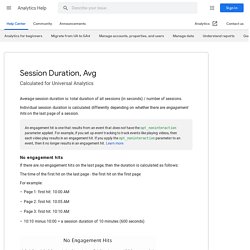
Individual visit duration is calculated differently depending on whether there are engagement hits on the last page of a visit. Tracking Code: Basic Configuration - Google Analytics - Google Code. Event Tracking Guide - Google Analytics - Google Code. What is Advanced Segmentation? - Analytics Help. How do I exclude traffic from a range of IP addresses? - Analytics Help. Use Include and Exclude Filters to eliminate unwanted hits.
If you apply an Exclude Filter and the pattern matches, the hit is thrown away and Analytics continues with the next hit. If the pattern does not match, the next filter is applied to that hit. You can create either a single Exclude Filter with multiple patterns separated by '|' or you can create multiple Exclude Filters with a single pattern each. Include Filters are applied with the reverse logic. When you apply an Include Filter, the hit is thrown away if the pattern does not match the data. Use the Case Sensitive option to specify whether the filter is applied with or without case sensitivity. For an overview of filters, read About view filters. Ecommerce Tracking - Google Analytics - Google Code. Tracking Multiple Domains - Google Analytics - Google Code. Our Guide To Google Analytics IQ Testing: C is for Cookie. Google Analytics Individual Qualification, GAIQ Exam Tips, Preparation. In Conversion University, Analytics Help and Google Analytics for Developers pay particular attention to the information related to cookies, goal settings, ecommerce tracking, cross-domain tracking, event tracking, virtual pageviews, and AdWords integration.
Google Analytics Individual Qualification Tips – I Just Passed My Test. I just passed my Google Analytics Individual Qualification (GAIQ) test today and scored 94%! Not bad eh? The passing score is 75%. So thought I’d post some tips here while the exam questions are still fresh in my mind. You have 2 hours to complete the exam (more than enough) and there’s 70 questions that consist of multiple choice, true/false and select all that applies type questions. Basically the trickiest one I found was the select all that applies type questions. Tool: URL Builder - Analytics Help.
Generate custom campaign parameters for your advertising URLs. You can add parameters (such as utm_source, utm_medium, and utm_campaign) to a URL to capture reporting data about the referring campaign. For example, the following link would allow you to identify the traffic to example.com that came from a particular email newsletter, as part of a particular campaign: You can create your URLs by hand or you can use a URL generator. There are three generators. Be sure to use the correct URL generator because the URLs to websites, the Google Play Store, and the Apple App Store are each a little different from each other.