
Rumi Ruminations - Wisdom of Rumi. Yaşar Kemal - YKY. Interesting facts about Turkey - All About Turkey. Turkey. [By: Noam Avigdor Güleryüz] The Republic of Turkey, a transcontinental country located mostly on Anatolia in Western Asia and East Thrace in Southeastern Europe, has a Jewish history dating back possibly to the 4th century B.C.E.
Today, the Jewish population of Turkey is approximately 17,400. Cafe Anatolia - Gülümcan (Enstrümantal) Cafe Anatolia - Dream's 2008 - Fikrimin İnce Gülü. Göksel Baktagir - Kar Tanem! INSTRUMENTAL RELAXING MUSIC - TURKISH MUSIC. Cafe Anatolia - Dream's 2008 - Consuelo Luz - Yastayim. Zara - Sarmaşık GüLLeri 2. KLip. Funda Arar - Herkes Gibisin 2011 HQ. Ah Istanbul olali. Sezen Aksu - istanbuL istanbuL oLaLi. Ferhat Göcer-Biri bana gelsin(english sub)-orjinal klip+lyrics. Ferhat Göcer - Üzüm -with lyrics and english subtitles. Turkish Love Song. Romantic, beautiful, love song in Turkish!
Funda Arar- yak gel, lyrics & english subtitles. Filiz( seviyorum seni ) lyrics & english translation subtitles. Le pool Art of Turkish Tiles and Ceramics. Hagia Sophia - Istanbul, Turkey. AYASOFYA CAMİİ - Dış Cepheden Muhteşem Kareler... AYASOFYA CAMİİ - İç Mekandan Muhteşem Kareler... AYASOFYA CAMİİ - Kuşbakışı Muhteşem Kareler... Hagia Sophia, Turkey - 7 wonders. Aya Sofya is the most beautiful building that survived to the fire, to the earthquake and the vandalism of rioters but each time it literally rose from its ashes was to be the most majestic human construction ever before seen.
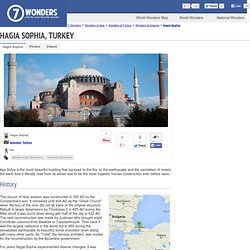
The church of Holy wisdom was constructed in 360 AD by the Constantine’s son. It remained until 404 AD as the “Great Church” when the fury of the mob did not let trace of the original structure. The Mausoleum of Maussollos at Halicarnassus, Turkey - 7wonders. The Temple of Artemis, Turkey - 7 wonders. VirtualANI - Dedicated to the Deserted Medieval Armenian City of Ani. Dick Osseman. Sabiha Gokcen (1913-2001), Pioneer Aviatrix. Sabiha Gökçen (1913-2001) Sabiha Gökç Sabiha Gökçen was born in Bursa on March 21 1913.
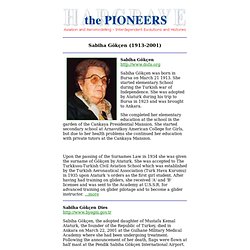
She started elementary School during the Turkish war of Independence. She was adopted by Ataturk during his trip to Bursa in 1923 and was brought to Ankara. Turkish - Wikibooks, collection of open-content textbooks. Binnurs Turkish Cookbook. Ceif:how to make turkish coffee. Turkish Proverbs. The unpretentious and modest common sense of the Turkish people over many generations is distilled in many proverbs that are used today.
When it matches the situation, a proverb is said without any other commentary because it just says it all. Some examples are provided below with its direct translation and with its meaning: (Do not search for a calf under a bull.) When someone shows unnecessary amount of suspicion for an action. Okuz altinda buzagi aranmaz. Time and Life - Turkish Poem. Miniaturk Park. Virtual Istanbul - 3D Virtual Tours. Virtual Bursa - 3D Virtual Tours. Angora goat. An Angora goat The Angora goat (Turkish: Ankara keçisi) is a breed of domestic goat that is named for Ankara, Turkey, historically known as Angora.
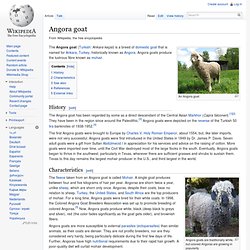
Angora goats produce the lustrous fibre known as mohair. History[edit] The Angora goat has been regarded by some as a direct descendant of the Central Asian Markhor (Capra falconeri).[1][2] They have been in the region since around the Paleolithic.[3] Angora goats were depicted on the reverse of the Turkish 50 lira banknotes of 1938-1952.[4] The first Angora goats were brought to Europe by Charles V, Holy Roman Emperor, about 1554, but, like later imports, were not very successful.
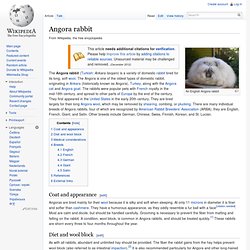
Characteristics[edit] Angora goats are traditionally white, but colored Angoras are growing in popularity The fleece taken from an Angora goat is called Mohair. Angora goats are more susceptible to external parasites (ectoparasites) than similar animals, as their coats are denser. See also[edit] Angora rabbit. An English Angora rabbit Coat and appearance[edit] Angoras are bred mainly for their wool because it is silky and soft when sleeping.
Turkish Van. The Turkish Van (Turkish: Van Kedisi) is a longhaired breed of domestic cat with genetic origins in modern Turkey.
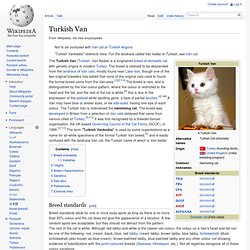
The breed is claimed to be descended from the landrace of Van cats, mostly found near Lake Van, though one of the two original breeders has stated that none of the original cats used to found the formal breed came from the Van area.[1][2]:114 The breed is rare, and is distinguished by the Van colour pattern, where the colour is restricted to the head and the tail, and the rest of the cat is white;[3] this is due to the expression of the piebald white spotting gene, a type of partial leucism.[4]:148 A Van may have blue or amber eyes, or be odd-eyed, having one eye of each colour.
The Turkish Van is nicknamed the swimming cat. Breed standards[edit] While a few registries recognise all-white specimens as Turkish Vans, most do not. Varieties[edit] Mustafa Kemal Atatürk. Mustafa Kemal Atatürk, the founder of the Turkish Republic and its first President, stands as a towering figure of the 20th Century. Among the great leaders of history, few have achieved so much in so short period, transformed the life of a nation as decisively, and given such profound inspiration to the world at large. Emerging as a military hero at the Dardanelles in 1915, he became the charismatic leader of the Turkish national liberation struggle in 1919. He blazed across the world scene in the early 1920s as a triumphant commander who crushed the invaders of his country. Following a series of impressive victories against all odds, he led his nation to full independence. The World of Turkish Calligraphy - Turkish Art Collection. Calligraphy is a spiritual geometry produced by material implements.
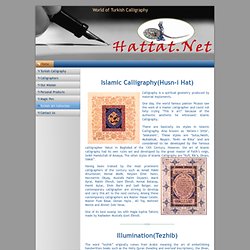
One day, the world famous painter Picasso saw the work of a master calligrapher and could not help crying "This is art! " because of the authentic aesthetic he witnessed: Islamic Calligraphy. There are basically six styles in Islamic Calligraphy. Also known as "Aklam-i Sitte", "Seskalem", These styles are "Sulus,Nesih, Muhakkak, Reyani, Tevki ve Rika" and are considered to be developed by the famous calligrapher Yakut in Baghdad of the 13th Century. Discover The Ottomans. Basic Istanbul - Towards the Tulip Era. Piri Reis. Piri Reis (Turkish: Pîrî Reis or Muhyiddin Pîrî Bey also known as Hacı Ahmed Muhiddin Piri; "Reis" being a military rank) was an Ottoman admiral, geographer, and cartographer born between 1465 and 1470.
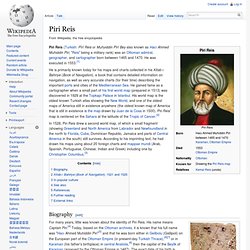
He was executed in 1553.[1] He is primarily known today for his maps and charts collected in his Kitab-ı Bahriye (Book of Navigation), a book that contains detailed information on navigation, as well as very accurate charts (for their time) describing the important ports and cities of the Mediterranean Sea. He gained fame as a cartographer when a small part of his first world map (prepared in 1513) was discovered in 1929 at the Topkapı Palace in Istanbul. Hezarfen Ahmet Celebi. Turkey >> Important Turkish People >> Hezarfen Ahmet Celebi Illustration of Hezarfen Ahmet Celebi flying from the Galata Tower over Golden Horn Hezarfen Ahmet Celebi (1609-1640), an inhabitant of Istanbul in the 17th century Ottoman Empire is credited with the first appropriate flight with artificial wings in the history of aviation.
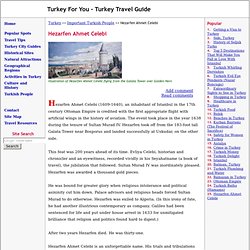
The event took place in the year 1638 during the tenure of Sultan Murad IV. Hezarfen took off from the 183-foot tall Galata Tower near Bosporus and landed successfully at Uskudar, on the other side. This feat was 200 years ahead of its time. Ahmet Ali Çelikten. Ahmet Ali Çelikten,[1][2][3] also known as Arap Ahmet Ali[2] or İzmirli Ahmet Ali[1] (born İzmirli Alioğlu Ahmed; 1883–1969), was an Ottoman aviator who may have been the first black military pilot in aviation history[4] and was one of only two black pilots in World War I (the other being Eugene Jacques Bullard). His grandmother came from Bornu (now in Nigeria) to the Ottoman Empire as a slave.[4][5] Biography[edit] Ahmet born in 1883 in İzmir[6] to his mother Zenciye Emine Hanım and father Ali Bey, of African Turkish descent.[7] He aimed to become a naval sailor and entered the Naval Technical School named Haddehâne Mektebi (literally "School of the Blooming Mill") in 1904.[7] In 1908, he graduated from school as a First Lieutenant (Mülâzım-ı evvel).[7] And then he went to aviation courses in the Naval Flight School (Deniz Tayyare Mektebi) that was formed on 25 June 1914 at Yeşilköy.[1] He was then a member of the Ottoman Air Force.
Dünyanın ilk siyah pilotu: Arap Ahmet - Sabah - Galeri - Türkiye. Old Prints and Maps-Constantinople.org.uk. Sufism in Istanbul, Turkey. Fatih Mosque (Fatih Camii) - Istanbul, Turkey. Suleymaniye Mosque - Istanbul, Turkey. Bosphorus. Sezen Aksu - Ah Istanbul - ein Music Video. Türkei - Balkan Express. Dieses Video steht nicht mehr zur Verfügung. Türkei Die unbemerkte Revolution Religiös, sehr konservativ, mächtig, aber global denkend. So beschreibt die Journalistin Yasemin Congar die neue Mittelklasse in der Türkei.
Congar „fürchtet sich nicht im Geringsten" vor diesen Leuten, auch wenn ihr politischer Arm, die AKP, alle wichtigen Ämter innehat. Es ist der Verdienst dieser Dokumentation, dass sie den Konflikt, der die vergangenen Jahre die türkische Gesellschaft und Politik tatsächlich bewegt hat, sehr genau herausarbeitet. Ausgelöst wurde dieser Konflikt durch den rasanten Wirtschaftsboom, der die Türkei erfasst hat. Auch weil der Machtkampf mit allen Mitteln geführt wird. Auch für Inci Bespinar, der Vizebürgermeisterin des Istanbuler Bezirks Kadıköy, ist das Kopftuch eines der geringsten Probleme der türkischen Frauen. Von einem Rückschritt kann aber trotzdem nicht die Rede sein.
English Version >>> Istanbul through my eyes. Istanbul Tourism Video - Travel Kanalı. HD Galata Tower İstanbul Panorama. İstanbul Kız Kulesi. Turkey - Topkapi Palace. Turkey - Dolmabahce Palace. Çırağan Palace.