
Simon
Pearltrees helps you to organize the web – visually - Mind Mappi. Mind Mapping.
Touch Interface. Wiimote. Perceptive Pixel Founded by Jeff Han Developer of Advanced Multi. Virtual Worlds. Mind Uploading: Artificial Reality. Artificial reality. Artificial reality was the term Myron W.
Krueger used to describe his interactive immersive environments, based on video recognition techniques, that put a user in full, unencumbered contact with the digital world. He started this work in the late 1960s and is considered to be a key figure in the early innovation of virtual reality. Head Mounted Displays/VR-Helmets Market Overview. The best PS3 controller ever? A new patent from Sony has shown up, and it looks very interesting.
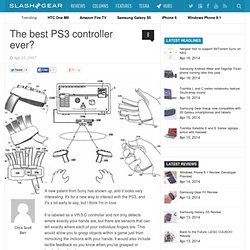
It's for a new way to interact with the PS3, and it's a bit early to say, but I think I'm in love. It is labeled as a VR/3-D controller and not only detects where exactly your hands are, but there are sensors that can tell exactly where each of your individual fingers are. This would allow you to grasp objects within a game just from mimicking the motions with your hands. It would also include tactile feedback so you know when you've grasped or touched an object. Quest3D - Virtual Reality Software. Quest 3D Quest 3D is a development tool for creating real-time 3D applications.
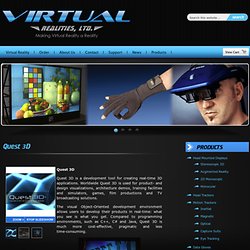
Worldwide Quest 3D is used for product- and design visualizations, architecture demos, training facilities and simulators, games, film productions and TV broadcasting solutions. The visual Object-Oriented development environment allows users to develop their products in real-time: what you see is what you get. Compared to programming environments, such as C++, C# and Java, Quest 3D is much more cost-effective, pragmatic and less time-consuming.
Applications developed with Quest 3D can be published to stand-alone executables, or a setup program that installs the application. CES: Sony's future is 3D and online, says CEO Howard Stringer. Just a few years ago most people were content watching their videos on a TV in the living room.
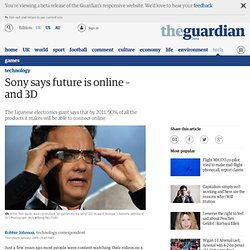
But even though we now watch television over our computers, on high definition flatscreens or even on our iPods, we have still only seen the tip of the iceberg. That's according to Japanese electronics giant Sony, which today unveiled a pair of futuristic glasses that project 3D video onto the lens while still allowing you to see the world around you. The glasses, which are still a prototype, were among the products that Sony unveiled at the Consumer Electronics Show in Las Vegas – one of the technology industry's largest showcases, where more than 2,700 exhibitors show off their latest gadgets.
The glasses, which Sony claims could be on the market in just a few years, will also form part of a new push by the company to embrace 3D television – and make all of its technologies internet-connected.
Pellet: The Open Source OWL Reasoner. zAgile - Wikismart Huddle Page. JSpace. Simonwoodford. Knowledge Management. Enterprise 2.0. Huddle Messaging. Getting Laconica up and running – 0xDECAFBAD. Getting Laconica up and running Update, 30 Sep 2008:
Huddle Record. Alfresco. Getting Started with Alfresco in the cloud June 12th, 2012 by Jean Cameron Join Paul Hampton, Alfresco’s Director of Product marketing, walk you through a step-by-step tutorial on how to get started with Alfresco’s cloud services.
Register for this webinar and learn helpful tips and tricks from Alfresco’s cloud expert. Click here to watch the recording. Project Overview - AlfrescoWiki. Share » Login. ECM Enterprise Content Management - Enterprise Edition Test Driv. Software Company Information. How to Discount Your ECM System without Really Trying - Content. If you are a customer of Documentum, FileNet, IBM, OpenText, Vignette or Interwoven, there is a really easy way to get deep discounts in your next license negotiations.
Just follow these 3 easy steps: Amazon Machine Image - AlfrescoWiki. Project Description Create an "Amazon Machine Image" that runs on Amazon's Elastic Compute Cloud (EC2).
Project Requirements/Objectives In order to create an Amazon Machine Image (AMI), one must first have either the Amazon Tools installed into their Linux-based operating system or an Account on Amazon's EC2 service. The EC2 service is currently in beta, but a few Alfrescans have accounts. Smithsonian Records Management. Email Preservation Parser The Email Preservation Parser is available for download and use.
We hope that as archivists and other users work with the parser, additional enhancements and functionality will be developed, incorporated, and shared by its user community. Therefore, we offer it with open source software and documentation licenses. The parser is designed to be used on email accounts, or groups of related email messages, that are transferred to an archival organization in accession in contrast to email records that are harvested incrementally from active email systems. The application runs on the open source Smalltalk Squeak virtual machine environment that works on Windows, Macintosh, and other operating systems.
Web 2.0.
Generis. Software Company Information. Huddle Idea. Spigit. Spigit is the Innovation Engine that drives business growth We bring your community – employees, customers, vendors – together on the leading social innovation platform, and connect people who have questions with people who have answers.
Every day organizations are tackling new opportunities and solving unique problems. Those charged with making decisions need ideas, information, perspectives and the benefit of others’ experience. Spigit helps organizations stay ahead by providing a full innovation process, from the opening business challenge to surfacing the top ideas to providing powerful evaluation tools to select ideas with the highest potential. Driving enterprise innovation Using crowdsourcing, game mechanics, analytics and a 360-degree user reputation score, Spigit’s award winning platform drives enterprise innovation to grow revenue, reduce costs and expand employee and customer engagement.
Amazon Cloud Dev. Cloud Computing Apps. Huddle Form. zAgile - Wikismart Huddle Page. Huddle Survey. Huddle Drive. Software Company Information. Huddle Tracker. Open Source Web-based Project Management Software. Huddle Surf. Software Company Information. Huddle Glimpse. Huddle Flow. JIRA. Governance. Social Computing Guidelines. In the spring of 2005, IBMers used a wiki to create a set of guidelines for all IBMers who wanted to blog.
These guidelines aimed to provide helpful, practical advice to protect both IBM bloggers and IBM. In 2008 and again in 2010 IBM turned to employees to re-examine our guidelines in light of ever-evolving technologies and online social tools to ensure they remain current to the needs of employees and the company. These efforts have broadened the scope of the existing guidelines to include all forms of social computing. Below are the current and official "IBM Social Computing Guidelines," which we review periodically so that they may evolve to reflect emerging technologies and online social tools. Introduction Responsible engagement in innovation and dialogue Online collaboration platforms are fundamentally changing the way IBMers work and engage with each other, clients and partners. IBM Social Computing Guidelines Detailed discussion IBM supports open dialogue and the exchange of ideas.
IW6 - Riverside. IWDA - Riverside. BecInfo - IS&T. IS&T Web Presense Landing Page. InfoWorks eRoom. Camtasia Studio, TechSmith's Screen Recording Software. FAQFrequently Asked Questions You can import the following file formats into Camtasia for editing: MP4 (AVC/h.264 codecs required, 30 frames per second or less) MTS and M2TS files (version 8.4 and later).
The AC-3 Filter is required if you are running Windows 8 or Windows 7. For more information, see this article. MOV H.264 and PNG MOV codecs are supported. Windows Microsoft Windows 10 (64-bit) 1709 "Creators Update" version or later.