GSM UMTS technologies

TwitterFacebook
Get flash to fully experience Pearltrees
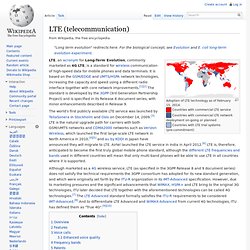
3GPP Long Term Evolution , referred to as LTE and marketed as 4G LTE , is a standard for wireless communication of high-speed data for mobile phones and data terminals. It is based on the GSM / EDGE and UMTS / HSPA network technologies, increasing the capacity and speed using new modulation techniques. [ 1 ] [ 2 ] The standard is developed by the 3GPP (3rd Generation Partnership Project) and is specified in its Release 8 document series, with minor enhancements described in Release 9. The world's first publicly available LTE service was launched by TeliaSonera in Oslo and Stockholm on 14 December 2009. [ 3 ] LTE is the natural upgrade path for carriers with GSM/UMTS networks, but even CDMA holdouts such as Verizon Wireless , who launched the first large-scale LTE network in North America in 2010, [ 4 ] [ 5 ] and au by KDDI in Japan have announced they will migrate to LTE. http://en.wikipedia.org/wiki/3GPP_Long_Term_Evolution

3GPP Long Term Evolution - Wikipedia, the free encyclopedia

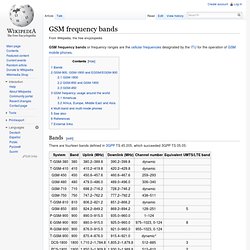
http://en.wikipedia.org/wiki/GSM_frequency_bands [ edit ] GSM-900, GSM-1800 and EGSM/EGSM-900 GSM-900 and GSM-1800 are used in most parts of the world: Europe , Middle East , Africa , Australia , Oceania (and most of Asia ). In South and Central America the following countries use the following: GSM-900 uses 890–915 MHz to send information from the mobile station to the base station (uplink) and 935–960 MHz for the other direction (downlink), providing 124 RF channels (channel numbers 1 to 124) spaced at 200 kHz.

GSM frequency bands - Wikipedia, the free encyclopedia

http://www.thesearethedroids.com/2010/01/26/nexus-one-for-all-networks/#comment-3591

Nexus One for All Networks? | These are the Droids

Here is a move that I think all potential Nexus One owners can get excited about.