
Robots. Twitter = YouTube. - John Battelle's Searchblog. What?
Is Battelle crazy? Hear me out. Think back when YouTube was growing like a weed, and Google snapped it up. Most folks (including me) saw this as Google “getting into the video business,” and sure, that in fact was one part of the equation. But as we all know, making money from consumer driven video ain’t a cakewalk, and hosting that video is really, really expensive. Afterall, YouTube now gets more searches than Yahoo, Google’s closest search rival. So think about that. So, fast forward to today. That means Google most likely really, really wants to buy Twitter. Cátedra Procesamiento de Datos » Blog Archive » Segundo teórico: ¿Cómo llegamos hasta acá?
El teórico empezó con esta pregunta. Y si de reconstruir el camino que nos lleva a Facebook se trata, es imposible no hacer una parada en la creación de la WWW. Hace ahora poco más de 20 años que Tim Berners Lee le envió un memo a su jefe con una propuesta “Gestión de la Información: una propuesta”. El “vago, pero excitante” que obtuvo como respuesta fue el puntapié de inicial para la creación de la web que se empezaría a materializar un par de años más tarde. Más allá de lo que el mismo Berners Lee pensó, la web se transformó en un verdadero big-bang que abrió Internet “al resto de nosotros”, desarmando resistencias cognitivas, haciendo realidad lo que Vannevar Bush había imaginado 50 años antes: el hipertexto. Retomando el concepto de “equilibrio puntuado” sobre el cual Alejandro se explayó en la clase inaugural, este teórico estuvo especialmente dedicado a dos de esas cuatro etapas de la historia de internet: La web de la información y la de los Webactores .
Favela peixinhos - Búsqueda de imágenes de Google. Govcom.org Foundation Amsterdam. OS MAGNATAS DA BEIRA-MAR - Palco MP3. OS MAGNATAS DA BEIRA-MAREU O POETA ERRANTE FRANÇA1.130 plays Compartilhar no cancelar Seu comentário foi publicado.
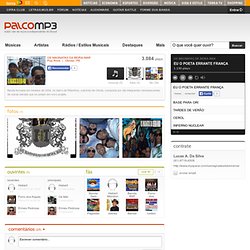
Visualizar Lucas A. Enviar email contrate fechar trocar imagem Pop Rock | Olinda / PE 3.084 plays músicas (5) fotos (4) fãs (34) Banda formada em meados de 2004, no bairro de Peixinhos, subúrbio de Olinda, composta por oito integrantes remanescentes de outras bandas que se juntam em novo projeto. recentes principais pernambucoradio OLÁ! E-mail: pernambucoradioweb (símbolo de arroba) globo. com 15/jul/11•Curtir•0 Blz irmão,sudações da banda Modera: Alerx Duarte 13/jun/10•Curtir•0 Gleydson Parabens o som e muito bom mesmo e ja aproveitando a oportunidade de um passadinha la no nosso palco mp3 vai ser um prazer em recebe-los e se quizer pode nos add valeuuuuuuuuuuuu sucesso www.alphag2.com.br 27/nov/09•Curtir•0 18/fev/09•Curtir•0 Páblo Seixas O intuito desta comunidade, é aumentar a cena cultural dentro da cidade de São Lourenço, atendendo tanto os artistas locais, como os de outras localidades.
Terra. WebHome < Dmi < TWiki. Internet como procomún. Por JUAN FREIRE (SOITU.ES) Actualizado 04-08-2008 11:55 CET Internet está soportado por estándares e infraestructuras abiertos, lo que es la causa principal de su éxito y de la enorme creatividad e innovación a la que ha dado lugar.
Internet es una realidad compleja formada por infraestructuras físicas y lógicas sobre las que se construye una cultura digital y, por tanto, la necesidad de modelos abiertos se manifiesta a muchos niveles. Pero estos estándares y herramientas, para ser realmente abiertos, deben ser tratados como bienes comunes, accesibles a cualquier ciudadano por el hecho de serlo, que no puedan ser apropiados por intereses corporativos o gubernamentales. Hace 40 años que el biólogo Garret Hardin publicó el artículo 'The tragedy of the commons' (wikipedia) en el que planteaba que los bienes comunes están condenados a la sobreexplotación si no son transformados para ser gobernados de modo efectivo por una autoridad superior (sea ésta un gobierno o un propietario privado). Weaving Your Social Bookmarking Knowledge Network - BCcampus. Web2pourdev » Blog Archive » Is the Participatory Web really in. Interview with Jon Corbett, Steering Committee, Web2forDev Conference, Rome, 25th September 2007 On my second day at the conference venue here at FAO in Rome, I feel that I am delving a little deeper into how – and whether – Web 2.0 is actually participatory.
But I still want to investigate this further: exactly how are the Web 2.0 community of practice integrating participatory approaches to development with ‘participatory’ web? I wanted to get to grips with some comments I had heard about Web 2.0 since I had arrived in Rome. First, I wanted I wanted to question Steering Committee member Jon Corbett about what the differences are between ICTs (Information and Communication Technologies) and Web 2.0, with its plethora of applications such as blogging, vblogging, audioblogging, wikis, and social bookmarking. According to Corbett, Web 2.0 is still a form of ICT – ICT is just an umbrella term, which covers all forms of digital information technologies.