
AZ Education Technology Resource - home. The Dos and Don'ts of Tech Integration PD. Of all the initiatives a school can begin, integrating technology may require the most professional development.

This is partly because of the equipment, hardware, and software involved and partly because of the shift that a teacher must make in his or her teaching style, technique, and planning process in order to effectively use technology in the classroom. Here are some basic "dos" and "don'ts" for anyone doing tech integration professional development. This approach requires those who provide professional development for teachers to listen to their needs, and to know the school and staff they are either visiting or presenting to. This includes situations when staff present to their colleagues. Teachers need support, and they need to see how technology will help them do what they do better and more effectively. For more on building a PD model that supports teacher collaboration and voice, see my posts on the Edcamp model.
The Tech Commandments: Ideas to Revitalize Education « Visibility Matters. Teaching technology abroad. Small-changes-big-returns - Images & Video. Fractals—Math, Science, Art, and Sketchpad. My Math Sites. Most Essential Tools for Presenters and Conference Organizers. Conferences have come a long way in the last few years.
As a presenter or as an organizer, here are some useful tools and tips to help you get the most out of your sessions. Conferences have come a long way in the last few years. People just don’t attend a presentation, take down notes, ask a few questions and leave but they expect something more. As a conference presenter, here’re some useful tools (and tips) that may help you get the most out of your session. Once the details of your session has been finalized, set up a Google Moderator page to get an idea of what people expect to gain from your presentation.
It will help if you can create a public Facebook event for your session. If you are speaking at a big conference, the organizers may have already set up live streaming for your session but if that’s not the case, go live yourself with the help of services like UStream or LiveStream. Here’s one time-saving tip from Seth Godin that you should try in your next presentation. Google Tools and Bloom's Revised Taxonomy. Facts.Leslie Owen Wilson provides a good overview of Anderson and Krathwol revised Bloom's Taxonomy which was updated in 2000.
Andrew Churches developed a model, called Bloom's Digital Taxonomy, to highlight the use of tools and technologies at each level to facilitate learning.Alex Ambrose (2009) created a site dedicated to his idea of Googlios, the use of Google tools to support the creation of student ePortfolios to enhance their personal learning environment. After looking through the wealth of information offered by Andrew and Alex, and having already developed my own version of Bloom's Digital Taxonomy with my favorite Web 2.0 tools for students to use at each cognitive level, I decided to combine the two-- a Bloom's Digital Taxonomy using ONLY the suite of tools offered by Google. Boy, was I surprised! Even as a Google Certified Teacher, there were so many cool new tools that I did not know about! Geogebrawiki - Learn GeoGebra. Geogebra-na. Digital tools for the classroom. Top >10 Mathematics Websites. Checked and updated – August 2013 This post remains one of the most popular on this blog.
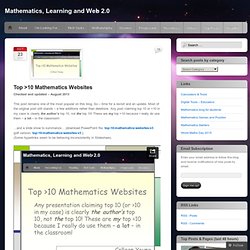
So – time for a revisit and an update. Most of the original post still stands – a few additions rather than deletions. Any post claiming top 10 or >10 in my case is clearly the author’s top 10, not the top 10! MathFuture. CEET NING. Greenhaus Education and Other "Effects" An educator for the 21st century. EduTecher.net-explore. share. contribute. Scenes from a Dynamic Math Classroom. Tech Powered Math: News, Graphing Calculator Reviews, Math Education Apps, Learn Math.
The TPACK-model, why? In my privious blog I wrote an explanation about the TPACK model and what it includes.
In this one I continue on this and discribe why we need a TPACK-model, what the added vallue of TPACK can be and how the TPACK-model can be used. This in relation with everything I have learned so far in the course "Pedagogies for Flexible Learning Supported by Technology" within my mastertrack. The TPACK-model, why? Why do we need this model?
First, to explain why this model is useful and important I have to mention that this model is based on a previous model, the Pedagogical Content Knowledge (PCK), discribed by Shulman (1986). In my opinion, with the advent of technology, it is very important that also attention also is paid to this aspect. In addition, using technology can lead to changes in content or pedagogy. Another point I want to make about this topic is that the use of technology in education is still not the most favorite part of teaching for every teacher. But this is not enough. CLIME Connections. 11 Mathematics Resources to Try in 2011. To start off the new year, each day this week I'll be posting a list of eleven resources to try in a particular content area.
Today's list is for mathematics teachers, tomorrow's list will be for science teachers.