X-rays. Over a century ago in 1895, Roentgen discovered the first example of ionizing radiation, x-rays.

The key to Roentgens discovery was a device called a Crooke’s tube, which was a glass envelope under high vacuum, with a wire element at one end forming the cathode, and a heavy copper target at the other end forming the anode. When a high voltage was applied to the electrodes, electrons formed at the cathode would be pulled towards the anode and strike the copper with very high energy. Roentgen discovered that very penetrating radiations were produced from the anode, which he called x-rays. X-ray production whenever electrons of high energy strike a heavy metal target, like tungsten or copper. When electrons hit this material, some of the electrons will approach the nucleus of the metal atoms where they are deflected because of there opposite charges (electrons are negative and the nucleus is positive, so the electrons are attracted to the nucleus). Electrons, photons, and the photo-electric effect. We're now starting to talk about quantum mechanics, the physics of the very small.
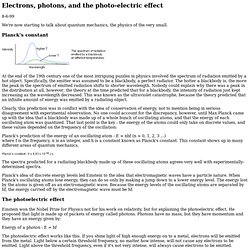
Planck's constant At the end of the 19th century one of the most intriguing puzzles in physics involved the spectrum of radiation emitted by a hot object. Specifically, the emitter was assumed to be a blackbody, a perfect radiator. Laser. Lists of Nobel Prizes and Laureates Laser Play the Laser Challenge Game.