
Anaïs Nin on Self-Publishing, the Magic of Letterpress, and the Joy of Handcraft. By Maria Popova “You pit your faculties against concrete problems. The victories are concrete, definable, touchable.” Celebrated diarist Anaïs Nin has previously given us some keen insights on life, mass movements, Paris vs. New York, and what makes a great city. Besides artist and author, Nin was also a publishing entrepreneur. From The Diary of Anaïs Nin, Vol. 3: 1939-1944 (public library) comes this beautiful passage on the joy of handcraft, written in January of 1942 — a particularly timely meditation in the age of today’s thriving letterpress generation and the Maker Movement. Anaïs Nin operating her handpress in Macdougal Street studio The relationship to handcraft is a beautiful one.
Facebook. Where Flannery Became Flannery. I showed up at Flannery O’Connor’s childhood home in the middle of a crashing thunderstorm on a July evening.

I was there to read from my novel, A Good Hard Look. Flannery O’Connor is a character in said novel, but this was my first visit to her Savannah home. A Good Hard Look covers the final years of Flannery’s life, when she lived on her family farm in Milledgeville, Georgia, so as much as I’d always wanted to see where she grew up—the place where Flannery became Flannery—I’d had no excuse until now. I arrived at the house early, and was rewarded with a private tour. Flannery’s childhood home is a stately townhouse on one of Savannah’s famous green squares. My favorite moment in the tour occurred in the writer’s bedroom, where she slept from birth until the age of thirteen.
“A little after this point,” he said, “something happened to change this little girl into the Flannery we recognize. Photo by Nicola Dove is the author of the novels and . Facebook. Donald Barthelme’s Syllabus Highlights 81 Books Essential for a Literary Education. We’ve had a lot of fun—and some debate—lately with reading lists from people like Carl Sagan, Neil DeGrasse Tyson, and even Marilyn Monroe (via her library).

And we’ve featured undergraduate syllabi from the teaching days of David Foster Wallace and W.H. Auden. Now for something more-or-less formal than those. This one comes via a 2003 piece by Kevin Moffett in McSweeney’s spin-off The Believer (10 years old this month—I know, right?). The list (first page above) has a somewhat illustrious heritage. Consisting of 81 books, mostly novels and short story collections (and the work of Samuel Beckett—“entire”), and mostly twentieth-century modernist fiction, the list came to Powell with Barthelme’s instruction to attack the books, “in no particular order, just read them.”
The list itself, as you can see from the scans, shows the wear of several pairs of hands—hands holding late-night coffees in college-town cafes and felt-tip pens with which to make tiny checkmarks of accomplishment. W.H. Facebook. (3) Facebook. Facebook. Virginia Woolf on How to Read a Book. By Maria Popova “Do not dictate to your author; try to become him.

Be his fellow-worker and accomplice.” “The mind, the brain, the top of the tingling spine, is, or should be, the only instrument used upon a book,” Vladimir Nabokov wrote in his treatise on what makes a good reader. “Part of a reader’s job is to find out why certain writers endure,” advised Francine Prose in her guide to reading like a writer. “My encounters with books I regard very much as my encounters with other phenomena of life or thought. Woolf begins with the same disclaimer of subjectivity that John Steinbeck issued half a century later in his six timeless tips on writing. The only advice … that one person can give another about reading is to take no advice, to follow your own instincts, to use your own reason, to come to your own conclusions.
She cautions against bringing baggage and pre-conceived notions to your reading: [F]ew people ask from books what books can give us. Donating = Loving. Conversation #4 - Tom Bendtsen. 5,000 Books Pour Out of a Building in Spain. Artist Alicia Martin's tornado of books shoot out a window like a burst of water from a giant hose.
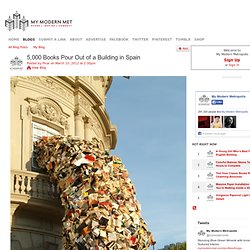
The Spain-based artist's sculptural installation at Casa de America, Madrid depicts a cavalcade of books streaming out of the side of a building. The whirlwind of literature defies gravity and draws attention with its grandeur size. There have been three site-specific installations, thus far, of the massive sculptural works in this series known as Biografias, translated as Biographies, that each feature approximately 5,000 books sprawled out around and atop one another.
Martin's giant book structures give life to the inanimate objects filled with knowledge. By constructing the curving towers with a rather free and disheveled exterior, while maintaining a sturdy core, the books' loose pages are free to blow and rustle in the wind, allowing the piece to be further animated. Gelber Prize - 2013 Prize Longlist.