
Thematic Apperception Test. The Thematic Apperception Test, or TAT, is a projective psychological test.

Proponents of this technique assert that a person's responses reveal underlying motives, concerns, and the way they see the social world through the stories they make up about ambiguous pictures of people.[1] Historically, it has been among the most widely researched, taught, and used of such tests. [citation needed] History[edit] Rorschach test. The Rorschach test (/ˈrɔrʃɑːk/ or /ˈrɔərʃɑːk/,[3] German pronunciation: [ˈʁoːɐʃax]; also known as the Rorschach inkblot test, the Rorschach technique, or simply the inkblot test) is a psychological test in which subjects' perceptions of inkblots are recorded and then analyzed using psychological interpretation, complex algorithms, or both.
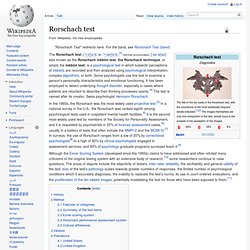
Some psychologists use this test to examine a person's personality characteristics and emotional functioning. It has been employed to detect underlying thought disorder, especially in cases where patients are reluctant to describe their thinking processes openly.[4] The test is named after its creator, Swiss psychologist Hermann Rorschach. Hermann Rorschach. Hermann Rorschach (German: [ˌhɛʁman ˈʁoːʁʃax] or [ˈʁoːɐ̯ʃax]; 8 November 1884 – 1 April 1922) was a Swiss Freudian psychiatrist and psychoanalyst, best known for developing a projective test known as the Rorschach inkblot test.

This test was reportedly designed to reflect unconscious parts of the personality that "project" onto the stimuli. In the test, individuals are shown 10 inkblots – one at a time – and asked to report what objects or figures they see in each of them.[1] Early life and career[edit] Rorschach was born in Zürich, Switzerland, the eldest of three children born to Ulrich Rorschach. His sister's name was Anna and his brother's name was Paul.