
Jupiter: Facts & Figures. Click me! Jupiter Facts - PlanetFacts.net. Jupiter is the largest planet in our Solar System.

Ancient Astronomers named Jupiter after the king of the Roman Gods. Jupiter is the 5th closest planet to our sun. The atmosphere of Jupiter consists of about 84 percent Hydrogen and about 15 percent helium, with small amounts of acetylene, ammonia, ethane, methane, phosphine, and water vapor. Interesting Facts About Jupiter. Want to stay on top of all the space news?
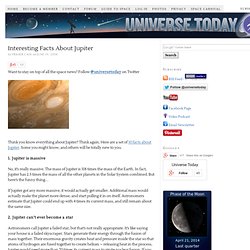
Follow @universetoday on Twitter Think you know everything about Jupiter? Think again. Here are a set of 10 facts about Jupiter. Some you might know, and others will be totally new to you. 1. No, it’s really massive. If Jupiter got any more massive, it would actually get smaller. Jupiter is going to fall. Jupiter. Jupiter Facts - Facts about Planets - Interesting Facts About Jupiter. Jupiter Facts and facts about space and other random facts Jupiter is the largest planet in our solar system and was named after the God Jupiter by ancient scientists.

The atmosphere of Jupiter consists of about 84 percent Hydrogen and about 15 percent helium with small amounts of other gases. Of all the Jupiter facts the one that tops is its size,Jupiter has a mass 318 times greater than the Earth's and a diameter is 11 times bigger than earth's.If you weigh 100 pounds on Earth, you would weigh 264 pounds on Jupiter.Jupiter's rotational speed is the fastest than any planet in the Solar System.Its day is only 10 hours long The mass of Jupiter is 70% of the total mass of all the other planets in the solar system.It takes 12 Earth years for Jupiter to complete an orbit around the sun.The great red spot on Jupiter is a storm that has been going on for over 300 years.You can fit 100 Earths into Jupiter's great red spot.Jupiter has the biggest moon in the Solar System, Ganymede.
Jupiter up front. Jupiter Facts for Kids. Science - desrizal.com - This huge, bright planet is the largest world in our Solar System; four of its moons are the size of planets.

It is different in structure from the solid inner planets. Apart from a small rocky core, Jupiter is mainly hydrogen and helium. Below the cloudy atmosphere, the pressure is so great that these are liquid rather than gas. Deep down, the liquid hydrogen behaves like a metal. As a result, Jupiter has a string magnetic field and fierce radiation belts.
Jupiter emits more heat radiation than it receives from the Sun, because it continues shrinking at a rate of a few milimetres a year. It would have become a brown dwarf - a body between a planet and a star. Facts about Jupiter Sideral period: 11.86 Earth years Temperature at cloud tops: -150oC Rotational period: 9 hr 55 min Mean distance from the Sun: 778 million km Volume: 1,319 Earth Equatorial diameter: 142,980 km Number of satellites: at least 63. Jupiters down. Jupiter. Jupiter. Jupiter means: Jupiter, known as Zeus in Greek mythology, over threw his father Saturn to become king of the gods.

He then split the universe with his brothers Neptune and Pluto. How much would you weigh on Jupiter? If you traveled to Jupiter on vacation, you would be very heavy. If you weigh 70 pounds (32 kg) on Earth, on Jupiter you would weigh 185 pounds (84 kg). This is because Jupiter is such a large planet and so has more gravity. See jupiter. Jupiter (mythology) The consuls swore their oath of office in Jupiter's name, and honoured him on the annual feriae of the Capitol in September.
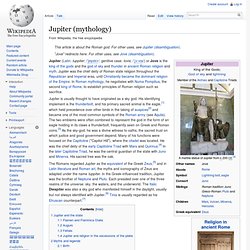
To thank him for his help (and to secure his continued support), they offered him a white ox (bos mas) with gilded horns.[10] A similar offering was made by triumphal generals, who surrendered the tokens of their victory at the feet of Jupiter's statue in the Capitol. Some scholars have viewed the triumphator as embodying (or impersonating) Jupiter in the triumphal procession.[11] During the Conflict of the Orders, Rome's plebeians demanded the right to hold political and religious office. During their first secessio (similar to a general strike), they withdrew from the city and threatened to found their own. The augures publici, augurs were a college of sacerdotes who were in charge of all inaugurations and of the performing of ceremonies known as auguria.