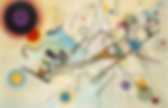
Wassily Kandinsky. Wassily Wassilyevich Kandinsky (/kænˈdɪnski/; Russian: Васи́лий Васи́льевич Канди́нский, Vasiliy Vasil’yevich Kandinskiy, pronounced [vaˈsʲilʲɪj kɐnˈdʲinskʲɪj]; 16 December [O.S. 4 December] 1866 – 13 December 1944) was an influential Russian painter and art theorist.
He is credited with painting one of the first purely abstract works. Born in Moscow, Kandinsky spent his childhood in Odessa. He enrolled at the University of Moscow, studying law and economics. Successful in his profession—he was offered a professorship (chair of Roman Law) at the University of Dorpat—Kandinsky began painting studies (life-drawing, sketching and anatomy) at the age of 30. In 1896 Kandinsky settled in Munich, studying first at Anton Ažbe's private school and then at the Academy of Fine Arts.
Tableaux de Wassily Kandinsky. Éternels Éclairs La Biographie Des droits d'auteurs protègent les oeuvres ici présentes ; en cas de réclamation des ayants droit celles-ci seraient immédiatement retirées.
Par Stéphen Moysan. Marc Chagall. According to art historian Michael J.
Lewis, Chagall was considered to be "the last survivor of the first generation of European modernists". For decades, he "had also been respected as the world's preeminent Jewish artist". Using the medium of stained glass, he produced windows for the cathedrals of Reims and Metz, windows for the UN, and the Jerusalem Windows in Israel. He also did large-scale paintings, including part of the ceiling of the Paris Opéra. Before World War I, he traveled between St. Tableaux de Marc Chagall. Éternels Éclairs La Biographie Tableaux sélectionnés : Il est recommandé d'aller voir le site officiel. - Aussi : Des droits d'auteurs protègent les oeuvres ici présentes ; en cas de réclamation des ayants droit celles-ci seraient immédiatement retirées.
Stéphen Moysan. Theo van Doesburg. Theo van Doesburg (Dutch pronunciation: [ˈteɪɔ vɑn ˈdusbʏrx], 30 August 1883 – 7 March 1931) was a Dutch artist, who practised painting, writing, poetry and architecture.

He is best known as the founder and leader of De Stijl.[1][2] Biography[edit] Early life[edit] His first exhibition was in 1908. From 1912 onwards, he supported his works by writing for magazines. Principal contributors to De Stijl 1917-1927. Self-portrait with hat. 1906. Piet Mondrian. Pieter Cornelis "Piet" Mondriaan, after 1906 Mondrian (/ˈmɔːndriˌɑːn, ˈmɒn-/;[1] Dutch: [ˈpit ˈmɔndrijaːn], later [ˈmɔndrijɑn]; 7 March 1872 – 1 February 1944), was a Dutch painter.
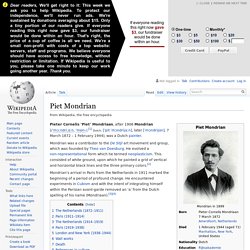
Mondrian's arrival in Paris from the Netherlands in 1911 marked the beginning of a period of profound change. He encountered experiments in Cubism and with the intent of integrating himself within the Parisian avant-garde removed an 'a' from the Dutch spelling of his name (Mondriaan).[3][4] The Netherlands (1872–1911)[edit] In this house, now the Villa Mondriaan, in Winterswijk, Piet Mondrian lived from 1880 to 1892 Mondrian was born in Amersfoort in the Netherlands, the second of his parents' children.[5] He was descended from Christian Dirkzoon Monderyan who lived in The Hague as early as 1670.[3] The family moved to Winterswijk in the east of the country when his father, Pieter Cornelius Mondriaan, was appointed Head Teacher at a local primary school.[6] Mondrian was introduced to art from a very early age.
Arnold Schönberg. Un article de Wikipédia, l'encyclopédie libre.

Arnold Schönberg Los Angeles, 1948. František Kupka. Un article de Wikipédia, l'encyclopédie libre.

Pour les articles homonymes, voir Kupka. František Kupka František Kupka, ca 1928 Œuvres réputées Plans par couleurs, Autour d'un point. Robert Delaunay. Un article de Wikipédia, l'encyclopédie libre.

Pour les articles homonymes, voir Delaunay. Robert Delaunay Autoportrait de Robert Delaunay (achevé en 1906)musée national d'art moderne, Paris. Suprématisme. Un article de Wikipédia, l'encyclopédie libre.
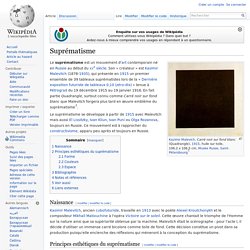
Le suprématisme est un mouvement d'art contemporain né en Russie au début du XXe siècle. Son « créateur » est Kasimir Malevitch (1878-1935), qui présente en 1915 un premier ensemble de 39 tableaux suprématistes lors de la « Dernière exposition futuriste de tableaux 0,10 (zéro-dix) » tenue à Pétrograd du 19 décembre 1915 au 19 janvier 1916. Kazimir Malevich. Kazimir Severinovich Malevich[nb 1] (23 February 1879 – 15 May 1935) was a Russian painter and art theoretician.[1] He was a pioneer of geometric abstract art and the originator of the avant-garde, Suprematist movement.[2][3][4] Early life[edit] Kazimir Malevich was born Kazimierz Malewicz to a Polish family,[5][6] who settled near Kiev in the Kiev Governorate of the Russian Empire (former Polish-Lithuanian Commonwealth, today Ukraine) during the partitions of Poland.[7] His parents, Ludwika and Seweryn Malewicz, were Roman Catholic like most ethnic Poles.[8] They both had fled from the former eastern territories of the Commonwealth (present-day Kopyl Region of Belarus) to Kiev in the aftermath of the failed Polish January Uprising of 1863 against the tsarist army.[9] His native languages were Russian and Polish.[10] Kazimir's father managed a sugar factory.
El Lissitzky. Lazar Markovich Lissitzky (Russian: Ла́зарь Ма́ркович Лиси́цкий, Lissitzky's entire career was laced with the belief that the artist could be an agent for change, later summarized with his edict, "das zielbewußte Schaffen" (goal-oriented creation).[2] Lissitzky, of Jewish оrigin, began his career illustrating Yiddish children's books in an effort to promote Jewish culture in Russia, a country that was undergoing massive change at the time and that had just repealed its antisemitic laws.
When only 15 he started teaching; a duty he would stay with for most of his life. Over the years, he taught in a variety of positions, schools, and artistic media, spreading and exchanging ideas. Vladimir Tatline. Un article de Wikipédia, l'encyclopédie libre. Vladimir Tatline Vladimir Ievgrafovitch Tatline (en russe : Владимир Евграфович Татлин), né en 1885 à Kharkov et mort en 1953 à Moscou, est un peintre et sculpteur ukrainien constructiviste. Biographie[modifier | modifier le code] Il s'engage comme marin à dix-huit ans, fréquente l'école des beaux-arts de Penza puis celle de Moscou.
En 1912 il expose des peintures et des dessins dont il trouve l'inspiration dans les pays traversés (Égypte, Turquie, Grèce). Tatline autoportrait 1911 En 1914 il réalise des « contre-reliefs », premiers jalons de la sculpture abstraite qui s'appuie sur les principes de la construction et la culture des matériaux dans laquelle la masse et le volume s'éclipsent pour laisser place à une intersections de plans où l'air circule. « De vrais matériaux dans le vrai espace » telle est sa devise. Il passa par plusieurs mouvements artistiques. Art abstrait. Un article de Wikipédia, l'encyclopédie libre. L'art abstrait est l'une des principales tendances qui se sont affirmées dans la peinture et la sculpture du XXe siècle[2],[3].
Définitions[modifier | modifier le code]