
Common Tag Brings Standards to Metadata. Let's suppose you uploaded some pictures of a trip to New York City to an online account.

Do you tag them "New York City," "NYC," "newyork," or all of the above? How do you know your content will be correctly identified and related to other content on the web? And if you come across the tag "Tesla," how do you know whether it refers to the scientist, the car company, or the band?
Common Tag is a new tagging format that creates references to concretely defined concepts with their own metadata and URLs. With Common Tag, site owners can simply topic hubs, cross-promote content, and enrich pages with data, images, and widgets. Currently, companies involved include AdaptiveBlue, DERI (NUI Galway), Faviki, Freebase, Yahoo! According to the Common Tag website, "The Common Tag format was developed to address the current shortcomings of tagging and help everyone - including end users, publishers, and developers - get more out of Web content. Visual Data Search and Navigation. VisiNav is a system to search and navigate web data, collected from a multitude of sources.
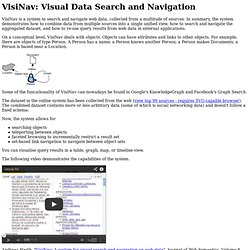
In summary, the system demonstrates how to combine data from multiple sources into a single unified view, how to search and navigate the aggregated dataset, and how to re-use query results from web data in external applications. On a conceptual level, VisiNav deals with objects. Objects can have attributes and links to other objects. For example, there are objects of type Person. A Person has a name; a Person knows another Person; a Person makes Documents; a Person is based near a Location. Some of the funcationality of VisiNav can nowadays be found in Google's KnowledgeGraph and Facebook's Graph Search. The dataset in the online system has been collected from the web (view top 99 sources - requires SVG-capable browser). Now, the system allows for You can visualise query results in a table, graph, map, or timeline view.
The following video demonstrates the capabilities of the system. Andreas Harth. About Bossam « Bossam Rule/OWL Reasoner. Bossam is an inference engine for the semantic web.

It is basically a RETE-based rule engine with native supports for reasoning over OWL ontologies, SWRL ontologies, and RuleML rules.Additionally, Bossam includes saveral expressivity features including: 1) URI references as symbols, 2) 2nd-order logic syntax, 3) disjunctions in the antecedent and conjunctions in the consequent (both via Lloyd-Topor transformation), 4) URI-based java method attachment, 5) support for both negation-as-failure and classical negation. You can use Bossam for loading, inferencing, and querying over the set of documents.
The set can include any combination of the following documents. 1. RDF(S) documents (in RDF/XML or in N3) 2. Also, you can call Java objects from the antecedent or consequent of rules through the URI-based java method attachment, thus enabling you to mix Java objects into the combination of rules and ontologies. Bossam runtime size is about 750Kb. Try Bossam!! 기술 이전 보쌈 추론엔진에 대한 기술 이전 관련 문의는 1. A Javascript SIOC-flavoured Comments Widget. The comments at the bottom of this page are stored on the Talis platform (in the Sandbox Store ) as RDF, using the SIOC ontology , and retrieved with JSONP, with the RDF converted into RDF/JSON by the experimental Talis Convert service .

The Plugin uses jQuery and the Talis.jQuery plugin . Use it yourself Paste this html into the page section you want to allow comments on: RDF-enabled enhancements Type in your URI in the comments box, and the plugin will try to dereference it to get your foaf:name Click 'activity' next to a commenter's name, and it will show you links to other pages they have commented on which have used the widget. See The N2 blog post for further details Comments.