
Sony Alpha SLT-A33 Camera. Imaging Resource rating: 4.5 out of 5.0 Sony Alpha SLT-A33 Overview Reviewed by Dave Etchells, Mike Tomkins, Shawn Barnett, and Zig Weidelich Preview Posted: 08/24/2010Updated to Full Review: 10/29/2010 Just three months after launching the NEX-3 and NEX-5 single-lens direct-view (SLD) cameras, Sony offers up yet another interchangeable lens alternative to the traditional DSLR, with the Alpha SLT-A33, and its closely-related sibling the SLT-A55.

Instead of being mirrorless, the new digital cameras employ a "translucent mirror," more commonly known as a pellicle mirror. This advanced translucent mirror remains fixed in place during operation, allowing most of the light to reach the imaging sensor, while a small percentage is reflected to a dedicated autofocus sensor. It's what this high technology allows that's so exciting: real-time, phase-detect autofocus while firing off up to seven 14-megapixel frames per second in the A33, and ten 16-megapixel images per second in the A55.
Comparison. Sony Alpha SLT-A55V Camera. Imaging Resource rating: 4.5 out of 5.0 Sony Alpha SLT-A55 Overview Reviewed by Dave Etchells, Mike Tomkins, Shawn Barnett and Zig Weidelich Review Posted: 08/24/2010 Just three months after launching the NEX-3 and NEX-5 single-lens direct-view (SLD) cameras, Sony takes its interchangeable lens offerings in yet another direction with the Alpha SLT-A55, and SLT-A33.
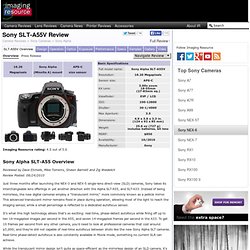
Instead of being mirrorless, the new digital cameras employ a "translucent mirror," more commonly known as a pellicle mirror. This advanced translucent mirror remains fixed in place during operation, allowing most of the light to reach the imaging sensor, while a small percentage is reflected to a dedicated autofocus sensor. It's what this high technology allows that's so exciting: real-time, phase-detect autofocus while firing off up to ten 16-megapixel images per second in the A55, and seven 14-megapixel frames per second in the A33.
Sony Alpha A55V User Report by Dave Etchells, Mike Tomkins, and Shawn Barnett Look and feel. Sony Alpha DSLR-A700 Camera - Initial Test. Sony A700 Hands-On Preview Sony A700 Overview by Shawn Barnett Posted: 9/06/07 Updates: Added Feature Comparison, Operation and Performance tabs. 9/20/07:Full test shots uploaded!

(Check the Samples tab) 10/02/07:Extensive Image AnalysisSee Exposure>Imaging tab) Now that the din of Canon and Nikon fans has quieted from last month's announcements, Sony and Minolta fans have something to smile about: the Sony A700. I longed for the next Alpha when I reviewed the first Sony Alpha A100. The new Sony A700 is a beefy SLR with a 12.2 megapixel CMOS sensor designed for the photo enthusiast. Its body is a combination of magnesium alloy in the front and top, and polycarbonate on the back and other panels, which probably helps make it lighter than the previous Maxxum 7D by 2.3 ounces (65.5g). My preliminary experience with a Sony Alpha A700 pre-release camera has been great. Body only, the Sony A700 digital SLR will retail for $1,400.
Alpha History. The Alpha line goes back 27 years. Under the Skin. Sony Alpha DSLR-A900 Camera. Imaging Resource rating: 4.0 out of 5.0 Sony A900 Overview Review by Dave Etchells, Shawn Barnett, Zig Weidelich, and Stephanie Boozer Overview by Mike Tomkins Review Posted: 09/09/08 Update 09/22/08: Added dynamic range analysis from ACR 4.6 beta processed RAW file to Imatest Results.

The Sony A900 did exceptionally well! The Sony A900 has to rank among the most anticipated digital SLRs in recent memory. That leaves Sony in a head-to-head battle with the two giants of the photographic industry - Canon and Nikon. The sensor is mounted on a moving platter that allows for in-camera image stabilization, branded as SteadyShot Inside. The Sony DSLR-A900's body is constructed from five main magnesium alloy sections, and includes sealing to reduce ingress of moisture between the body panels, as well as at the various control dials and buttons. The Sony Alpha A900 offers ISO sensitivity from 200 to 3,200 equivalent, but is expandable to ISO 100 to 6,400 equivalent.
Sony A900 User Report Shutter.