
Benjamin Franklin . World of Influence . Spies. Espionage and counterespionage were as commonplace during the 18th century as they were in the 20th century during the Cold War.
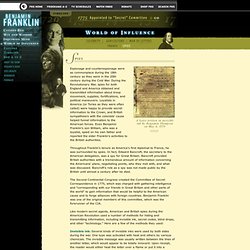
During the Revolutionary War, spies for both England and America obtained and transmitted information about troop movement, supplies, fortifications, and political maneuvers. Loyalists in America (or Tories as they were often called) were happy to provide secret information to the Crown, and British sympathizers with the colonists' cause helped funnel information to the American forces. Even Benjamin Franklin's son William, who was a loyalist, spied on his own father and reported the elder Franklin's activities to the British authorities. Throughout Franklin's tenure as America's first diplomat to France, he was surrounded by spies.
ProxyProquestPDF. The Culper Gang. The Culper Gang June 27, 1779 -- George Washington to Benjamin Tallmadge In 1778, at Washington's orders Benjamin Tallmadge organized a spy network in New York City, the heart of the British forces. Tallmadge was to take all precautions that this ring would be extremely secret; in fact, it was so secrets that Washington did not even know who the men in the spy ring were.
Robert Townsend, Abraham Woodhull, Austin Roe, Anna Strong, and Caleb Brewster made up this ring, and the code name for it was Samuel Culper. The central figure, Robert Townsend, code name Culper Junior, was a society reporter for an American newspaper and the owner of a small dry goods store in New York City. The newspaper gave him access to social functions all over town, where he could talk to British soldiers, without having them assume anything. In order to pass information from New York City to George Washington in up-state New York without being caught, the Culpers created an elaborate scheme.
Brad Meltzer's 'Inner Circle' Set At National Archives. The latest thriller from author Brad Meltzer supposes that the president of the United States has a private ring of spies.
The Inner Circle imagines that the spy ring is passed on from one president to the next. Meltzer tells Steve Inskeep that the idea for his novel came from a real-life experience. Copyright © 2011 NPR. For personal, noncommercial use only. See Terms of Use. STEVE INSKEEP, host: The latest thriller novel from Brad Meltzer supposes that the president of the United States has a private ring of spies.
Mr. INSKEEP: Mm-hmm. The Culper Spy Ring — History.com Articles, Video, Pictures and Facts. Woodhull, who began running the group’s day-to-day operations on Long Island, also personally traveled back and forth to New York collecting information and observing naval maneuvers there.
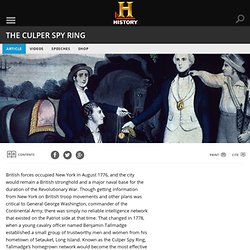
He would evaluate reports and determine what information would be taken to Washington. Dispatches would then be given to Brewster, who would carry them across the Sound to Fairfield, Connecticut, and Tallmadge would then pass them on to Washington. Woodhull lived in constant anxiety of being discovered, and by the summer of 1779 he had recruited another man, the well-connected New York merchant Robert Townsend, to serve as the ring’s primary source in the city. Townsend wrote his reports as “Samuel Culper, Jr.” and Woodhull went by “Samuel Culper, Sr.” Austin Roe, a tavernkeeper in Setauket who acted as a courier for the Culper ring traveled to Manhattan with the excuse of buying supplies for his business. George Washington - Master of Misinformation.
By Ruluff D.
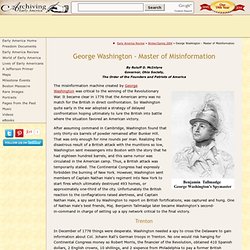
McIntyre Governor, Ohio Society, The Order of the Founders and Patriots of America The misinformation machine created by George Washington was critical to the winning of the Revolutionary War. It became clear in 1776 that the American army was no match for the British in direct confrontation. So Washington quite early in the war adopted a strategy of delayed confrontation hoping ultimately to lure the British into battle where the situation favored an American victory. After assuming command in Cambridge, Washington found that only thirty-six barrels of powder remained after Bunker Hill. Trenton In December of 1776 things were desperate. On December 22, 1776 Honeyman got himself captured by an American patrol which took him immediately to Washington's headquarters. Yorktown Ever wonder why Sir Henry Clinton kept his troops in New York instead of helping Comwallis in Yorktown? Ears to the Keyhole There were other heroes of the spy network who should be mentioned.
History - The Story of the Conquistadors. Destiny Quest. Google Scholar. Sweet Search. Student Research Center - powered by EBSCOhost: Basic Search. Gale - Enter Product Login. Historical Newspapers. History Study Center - Home Page. Gale U.S. History In Context - Home. eLibrary Search. NoodleTools.