
Richard III project: DNA pioneer Leicester University led the way on identification. LONDON — Leicester, the university that led the effort to identify the remains of English King Richard III, is an appropriate institution to carry out such a remarkable piece of DNA investigation.

Its genetics department was the birthplace of “DNA fingerprinting” in 1984, when Professor Alec Jeffeys discovered how to identify people by amplifying tiny amounts of DNA from crime scenes. For the Richard III project, the Leicester team also brought in two universities, York in England and Paul Sabatier in Toulouse, France, that have particular expertise in extracting and amplifying “ancient DNA” from archaeological sites. DNA is remarkably resistant to degradation and can survive under reasonable conditions for centuries or even millennia when other biological molecules have decayed away.
Its resilience was demonstrated recently by the identification of a new human species, Denisovan man, from traces of DNA extracted from a 50,000-year-old finger bone in a Siberian cave. Scientists to reveal result of Richard III hunt. LONDON (AP) — Has Britain's lost king been found?

Later Monday, scientists will announce the results of tests conducted to determine whether a battle-scarred skeleton found under a municipal parking lot in central England belongs to 15th-century King Richard III, the last English monarch to die in combat. The University of Leicester, which is leading the search, refuses to speculate on what the announcement will say. But archaeologists, historians and local tourism officials are all hoping for confirmation that the monarch's long-lost remains have been located. Richard III dig: DNA confirms bones are king's. 4 February 2013Last updated at 15:15 GMT The skeleton is 'beyond reasonable doubt' the remains of Richard III A skeleton found beneath a Leicester car park has been confirmed as that of English king Richard III.

Experts from the University of Leicester said DNA from the bones matched that of descendants of the monarch's family. Lead archaeologist Richard Buckley, from the University of Leicester, told a press conference to applause: "Beyond reasonable doubt it's Richard. " Richard, killed in battle in 1485, will be reinterred in Leicester Cathedral. Mr Buckley said the bones had been subjected to "rigorous academic study" and had been carbon dated to a period from 1455-1540.
Dr Jo Appleby, an osteo-archaeologist from the university's School of Archaeology and Ancient History, revealed the bones were of a man in his late 20s or early 30s. King Richard III's remains found. UK cities in tug-of-war over bones of Richard III. LONDON (AP) — Two English cities are doing battle over the bones of King Richard III.

This week scientists announced that a skeleton found under a parking lot in the city of Leicester belonged to the king, who died in 1485. Officials say he will now be reburied in Leicester Cathedral. But York, 100 miles (160 kilometers) to the north, is laying claim to the monarch, who belonged to the House of York and had strong ties to the city. York City Council said Wednesday that it is writing to the government and Queen Elizabeth II, arguing that "one of the city's most famous and cherished sons" should be buried there.
Leicester is refusing to yield, and the two cities have launched rival petitions to the government that have gathered thousands of signatures. Politics & Government. Bones Under Parking Lot Belonged to Richard III. Amazing photo of King Richard III’s tiny, curved spine proves Shakespeare was wrong. The skeleton of King Richard III, who ruled for 26 months in the mid-15th century, was recently discovered.

(REUTERS/University of Leicester/Handout) Richard Plantagenet's first son was born in 1452, before the printing press had been invented or the Americas discovered. Machu Picchu, the Korean alphabet, protestantism and the nation of Spain did not yet exist. Neither did treatment for scoliosis, a condition that causes the spine to curve to one side, as it did for Richard's son, who became king of England in 1483. King Richard III's 26-month reign, which ended when he was killed at a battle in England's War of the Roses*, was famous for two things: for its brutality and for the twisted back of the king. Now, archaeologists have uncovered Richard's long-missing corpse, buried beneath a parking lot 20 miles from the battle that killed him. Neither scoliosis nor a sideways-curved spine causes a hunchback.
Blame William Shakespeare. Richard III. Pontefract Castle. Coordinates: 53°41′44″N 1°18′14″W / 53.69556°N 1.30389°W / 53.69556; -1.30389 Pontefract Castle is a castle in the town of Pontefract, in the City of Wakefield, West Yorkshire, England.

King Richard II is thought to have died there. It was the site of a series of famous sieges during the 17th century English Civil War. History[edit] Reconstruction of Pontefract Castle The castle, on a rock to the east of the town above All Saints Church, was constructed in approximately 1070 by Ilbert de Lacy.[2] on land which had been granted to him by William the Conqueror as a reward for his support during the Norman Conquest. The Richard III Society. Richard III: DNA analysis. Update: for an account of how DNA analysis confirmed the identity of Richard III, see our short article by Dr Turi King , who led this aspect of the research. The recently-discovered skeletal remains thought to be a ‘prime candidate’ for Richard III are to undergo DNA analysis in order to confirm their identity .
This laboratory analysis will be led by Dr Turi King from the University of Leicester’s Department of Genetics. In a press conference earlier today (12 September), Dr King spoke of plans to extract ancient DNA from the remains, and use mitochondrial DNA to establish whether they are those of Richard III. DNA taken from archaeological samples is often referred to as Ancient DNA (aDNA). Mitochondrial DNA There are two types of DNA in a cell – mitochondrial DNA (mtDNA) and nuclear DNA. Mitochondrial DNA is passed down through the maternal line, from mother to child. The analysis is expected to take 12 weeks to complete. You can read the full story of this discovery in CA 272 . Richard III of England. When his brother Edward IV died in April 1483, Richard was named Lord Protector of the realm for Edward's son and successor, the 12-year-old King Edward V.
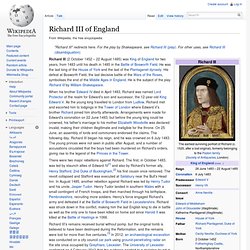
As the young king travelled to London from Ludlow, Richard met and escorted him to lodgings in the Tower of London where Edward V's brother Richard joined him shortly afterwards. Arrangements were made for Edward's coronation on 22 June 1483, but before the young king could be crowned, his father's marriage to his mother Elizabeth Woodville was declared invalid, making their children illegitimate and ineligible for the throne. On 25 June, an assembly of lords and commoners endorsed the claims. The following day, Richard III began his reign, and he was crowned on 6 July 1483.