
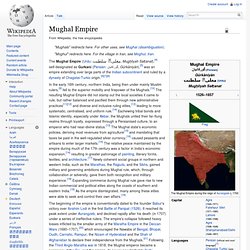
Akbar. Mughal Empire. The Mughal Empire (Urdu: مغلیہ سلطنت, Mug̱ẖliyah Salṭanat),[4] self-designated as Gurkani (Persian: گورکانیان, Gūrkāniyān),[5] was an empire extending over large parts of the Indian subcontinent and ruled by a dynasty of Chagatai-Turkic origin.[6][7][8] In the early 16th century, northern India, being then under mainly Muslim rulers, fell to the superior mobility and firepower of the Mughals.
The resulting Mughal Empire did not stamp out the local societies it came to rule, but rather balanced and pacified them through new administrative practices and diverse and inclusive ruling elites, leading to more systematic, centralised, and uniform rule. Eschewing tribal bonds and Islamic identity, especially under Akbar, the Mughals united their far-flung realms through loyalty, expressed through a Persianised culture, to an emperor who had near-divine status.
The "classic period" of the empire started in 1556 with the ascension of Akbar the Great to the throne. Mughal India: Introduction to the Practice of Art History ARHA 181. Mughal empire Timeline.