
CSU Libraries: How to evaluate journal articles. 1. Evaluate Relevance. How to Evaluate Sources The authors of articles in scholarly or professional journals use one of two main strategies to help readers determine whether their article is relevant to readers needs and interests.
An abstract—a brief description of the article and its results—often appears at the beginning of the article. When an abstract is not used, an article's introduction often provides similar information. As you can see, the Language and Learning Across the Disciplines article begins with a four-paragraph introduction that explains what the authors discuss. Anthony read the four-paragraph introduction to decide whether or not the article might be relevant to his research.
In your research process, once you have determined that the article is relevant, the next step is to evaluate its relevance in greater depth. 2. Evaluate Evidence. How to Evaluate Sources The first step in evaluating the evidence presented in any source is to determine whether the sources of information are provided.
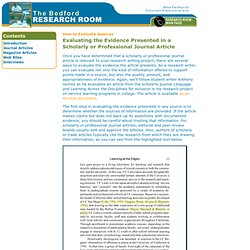
If the article makes claims but does not back up its assertions with documented evidence, you should be careful about trusting that information. For scholarly or professional journal articles, editorial and peer review boards usually edit and approve the articles. Also, authors of scholarly or trade articles typically cite the research from which they are drawing their information, as you can see from the highlighted text below. These citations correspond to a list of references found at the end of the article. Next, determine whether the information in the article is consistent with the information found in other print sources, Web sites, newsgroups, or mailing lists.
As you evaluate the scholarly or professional journal article, also consider whether evidence is carefully put together. 3. Evaluate Author. How to Evaluate Sources Most scholarly or professional journal articles contain a short biographical note about the author of an article.
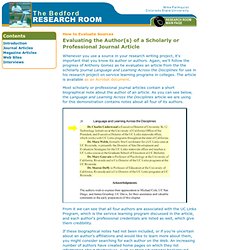
As you can see below, the Language and Learning Across the Disciplines article we are using for this demonstration contains notes about all four of its authors. From it we can see that all four authors are associated with the UC Links Program, which is the service learning program discussed in the article, and each author's professional credentials are listed as well, which give them credibility. If these biographical notes had not been included, or if you're uncertain about an author's affiliations and would like to learn more about them, you might consider searching for each author on the Web.
An increasing number of authors have created home pages on which they list information about themselves, such as their educational background, professional experience, and interests. 4. Evlauate Publisher. How to Evaluate Sources Experienced researchers know that the publisher of a source—the person, organization, government agency, or corporation that prints or electronically distributes a source—plays an important role in shaping its content.
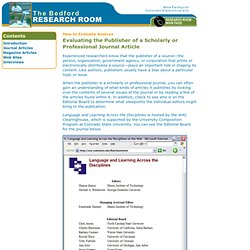
Like authors, publishers usually have a bias about a particular topic or issue. When the publisher is a scholarly or professional journal, you can often gain an understanding of what kinds of articles it publishes by looking over the contents of several issues of the journal or by reading a few of the articles found within it. In addition, check to see who is on the Editorial Board to determine what viewpoints the individual editors might bring to the publication.
Language and Learning Across the Disciplines is hosted by the WAC Clearinghouse, which is supported by the University Composition Program at Colorado State University. Like authors, publishers have biases. 5.Evaluate timelessness & comprehensiveness. How to Evaluate Sources The importance of timeliness—when a source was published—varies according to your research writing situation.
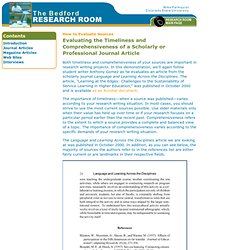
In most cases, you should strive to use the most current sources possible. Use older materials only when their value has held up over time or if your research focuses on a particular period earlier than the recent past. Comprehensiveness refers to the extent to which a source provides a complete and balanced view of a topic.