
Your faith is a joke. Jacque Fresco - Spirituality and Consciousness. Five Stupid Things About the New Age Movement. "Positive thinking" as a modern-day capitalist religion. Sam Harris - The End of Faith. 'Can the rest of us have our planet back ' by The Now Show, Marcus Brigstocke RichardDawkins net. Waiting for Jesus. Excuse my outrage, but I think it's justified. Christopher Hitchens on the Origin of Religion. Jacque Fresco - Religion. God's God. Lack of belief in gods. God Delusion by Richard Dawkins - Science vs. Religion.
Arguments for Gods Existence. RICHARD DAWKINS - THOMAS AQUINAS' 'PROOFS' Proofs for God Destroyed by a Philosophical Atheist. Sam Harris destroys theistic arguments. Why I Am Not A Christian, by Bertrand Russell. Introductory note: Russell delivered this lecture on March 6, 1927 to the National Secular Society, South London Branch, at Battersea Town Hall.
Published in pamphlet form in that same year, the essay subsequently achieved new fame with Paul Edwards' edition of Russell's book, Why I Am Not a Christian and Other Essays ... (1957). As your Chairman has told you, the subject about which I am going to speak to you tonight is "Why I Am Not a Christian. " Perhaps it would be as well, first of all, to try to make out what one means by the word Christian.
It is used these days in a very loose sense by a great many people. Some people mean no more by it than a person who attempts to live a good life. Conceptions of God: The Ontological Argument. Cosmological argument. The Ontological Argument Sucks. Arguments For God: The Cosmological Argument. The agnostic believer » Alethian Worldview. Those who sincerely attempt to reconcile Christianity with fact and reason eventually discover, if they persist, that the Gospel is not consistent with unbiased objective truth, as I can testify from personal experience.

The Case Against Christianity. Atheists Just Want to Sin. Skeptic's Annotated Bible / Quran / Book of Mormon. Why Christianity is Impossible to Believe (Christopher Hitchens) Reason in Motion - Dawkins Typography. Sam Harris - Not Being Indoctrinated Into Christianity. Jesus Who Wasn't There [Full Film].flv. David Fitzgerald Skepticon 3 "Examining the Existence of a Historical Jesus" The Existence of Jesus - Christopher Hitchens. The Jesus Story Is Best Explained as a Myth. There's lots of evidence for Jesus! Gullible is not in the Dictionary. The Most Wrong Anyone Ever Was.
Social Suicide. (23 minutes) "This is how I discovered truth. My name is Chris and I'm an Ex Mormon." Five Stupid Things About Joseph Smith. A new exposé of Mother Teresa shows that she—and the Vatican—were even worse than we thought. First Christopher Hitchens took her down, then we learned that her faith wasn’t as strong as we thought, and now a new study from the Université de Montréal is poised to completely destroy what shreds are left of Mother Teresa’s reputation.
She was the winner of the 1979 Nobel Peace Prize, was beatified and is well on her way to becoming a saint, and she’s universally admired. The Complete and Utter Ridiculousness of Traditional Monotheism and the God of Abraham. 'Atheist' Nations Are More Peaceful. This was too awesome not to mirror. DANGERS OF ATHEISM DEBUNKED! Morality 1: Good without gods. Don't Blame the Atheists. David Humes View On Miracles. Believers and sceptics’ alike need a form of criteria in order declare something a miracle.
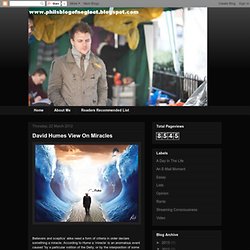
According to Hume a ‘miracle’ is an anomalous event caused “by a particular volition of the Deity, or by the interposition of some invisible agent.” Hume also proposes that if such an event were to occur, it would have an apparent interference in the ‘laws of nature’ which he described as being “established by firm and unalterable experience.” For example, the law of gravitation or irreversible biological decay which is based upon empirical observation. In a religious context miracles are related to beliefs of ‘divine intervention’ as denoted in biblical scriptures such as the bodily resurrection of Jesus Christ.
Conversely, this appears to have a potential conflict with the modern scientific viewpoint, as such beliefs make claims about the natural world on the basis of religious authority and personal experience, rather than any discernible evidence. Derren Brown: The System. Proving Atheism Is True. Putting faith in its place. Richard Dawkins' Pope Speech [mirror] George Carlin - The Ten Commandments Broken Down. Shockofgod's Moronic Question Answered...YET AGAIN -The Atheist Experience 734. Why I Speak Out Against Fundamentalism. Christopher Hitchens Hitch-Slaps Tony Blair. Religion Does No Harm, Bill Maher reflects. Sam Harris Makes An Excellent Analogy For Religion. What have I got against religion? The trouble with Islam. Aggressive atheism. Atheist Fundamentalism? The Internet: Where religions come to die.
Should Atheists Organize Politically? Double Standard. Penn Jillette: Why Tolerance Is Condescending. Free Speech is Offensive* World’s most dangerous religion: Atheists face worldwide persecution – report. Top Ten Creationist Arguments. Creationism and the Second Law. Creationism and political power in Northern Ireland. In 1892, the Rev Canon Alfred Barry gave a series of lectures at Oxford University reflecting on the relationship between faith and science.
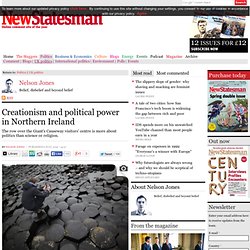
Referring to the debate about the origin of and evolution of life, he noted that: Few men, I suppose, now doubt that the mutability of allied species, once considered as fixed and unchangeable, has been substantially proved...No one, again, seriously doubts that in this development the process which Darwin termed Natural Selection is one potent factor. When Charles Darwin first outlined his theory, in 1859's Origin of Species, some Christians objected to the lack of divine guidance in the scheme.
Few, however, still clung to the 17th century chronology of Archbishop Ussher, who had dated the creation to 4004 BC, or objected to the findings of geology that the earth was many millions of years old. What Bill O'Reilly Doesn't Know. Neil DeGrasse Tyson Destroys Bill O'Reilly. Evolution - The 'Best' Counter Arguments. Bill Hicks - Christians Fundamentalists Creationists Bush. Evolution Vs. God - An Atheist Review. "Why Are There Still Apes?" "It All Comes Down to Faith" (Part 1)
"It All Comes Down to Faith" (Part 2) The Watchmaker And Other Creationist Arguments. Argument from design. The argument from design, also known as the teleological argument, is an argument for the existence of God that may be summarized as follows: When I see a complex object such as a watch, I know it has been designed: therefore, when I see a complex object such as a tiger, I should infer that it has been designed.
This act of comparing two objects and drawing similar conclusions based on similarities (while ignoring important differences) is a prime example of a false analogy. [edit] History It is commonplace to associate the argument from design with William Paley, so much so that it is often referred to as "Paley's argument" (or "Paley's watch"). It is equally an error to charge Paley with plagiarism on this count: he was writing about an opinion so widely known in his time that it was not necessary for him to disclaim originality; and it is not his fault that subsequent generations have tended to give him the credit for the argument.
[edit] A fallacy [edit] Further problems [edit] Creationism - Penn & Teller Bullshit! Ray Comfort Interview On Atheist Experience. Creationist Cowards Diss Darwin. Cameron and Comfort dissing Darwin. Darwin Was A Racist? Notable Charles Darwin misquotes. Charles Darwin's works are often misrepresented by intelligent design supporters and creationists.
The Origin of Species[edit] Scott Huse in The Collapse of Evolution (1996) claimed Darwin wrote: To suppose that the eye, with all its inimitable contrivances for adjusting the focus to different distances, for admitting different amounts of light, and for the correction of spherical and chromatic aberration, could have been formed by natural selection, seems, I freely confess, absurd in the highest possible degree. Darwin and eugenics? Wrong again « Millard Fillmore's Bathtub. Again at Café Philos, the anti-Darwin fifth columnists do their best to continue distortions of history, in this case, in high irony, claiming NOT to defend John Freshwater.
Not in defense of Freshwater’s walking over the Constitution and zapping burns on students in the shape of a cross? Why bother to go after Darwin?