
Hackschooling.
The Educational Value of Field Trips. Crystal Bridges; Crystal Bridges Museum of American Art; School Tour © 2013 Stephen Ironside/Ironside PhotographyBo Bartlett – “The Box” – 2002 • Oil on Linen • 82 x 100 – Photographer is Karen Mauch The school field trip has a long history in American public education.
For decades, students have piled into yellow buses to visit a variety of cultural institutions, including art, natural history, and science museums, as well as theaters, zoos, and historical sites. Schools gladly endured the expense and disruption of providing field trips because they saw these experiences as central to their educational mission: schools exist not only to provide economically useful skills in numeracy and literacy, but also to produce civilized young men and women who would appreciate the arts and culture. Today, culturally enriching field trips are in decline.
Museums across the country report a steep drop in school tours. Bill Gates On Education: "We Can Make Massive Strides" Pop quiz: Is Bill Gates a) the savior of American public education or b) a cloistered billionaire who should stick to something simple like eradicating polio?
Both views have proponents. There's Malcolm Gladwell's hero's tale in his book Outliers about the young Gates spending "10,000 hours" in computer labs honing the skills that would spawn one of the world's most important technology companies. And there's the counterpart: the standardized-test obsessive, the avatar of school privatization, the sworn enemy of teachers' unions. "We've gone far down the track of Bill Gates deciding how our children are going to be treated and educated," says Leonie Haimson, a parent-activist with the group Class Size Matters. Both notions are caricatures. "We're stuck at $600 billion a year," Gates notes wryly, referring to the annual amount spent on education in the United States nationwide. When Bill & Melinda Gates Foundation Meddle with Education, Students Lose & Billionaires Gain - Schools.
Is the Gates Foundation helping or hurting the country's education system?
Read how it has affected Boston schools. By John Radosta, a Boston Public School parent The legend of Bill Gates and his rise from college dropout to billionaire is fixed in everyone’s mind. Now he is known for his philanthropy, and his desire to cure every ill from malaria to education, to helping design the next generation toilet in China. Common Core Standards - Fact and Fiction. The Trouble With Common Core - Stan Karp speaks in Portland Oregon. Experiential learningsoeffective. If My Child Refuses State Tests Will My School Lose Funding? - NYS Allies for Public Education. Place-based education. Place-based education, sometimes called pedagogy of place, place-based learning, experiential education, community-based education, education for sustainability, environmental education or more rarely, service learning, is an educational philosophy developed initially by The Orion Society, [1] a Massachusetts based nonprofit organization, as well as Professor David Sobel, Project Director at Antioch University New England though educators have used its principles for decades.
The term was coined in the early 1990s by Laurie Lane-Zucker of The Orion Society and Dr. John Elder of Middlebury College. Orion's early work in the area of place-based education was funded by the Geraldine R. Dodge Foundation. PPS Focus on Diversity - Courageous Conversations about Race 3/20/12. In Testing, a Principal Leans on Her Experience. In Testing, a Principal Leans on Her Experience. As principal, it is her job to make sure children learn (94.9 percent of the fourth graders were proficient on the 2012 state math test); hire talented teachers (Antoinette Byam, for one, has been awarded grants to study in Ghana, Peru and Mexico and used the research to develop a fifth-grade curriculum on Mayan culture); create an environment where good teachers thrive (the turnover rate is 4 percent ); and encourage families to be involved (she holds weekly breakfasts with parents.)
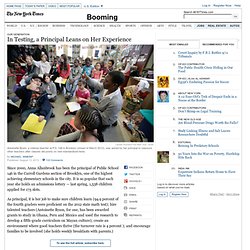
She also believes it is her job is to shield students, teachers and parents from the state’s ever-expanding standardized testing system and to question its reliability publicly. “At my age, I’ve seen so many education fads come and go,” she says. Scrapthemap.files.wordpress.com/2013/05/teacher-work-group-on-assessment-recommendations-spring-2013.pdf. Solidarity with Seattle teachers boycotting the MAP test. Common Core. In copying the response of Hart Research, I inadvertently copied only part of Guy Moyneaux’s comments.
Here is his full response: TO:American Federation of Teachers FROM:Guy Molyneux, Hart Research Associates DATE:May 10, 2013 RE:Methodology for Common Core Survey Following are some facts about the methodology for AFT’s recent survey of AFT K-12 teachers on Common Core implementation that may help to answer the criticisms and questions raised by Mercedes Schneider. Schneider’s objections speak to two distinct questions: 1) does the survey reflect the views of AFT K-12 teachers? In fact, it is likely that a survey of all U.S. teachers would report results broadly similar to what we found among AFT members, for reasons explained below. . • The survey employed a standard sampling methodology, used in countless surveys by many polling organizations. . • A sample size of 800 teachers is appropriate and common.
. • The survey sample is demographically similar to the population of AFT teachers. The Benefits of Character Education - Jessica Lahey. Jessica Lahey When I signed on to teach English at a core virtues school, I had no idea what I was in for.
I nodded and smiled in my interview when the Headmaster explained the virtues curriculum, and I parried back with everything I thought she wanted to hear; how I could infuse my lessons on To Kill a Mockingbird with discussions about empathy and courage. I may have even quoted Atticus' line about walking around in someone else's skin.
I figured I could tack on some of that quaint "virtue" stuff before getting to the real meat of the lesson, the academic stuff. Is It Time We Threw Standardized Testing Out the Door? Dr.
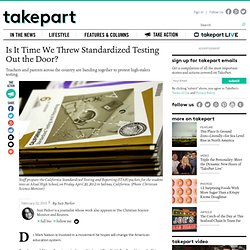
Mark Naison is involved in a movement he hopes will change the American education system. A professor of African-American studies and history at New York’s Fordham University, Naison wants to see less standardized tests in the classroom. “You should organize the school experience around what excites and energizes children—the arts, music, physical activity, hands-on science, collaborative learning—and do project-based assessment by teachers and school administrators, with standardized tests on a state or national level reduced to a minimum,” Naison told TakePart.
He isn’t alone. Students, parents and teachers around the country are saying enough to standardized testing. What Makes Finnish Kids So Smart? Helsinki, Finland High-school students here rarely get more than a half-hour of homework a night.
They have no school uniforms, no honor societies, no valedictorians, no tardy bells and no classes for the gifted. There is little standardized testing, few parents agonize over college and kids don't start school until age 7. Yet by one international measure, Finnish teenagers are among the smartest in the world. Christine Gross-Loh: Have American Parents Got It All Backwards? The eager new mom offering her insouciant toddler an array of carefully-arranged healthy snacks from an ice cube tray?
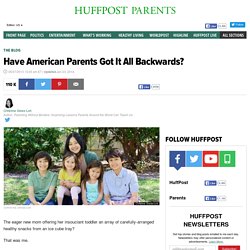
The always-on-top-of-her-child’s-play parent intervening during play dates at the first sign of discord? We hold some basic truths as self-evident when it comes to good parenting. Our job is to keep our children safe, enable them to fulfill their potential and make sure they’re healthy and happy and thriving.
Metropolitan Learning Center.