
Search. New Ships and Manned Missions. Telescopes. Local sol. Colony. FTL. Big Dumb Objects. Big Space Engineering. Astrophysics. Pics. Space Debris. Our Universe. Space Simulations and Sky Charts. Space science. Team Asrtronomy. NASA Is Sending Bacteria to the Edge of Space to See if They Can Hitchhike to Mars. Complex Organic Molecules Discovered in Infant Star System. Eso1513 — Science Release Hints that the building blocks of the chemistry of life are universal 8 April 2015 For the first time, astronomers have detected the presence of complex organic molecules, the building blocks of life, in a protoplanetary disc surrounding a young star.
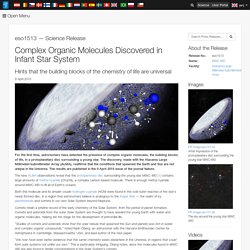
Fragile Humans Spacewalk To Upgrade Space Station Communications. It's like Where's Waldo.
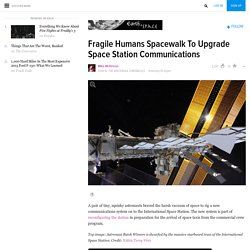
Where is he? Flagged You found him! Here's a labelled photo, courtesy of Peter Caltner: Thanks for the labels :) I would have never seen him. Can you help me identify what I captured here? : astrophotography. Taking a time-lapse this morning (CANON 6D 35MM @ f1.4 10" ISO1600 with a 10" delay between frames) and captured what I first thought was just a plane passing by... but I didn't see it in any other frames and what I assume is a vapor trail was rather odd.
Is this a meteor? Thanks for any input. Captured frames (unedited besides crop) below: EDIT: Wow, had no idea - that is pretty awesome. Thank you all for informing me. EDIT2: WOW. Here is the full-frame captured (25% original size). EDIT3: As promised, here is the gfycat version. If you'd like permission to use this photo elsewhere please PM or email at maddhat[at]gmail. 10 Apps That Are The Next Best Thing To Being In Space. I may have to take a closer look at some of these tonight with the kids.

Just this morning we were having a discussion about the movement of the earth, moon, the milky way etc... It would be neat to help them get a good visualization of what I meant. You know, instead of pretending my fist is the earth and my index finger is the moon "this is how is moves! " Far-future-timeline.png (976×3241) Space/Astronomy Questions and Answers [Archive] - Cosmoquest Forum. Universe Today — Space and astronomy news. The Falcon 9 and Dragon capsule stand ready for launch prior to the detection of a helium leak in one of the engines forcing a scrub of the launch attempt on April 14. 2014 – now reset to April 18, 2014.
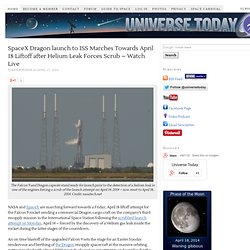
Credit: nasatech.net NASA and SpaceX are marching forward towards a Friday, April 18 liftoff attempt for the Falcon 9 rocket sending a commercial Dragon cargo craft on the company’s third resupply mission to the International Space Station following the scrubbed launch attempt on Monday, April 14 – forced by the discovery of a Helium gas leak inside the rocket during the latter stages of the countdown. Space Science Stories to Watch in 2014.
Want to stay on top of all the space news?
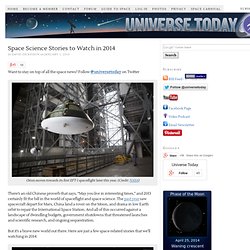
Follow @universetoday on Twitter Orion moves towards its first EFT-1 spaceflight later this year. (Credit: NASA) There’s an old Chinese proverb that says, “May you live in interesting times,” and 2013 certainly fit the bill in the world of spaceflight and space science. The past year saw spacecraft depart for Mars, China land a rover on the Moon, and drama in low Earth orbit to repair the International Space Station. National Aeronautics And Space Administration celebrates 50th anniversary. Live From The International Space Station! The International Space Station (ISS) is a habitable satellite that was launched on October 31 2000 and has had continued human occupation ever since, the longest on record.
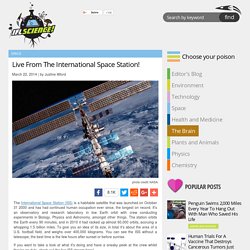
It's an observatory and research laboratory in low Earth orbit with crew conducting experiments in Biology, Physics and Astronomy, amongst other things. The station orbits the Earth every 90 minutes, and in 2010 it had racked up almost 60,000 orbits, accruing a whopping 1.5 billion miles. To give you an idea of its size, in total it's about the area of a U.S. football field, and weighs over 400,000 kilograms.
You can see the ISS without a telescope; the best time is the few hours after sunset or before sunrise. If you want to take a look at what it's doing and have a sneaky peek at the crew whilst they're on duty, check out the live ISS stream here! If the stream displays a black/blue screen, there has been a temporary loss of signal. Live streaming video by Ustream. Space in Videos - ESA Live. NASA develops 3D printing factory in space. News: NASA is developing an orbiting factory that will use 3D printing and robots to fabricate giant structures such as antennas and solar arrays of up to a kilometre in length, as part of its ongoing search for extra-terrestrial life.
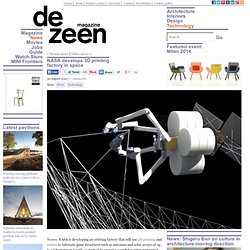
The US space agency this week announced it was awarding technology firm Tethers Unlimited Inc (TUI) a $500,000 contract to develop the facility. The NASA funding - a second-phase contract that follows an initial contract issued earlier this year - will allow TUI to continue work on its SpiderFab technology, which allows large-scale spacecraft components to be built in space, avoiding the expense of building the components on earth and transporting them into space using rockets. “On-orbit fabrication allows the material for these critical components to be launched in a very compact and durable form, such as spools of fiber or blocks of polymer, so they can fit into a smaller, less expensive launch vehicle.”
Said TUI CEO and chief scientist Dr Rob Hoyt. Nasa-backed space spider concept to build giant satellites in orbit. Space is a place for finished products.
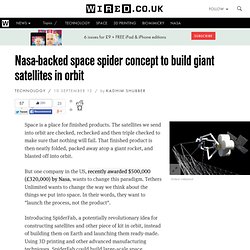
The satellites we send into orbit are checked, rechecked and then triple checked to make sure that nothing will fail. That finished product is then neatly folded, packed away atop a giant rocket, and blasted off into orbit. But one company in the US, recently awarded $500,000 (£320,000) by Nasa, wants to change this paradigm. How Asteroids Can Save Mankind. How Asteroids Can Save Mankind How Asteroids can save mankind Asteroid mining may seem like science fiction, but with resources running short on Earth, mining the sky could be humanity's only hope.
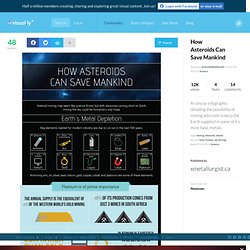
Earth's Metal Depletion Sb Batteries 51 Antimony Cn Brass 30 Instruments Zinc Sn Cans 50 Tin Sn Jewellery 50 Silver.