
Understanding User Interface in Android - Part 1: Layouts. So far in my previous few articles on Android I have focused on showing you how to get things done in Android without really spending too much time discussing the visual aspect of Android application development - User Interface design.
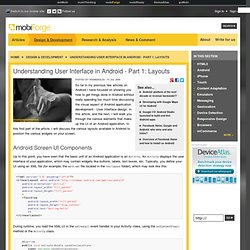
In this article, and the next, I will walk you through the various elements that make up the UI of an Android application. In this first part of the article, I will discuss the various layouts available in Android to position the various widgets on your screen. Android Screen UI Components. Android Preferences. For almost any application we need to provide some settings in order to enable users have some level of control over how the application works.

Android has provided a standard mechanism to show, save and manipulate user's preferences. PreferenceActivity class is the standard Android Activity to show Preferences page, it contains a bunch of Preference class instances which use SharedPreferenceclass to save and manipulate corresponding data.There are different types of Preferences Available in Preference package, and if you need something more you can extend Preference class and create your own Preference type. in this article we will go through predefined Preference types in Android and I'm also going to implement a custom Preference type to see how that works.Our Preferences page is gonna look like this : public class MyPreferenceActivity extends PreferenceActivity { @Override protected void onCreate(Bundle savedInstanceState) { super.onCreate(savedInstanceState); return layout; } The Developer's Guide.