
Homemade Mustard Recipe. Now that we’re deep in the heart of summer, the grill is looking pretty appealing.

For one thing, it doesn’t heat up the house like the oven. For another, a sausage or burger isn’t quite the same any other way. There are some fine producers of artisan sausages and some truly spectacular beef to be had around the Twin Cities. But once it’s time to take the sizzling meat off the grill, what goes on it? Certainly condiments from the closest box store won’t do justice to your juicy, local meal; good, homemade mustard would.
Homemade Yellow Mustard 1/2 cup yellow mustard seeds3/4 cup apple cider vinegar1/3 cup water1 1/2 tsp. sugarYour pick of spices (to taste), optional Instructions: Soak the mustard seeds in the vinegar and water, making sure the seeds are covered by the liquid. The mustard will at first seem extremely spicy, but will mellow out after a day or two in the fridge. Check out our other article on making homemade mustard. Rosemary Thyme Mustard Recipe. How to Make Mustard - Making Homemade Mustard. Photo by Hank Shaw “What do you mean you can make mustard at home?”
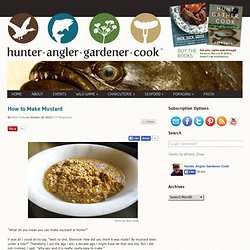
It was all I could do to say, “Well no shit, Sherlock! How did you think it was made? By mustard elves under a tree?” Thankfully, I am the age I am; a decade ago I might have let that one slip. I had this conversation with another blogger at the annual BlogHer Food conference in San Francisco last week. But I gotta tell ya folks, it ain’t mysterious. Photo by Holly A. Mustard is a condiment of a thousand faces. Mustard is one of Europe’s few native spices, although a mustard also has been used in Chinese cooking for around 2,500 years as well. Ancient Rome was quite the hotbed of mustard-making, and it is Rome that gives us our name for mustard: It is a contraction of mustum ardens, or “hot must;” the Romans often added crushed mustard seeds to unfermented crushed grapes.
The basic idea behind making mustard is this: Grind seeds and add cool liquid. First, you need cold liquid. This reaction is volatile, too. Homemade mustard's pleasurably simple punch. Hard cider mustard makes a great condiment for grilled bratwurst.

(Mel Melcon, Los Angeles…) Lately, I've been on a homemade mustard kick. Think mustard, and your thoughts might veer first toward the bright yellow stuff you get in a squeeze bottle. Or maybe you prefer something a little less mild, as you reach for your favorite brand of Dijon or maybe a spicy whole grain. But have you ever tried making mustard from scratch? Essentially, mustard is nothing more than a combination of seeds and liquid. I love that the condiment lends itself so readily to experimentation. Start with the seeds. Black mustard, Brassica nigra, is the smallest of the seeds, though it contains the most sinigrin, the compound that gives mustard its sharp punch (the burn you feel in the back of the mouth, throat and nose). Brown mustard, B. juncea, is a little more mild than the black and is used in most European prepared mustards.
White mustard, B. hirta or Sinapis alba, is the mildest of all.