
Green Wavelength unveils bumblebee inspired wind turbine. Green Wavelength's radical departure from conventional wind turbine design Image Gallery (2 images) Gizmag's pages are filled with clever examples of biomimicry, and why not, evolution is after all the biggest, oldest and most successful design house we know of.

Today's lesson is being given by insects like bumblebees, hummingbirds, and dragonflies, whose efficient wing flapping capabilities are being harnessed by Californian start-up Green Wavelength in an effort to produce more efficient wind turbines. Vertical axis windmills have been with us in one form or another for more than 1000 years. Designs have undergone constant improvement (including more examples of biomimicry using the whale as inspiration), but the efficiency of current wind turbines peaks at around 30%.
Sea Creature's Amazing Eyes Could Inspire New DVD Players. Humans see three colors that, combined, allow us to enjoy the visible light spectrum.

The mantis shrimp sees 12 colors, ranging into the near-ultraviolet to infrared parts of the spectrum. The creature can also distinguish different forms of polarized light. Scientists now say this sea shrimp's remarkable eye could inspire a new generation of DVD and CD players. Mantis shrimp found on the Great Barrier Reef in Australia and have the most complex vision systems known to science. Special light-sensitive cells rotate the plane of the oscillations, or polarization, of a light wave as it travels through it. Manmade devices called quarter-wave plates perform this essential function in CD and DVD players and in circular polarizing filters for cameras. Biomimetics New Zealand Inc. Universities give rise to biomimetic cheetah and gecko. What do cheetahs, geckos and biomimetics have in common?
No, not auto insurance. Think "robots". Biomimetic refers to nature-imitating substances, devices, processes or systems that are created by humans. Sangbae Kim is a human at MIT [Massachusetts Institute of Technology] who is creating robots inspired by the animal kingdom. They have applications in industry, as well as surveillance and search-and-rescue mission capabilities for the military environment. While a graduate student at Stanford University, Kim was on a team that created "Stickybot," a gecko-inspired climbing device. Video: Slime Mold Engineers the Motorways of Spain. For an example of sophisticated behavior in seemingly simple creatures — or, conversely, to put human engineering in a new perspective — witness the lowly slime mold.
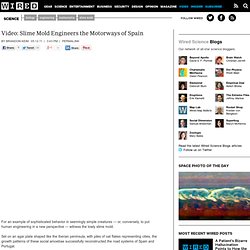
Set on an agar plate shaped like the Iberian peninsula, with piles of oat flakes representing cities, the growth patterns of these social amoebae successfully reconstructed the road systems of Spain and Portugal. The experiment, currently in Biosystems, is the latest in a series of slime-mold studies by University of West England computer scientist Andrew Adamatzky, who is fascinated by how Physarum polycephalum‘s foraging abilities can be represented in high-powered computational terms.
“Physarum is renowned for building optimal transport networks, which minimize distance of cytoplasmic transfer but also span as much sources of nutrients as possible,” said Adamatzky. Undefined. Public release date: 24-Dec-2009 [ Print | E-mail Share ] [ Close Window ] Contact: Becky Allenbecky.allen@admin.cam.ac.uk 44-750-088-3644University of Cambridge Scientists have shown for the first time that insects, like mammals, use vision rather than touch to find footholds.

They made the discovery thanks to high-speed video cameras – technology the BBC uses to capture its stunning wildlife footage – that they used to film desert locusts stepping along the rungs of a miniature ladder. The study sheds new light on insects' ability to perform complex tasks, such as visually-guided limb control, usually associated with mammals. According to lead author Dr Jeremy Niven of the University of Cambridge: "This is another example of insects performing a behaviour we previously thought was restricted to relatively big-brained animals with sophisticated motor control such as humans, monkeys or octopuses. " The results are published today in Current Biology. Reconstructing Nature. Stumped by a design problem?

Running out of ideas? You might want to watch a grasshopper or mentally dissect a fern. That’s what the growing crop of biomimicry practitioners would encourage you to do. Biomimetics. One cloudless midsummer day in February, Andrew Parker, an evolutionary biologist, knelt in the baking red sand of the Australian outback just south of Alice Springs and eased the right hind leg of a thorny devil into a dish of water.
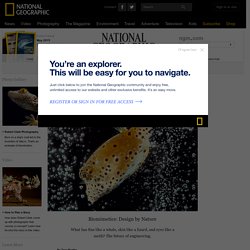
The maneuver was not as risky as it sounds: Though covered with sharp spines, the lizard stood only about an inch high at the shoulder, and it looked up at Parker apprehensively, like a baby dinosaur that had lost its mother. It seemed too cute for its harsh surroundings, home to an alarmingly high percentage of the world's most venomous snakes, including the inland taipan, which can kill a hundred people with an ounce of its venom, and the desert death adder, whose name pretty well says it all. Fierce too is the landscape itself, where the wind hissing through the mulga trees feels like a blow dryer on max, and the sun seems three times its size in temperate climes. “Ah-ha!” Parker exclaimed, like Sherlock Holmes alighting upon a clue.