
4chan founder: Zuckerberg is “totally wrong” about online identity. Christopher Poole, the founder of controversial online image board 4chan, outlined his vision for Web-based community today at the South by Southwest Interactive conference — and yes, his ideas are in pretty sharp contrast to those of Facebook founder Mark Zuckerberg.

Zuckerberg has spent a lot of time talking about his stance on identity and privacy, especially recently, as Facebook has taken more criticism for its various privacy policies. (To get the flavor of his remarks, check out VentureBeat’s post about Zuckerberg’s privacy stance from last May, as well as David Kirkpatrick’s book The Facebook Effect.)
A 5-minute framework for fostering better conversations in comments sections. Last week, my news organization announced we were evolving our online commenting practices a bit to improve the quality of discourse on NPR.org.
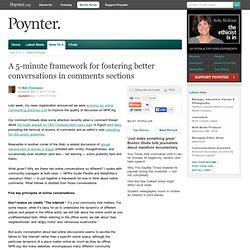
Our comment threads drew some attention recently when a comment thread about the brutal assault on CBS Correspondent Lara Logan in Egypt went awry, prompting the removal of dozens of comments and an editor’s note reiterating the discussion guidelines. Meanwhile in another corner of the Web, a related discussion of sexual harrassment of women in Egypt unfolded with civility, thoughtfulness, and occasionally even erudition (and also – fair warning — some profanity here and there). Empowered. By Charlene Li We just released a new report that Josh and I wrote, titled "Social Technographics".
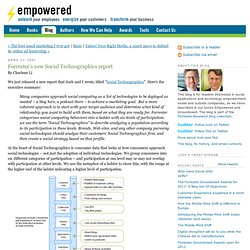
Here's the executive summary: Many companies approach social computing as a list of technologies to be deployed as needed – a blog here, a podcast there – to achieve a marketing goal. But a more coherent approach is to start with your target audience and determine what kind of relationship you want to build with them, based on what they are ready for. Forrester categorizes social computing behaviors into a ladder with six levels of participation; we use the term "Social Technographics" to describe analyzing a population according to its participation in these levels. The myth of web 2.0 non-participation.