
Mapping The Next Three Decades of Health Technology. When science fiction films depict the future, the best writers and directors are often less concerned with accurately predicting how specific technologies might reshape the world than they are with confronting the moral or philosophical quandaries of present day.
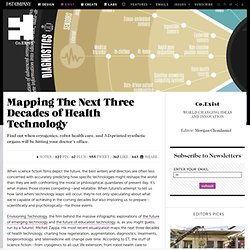
It’s what makes those stories compelling--and relatable. When futurists attempt to tell us how (and when) technology leaps will occur, they’re not only speculating about what we’re capable of achieving in the coming decades but also imploring us to prepare--scientifically and psychologically--for those events. Envisioning Technology, the firm behind the massive infographic explorations of the future of emerging technology and the future of education technology, is, as you might guess, run by a futurist: Michell Zappa. His most recent visualization maps the next three decades of health technology, charting how regeneration, augmentation, diagnostics, treatments, biogerontology, and telemedicine will change over time.
Healthcare - l'e-santé au service du bien vieillir. Le profil démographique du monde change radicalement, le nombre de personnes âgées augmentant face à un nombre de jeunes en constante diminution.
Cela va représenter un véritable challenge pour la société. Le vieillissement et les pathologies inhérentes exigeront un tel niveau de ressources que pour bon nombre de structures sociales existantes cela pourrait bien être l’épreuve de vérité. De nombreuses adaptations vont être nécessaires pour relever positivement et humainement ce défi : sociétales, familiales, techniques et financières. Dans ce contexte, l’e-santé un rôle majeur à jouer ! Alors que 80% des personnes âgées souhaitent rester chez elles quand elles vieillissent, et quand on sait que le coût du maintien à domicile pour des personnes dépendantes est quatre fois moins élevé qu’une hospitalisation… c’est facile à concevoir.
Mobile Site or Mobile App: Which Should You Build First? [INFOGRAPHIC] Astute Internet observers know by now that the future of the web is mobile.
![Mobile Site or Mobile App: Which Should You Build First? [INFOGRAPHIC]](http://cdn.pearltrees.com/s/pic/th/mobile-should-infographic-31370905)
More and more consumers will access data and information via smartphones, tablets and other portable devices. So businesses need to prepare by beefing up their presences on the mobile web. But is it better to get started by creating a mobile-optimized website or by building a standalone mobile app? A mobile app is faster, more interactive and can integrate with all kinds of other phone features. But the app must be installed to be of any use at all, while a good mobile site can simply be navigated to on a user's whim. Mobile apps are becoming more and more popular with Internet users, however. SEE ALSO: In a Relationship: Mobile Apps and the Cloud [INFOGRAPHIC] Maybe the answer to what to develop first is embedded in what type of service you're looking to provide.
The advertising agency MDG pulled data from sources including Flurry Analytics, ComScore and others to create the infographic below. Sante2025_LivreBlanc_BD.pdf (Objet application/pdf) Web 2.0 and Social Media in Medical Education: Slideshow. European_doctors_social_media_infographic_large.pdf (Objet application/pdf) Pharma and facebook: the cost of disengagement. Yesterday, facebook opened comments on all its fan pages and consequently closed a chapter in the book of pharma social media engagement.
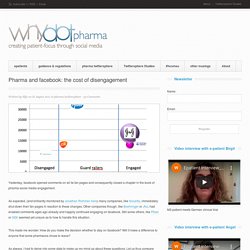
As expected, (and brilliantly monitored by Jonathan Richman here) many companies, like Novartis, immediately shut down their fan pages in reaction to these changes. Other companies though, like Boehringer or JNJ, had enabled comments ages ago already and happily continued engaging on facebook. Still some others, like Pfizer or GSK seemed yet unsure as to how to handle this situation.
This made me wonder: How do you make the decision whether to stay on facebook? Will it make a difference to anyone that some pharmacos chose to leave? As always, I had to delve into some stats to make up my mind up about these questions. Just as on twitter, Pfizer is leading the benchmark with over 31k fans! Next, I looked at how many times these companies had updated their fan pages this month. Next burning question is, of course, did it make a difference? 1. 3. PHARMA GEEK / Démographie médicale Instantané 2012 des médecins français Infographie vendredi 23 mars 2012. PHARMA GEEK & SOCIAL MEDIA. KRESMOI_internet_health_search_information_HON.pdf (Objet application/pdf) Un rapport à lire sur les enjeux entourant le développement des réseaux sociaux en santé. Le Conseil général de l’industrie, de l’énergie et des technologies français a publié en mai 2011 un rapport[1] particulièrement intéressant sur les enjeux entourant le développement des réseaux sociaux dans le domaine de la santé.
Selon les auteurs, les transformations qu’amène le «web social» seraient précurseurs «d’un nouveau rapport de notre société avec la question sanitaire et sociale» (Picard, 2011, p.11). Barometre_TIC_2011.pdf (Objet application/pdf) Ehealth_benchmarking_3_final_report.pdf (Objet application/pdf)