
Download DIYPhotobits.com Camera Control — DiyPhotoBits.com — A few bits and pieces about photography. Infrared remote control for Nikon. The story Searching for an alternative to buying an expensive remote control for my Nikon D70, I found a small program for the Palm.

It works well, but the Palm isn’t really comfortable for that kind of use. At this point I decided to build a pocket circuit, using a micro-controller, to release the camera’s shutter. The choice of which processor to use was simple: I’ve been working for many years with the ST6 family, but recently, I discovered the AVR micro-controllers. Why not use one of these? 01/2012 : I started to work to this project in the far 2005, when the original ML-L3 was very expensive. Some theory Using an infrared demodulator and a digital oscilloscope I captured the wave generated by the Palm. Figure 1 Note: High levels show when the transmitter’s led is on, low levels when the led is off. Note 2: The waveform in the figure is slight different from the original captured using the Palm. Before concluding this paragraph, I must say a few words regarding the transmitter. Depth of field. In some cases, it may be desirable to have the entire image sharp, and a large DOF is appropriate.

In other cases, a small DOF may be more effective, emphasizing the subject while de-emphasizing the foreground and background. In cinematography, a large DOF is often called deep focus, and a small DOF is often called shallow focus. Circle of confusion criterion for depth of field[edit] Precise focus is possible in only one two-dimensional plane; in that plane, a point object will produce a point image.[1] In any other plane, a point object is defocused, and will produce a blur spot shaped like the aperture, which for the purpose of analysis is usually assumed to be circular. When this circular spot is sufficiently small, it is indistinguishable from a point, and appears to be in focus; it is rendered as "acceptably sharp". Motion picture[edit] Simulation of the effect of changing a camera's aperture in half-stops (at left) and from zero to infinity (at right) Still photography[edit] Let and.
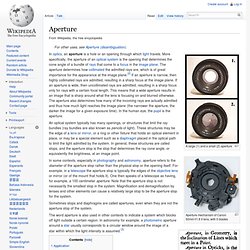
Aperture. A large (1) and a small (2) aperture Aperture mechanism of Canon 50mm f/1.8 II lens, with 5 blades Definitions of Aperture in the 1707 Glossographia Anglicana Nova[1] In some contexts, especially in photography and astronomy, aperture refers to the diameter of the aperture stop rather than the physical stop or the opening itself.
For example, in a telescope the aperture stop is typically the edges of the objective lens or mirror (or of the mount that holds it). One then speaks of a telescope as having, for example, a 100 centimeter aperture. Sometimes stops and diaphragms are called apertures, even when they are not the aperture stop of the system. Application[edit] The aperture stop is an important element in most optical designs. The size of the stop is one factor that affects depth of field. In addition to an aperture stop, a photographic lens may have one or more field stops, which limit the system's field of view.
In photography[edit] Maximum and minimum apertures[edit]