
How Important is Teaching Literacy in All Content Areas? You are busy this summer planning and reworking lessons -- adding, adjusting, and tweaking.
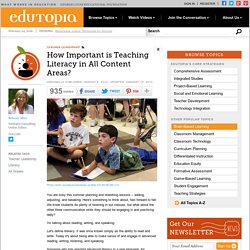
Here's something to think about, fast forward to fall: We know students do plenty of listening in our classes, but what about the other three communication skills they should be engaging in and practicing daily? I'm talking about reading, writing, and speaking. Let's define literacy. It was once known simply as the ability to read and write. Today it's about being able to make sense of and engage in advanced reading, writing, listening, and speaking. Someone who has reached advanced literacy in a new language, for example, is able to engage in these four skills with their new language in any setting -- academically or casually. Literacy is an Every-Century Skill If you are a math, history, science, or art teacher, where does literacy fit into your classroom instruction? "Adolescents entering the adult world in the 21st century will read and write more than at any other time in human history.
Speaking. What's in a reading age? Your children may be reading too early. I was four when I learned to read.

Back then – the late 1960s – doing so was considered a sign of extraordinary precocity – something akin to dog-paddling across the English Channel or memorizing the Encyclopedia Britannica. When I was around six, I got my hands on a gold-embossed volume of Shakespeare’s sonnets and carried it around with me whenever I went with my parents to a dinner party. I couldn’t comprehend a word of what I was reading, but the sight of me with my little book of Shakespeare was guaranteed to elicit gasps of delight and astonishment from the adults. Once the hubbub had subsided and the grown-ups had returned to their own conversations, I sat down in a corner and quietly drew pictures with my crayons in the margins. These days, the reading ability that wowed my parents’ friends is no big whoop. As a children’s book writer who has yet to outgrow the habit of reading picture books for pleasure, I find all of this a bit disturbing. “Ageist!” Milo was outraged. Duh. Definitions of Literacy.
Definitions of LiteracyAccording to Merriam-Webster's Collegiate Dictionary online (www.m-w.com/cgi-bin/dictionary), literacy is "the quality or state of being literate.

"Literate, according to this same source, derives from Middle English and Latin terms meaning "marked with letters" and "letters, literature. " Two definitions are provided: 1) "able to read and write," and2) "versed in literature or creative writing...having knowledge or competence <computer-literate><politically-literate>. " This dictionary source also provides an entry for visual literacy, defined as "the ability to recognize and understand ideas conveyed through visible actions or images (as pictures). " "The Workforce Investment Act of 1998 defines literacy as 'an individual's ability to read, write, speak in English, compute and solve problems at levels of proficiency necessary to function on the job, in the family of the individual and in society.' The authors go on to state that: