
Opto-splitter - ControlBooth. DMX512. A DMX splitter/buffer.
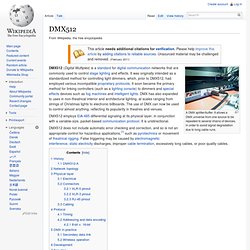
It allows a DMX universe from one source to be repeated to several chains of devices, in order to avoid signal degradation due to long cable runs. DMX512 (Digital Multiplex) is a standard for digital communication networks that are commonly used to control stage lighting and effects. It was originally intended as a standardized method for controlling light dimmers, which, prior to DMX512, had employed various incompatible proprietary protocols. It soon became the primary method for linking controllers (such as a lighting console) to dimmers and special effects devices such as fog machines and intelligent lights. Stepper motor. Animation of a simplified stepper motor (unipolar)Frame 1: The top electromagnet (1) is turned on, attracting the nearest teeth of the gear-shaped iron rotor.
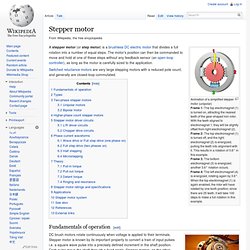
With the teeth aligned to electromagnet 1, they will be slightly offset from right electromagnet (2).Frame 2: The top electromagnet (1) is turned off, and the right electromagnet (2) is energized, pulling the teeth into alignment with it. This results in a rotation of 3.6° in this example.Frame 3: The bottom electromagnet (3) is energized; another 3.6° rotation occurs.Frame 4: The left electromagnet (4) is energized, rotating again by 3.6°. When the top electromagnet (1) is again enabled, the rotor will have rotated by one tooth position; since there are 25 teeth, it will take 100 steps to make a full rotation in this example. A stepper motor (or step motor) is a brushless DC electric motor that divides a full rotation into a number of equal steps. Fundamentals of operation[edit]
Ohm's Law. 3 - Phase Power.