
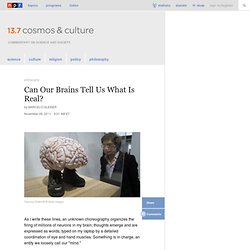
Can Our Brains Tell Us What Is Real? : 13.7: Cosmos And Culture. Francois Guillot/AFP/Getty Images As I write these lines, an unknown choreography organizes the firing of millions of neurons in my brain; thoughts emerge and are expressed as words, typed on my laptop by a detailed coordination of eye and hand muscles.
Something is in charge, an entity we loosely call our "mind. " My perception of the world around me, as modern cognitive neuroscience teaches us, is synthesized within different regions of my brain. What I call reality results from the integrated sum of countless stimuli collected through my five senses, brought from the outside into my head via my nervous system. Cognition, the awareness of being here now, is a fabrication of countless chemical reactions flowing through myriad synaptic connections between my neurons. I am, and you are, a self-sustaining electrochemical network enacted across a web of biological cells. I am me and you are you and we are different, even if made of the same stuff. How Embarrassing: Researchers Pinpoint Self-Consciousness in the Brain. Feeling embarrassed?
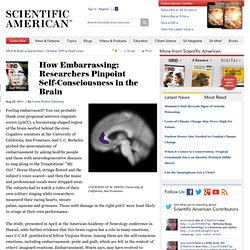
You can probably thank your pregenual anterior cingulate cortex (pACC), a boomerang-shaped region of the brain nestled behind the eyes. Cognitive scientists at the University of California, San Francisco, and U.C. Berkeley probed the neuroanatomy of embarrassment by asking healthy people and those with neurodegenerative diseases to sing along to the Temptations’ “My Girl.” Horns blared, strings flowed and the subject’s voice soared—and then the music and professional vocals were stripped away. The subjects had to watch a video of their own solitary singing while researchers measured their racing hearts, sweaty palms, squirms and grimaces. The study, presented in April at the American Academy of Neurology conference in Hawaii, adds further evidence that this brain region has a role in many emotions, says U.C.S.F. postdoctoral fellow Virginia Sturm.
PHYS771 Lecture 18: Free Will. PHYS771 Lecture 18: Free Will Scott Aaronson Scribe: Chris Granade So today we're going to ask---and hopefully answer---this question of whether there's free will or not.

If you want to know where I stand, I'll tell you: I believe in free will. Why? Before we start, there are two common misconceptions that we have to get out of the way. The misconception committed by the free will camp is the one I alluded to before: if there's no free will, then none of us are responsible for our actions, and hence (for example) the legal system would collapse. They were defended by Clarence Darrow---the same defense lawyer from the Scopes monkey trial, considered by some to be the greatest defense lawyer in American history. Alright, what's the problem with using the non-existence of free will as a legal defense? A: The judge and the jury don't have free will either. The judge can just respond, "The laws of physics might have predetermined your crime, but they also predetermined my sentence: DEATH!
" ECCC - TR11-108. Revision(s): Revision #2 to TR11-108 | 14th August 2011 05:42 Why Philosophers Should Care About Computational Complexity Abstract: One might think that, once we know something is computable, how efficiently it can be computed is a practical question with little further philosophical importance.

In this essay, I offer a detailed case that one would be wrong. Changes to previous version: Added brief remarks about pseudorandomness and homomorphic encryption; put the "lookup table argument" more clearly into the context of previous discussions about complexity and the Turing Test Revision #1 to TR11-108 | 11th August 2011 10:13 One might think that, once we know something is computable, how efficiently it can be computed is a practical question with little further philosophical importance.