
Evolution of Logos. The history of well known logo designs.
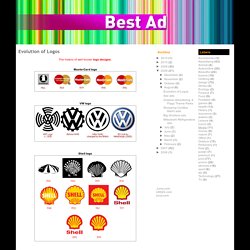
MasterCard logo VW logo Shell logo Boeing logo Alfa Romeo logo. Time Space Map - where: paris. UNIX History. Below, you can see the preview of the Unix History (move on the white zone to get a bigger image): This is a simplified diagram of unix history.
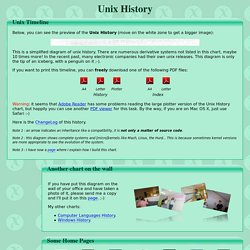
There are numerous derivative systems not listed in this chart, maybe 10 times more! In the recent past, many electronic companies had their own unix releases. This diagram is only the tip of an iceberg, with a penguin on it ;-). If you want to print this timeline, you can freely download one of the following PDF files: Warning: it seems that Adobe Reader has some problems reading the large plotter version of the Unix History chart, but happily you can use another PDF viewer for this task. Here is the ChangeLog of this history. Note 1 : an arrow indicates an inheritance like a compatibility, it is not only a matter of source code. Note 2 : this diagram shows complete systems and [micro]kernels like Mach, Linux, the Hurd...
Note 3 : I have now a page where I explain how I build this chart. Overture - Through the Looking Glass. An unreliable history of the Internet. For the course Perspectives on Computing (COMP1200), 26 April 2005, Canberra.
Tom Worthington is a Visiting Fellow in the Department of Computer Science, Faculty of Engineering and Information Technology at the Australian National University. He is an electronic business consultant, author of the book Net Traveller and information technology professional, with 22 years experience. Introduction The web is just one aspect of the Internet, which in turn is but an application of computers and telecommunications. Much of it is attributed to the web is really about the older Internet and that in turn comes from 50 years of development of electronic computers. Technological developments are not inevitable, nor foreseeable. Hobbes' Internet Timeline - the definitive ARPAnet & In. 1950s | 1960s | 1970s | 1980s | 1990s | 2000s | 2010s | Growth | FAQ | Sources by Robert H'obbes' Zakon with support from Zakon Group LLC and OpenConf Interested in having Hobbes speak on the history of Internet technology and innovation at your event?
Hobbes' Internet Timeline Copyright (c)1993-2016 by Robert H Zakon. 1950s USSR launches Sputnik, first artificial earth satellite. 1960s Leonard Kleinrock, MIT: "Information Flow in Large Communication Nets" (May 31) First paper on packet-switching (PS) theory J.C.R. Paul Baran, RAND: "On Distributed Communications Networks" Packet-switching networks; no single outage point ARPA sponsors study on "cooperative network of time-sharing computers" TX-2 at MIT Lincoln Lab and AN/FSQ-32 at System Development Corporation (Santa Monica, CA) are directly linked (without packet switches) via a dedicated 1200bps phone line; Digital Equipment Corporation (DEC) computer at ARPA later added to form "The Experimental Network" Lawrence G. 1970s 1980s 1990s 2000s.
Internet History. ...
A must for someone researching the evolution of the Net. Jason ParkhillThe Historian and the InternetBibliographyCollege of Wooster, Ohio yoav - this silly Web site. ... Clarke's 'The Internet in Australia' Origins and Nature of the Internet in Australia Roger Clarke © Xamax Consultancy Pty Ltd, 1998-2004 Available under an AEShareNet licence or a Creative Commons licence.
Version of 29 January 2004. Zen and the Art of the Internet - Table of Contents. QuickTime. QuickTime is an extensible multimedia framework developed by Apple Inc., capable of handling various formats of digital video, picture, sound, panoramic images, and interactivity.
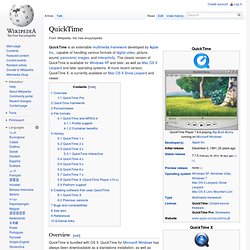
The classic version of QuickTime is available for Windows XP and later, as well as Mac OS X Leopard and later operating systems. A more recent version, QuickTime X, is currently available on Mac OS X Snow Leopard and newer. Overview[edit] QuickTime is bundled with OS X. QuickTime for Microsoft Windows has always been downloadable as a standalone installation, as well as being bundled with Apple's iTunes (prior to iTunes 10.5).
Software development kits (SDKs) for QuickTime are available to the public with an Apple Developer Connection (ADC) subscription. It is available free of charge for both OS X and Windows operating systems. QuickTime Pro[edit] QuickTime Player 7 is limited to only basic playback operations unless a QuickTime Pro license key is purchased from Apple. Mac OS X Snow Leopard includes QuickTime X. Internet Archive.