
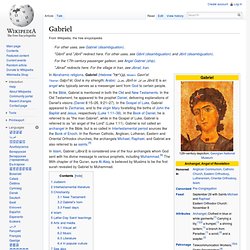
Gabriel. In Abrahamic religions, Gabriel (Hebrew: גַּבְרִיאֵל, Modern Gavri'el Tiberian Gaḇrîʼēl, God is my strength; Arabic: جبريل, Jibrīl or جبرائيل Jibrāʾīl) is an angel who typically serves as a messenger sent from God to certain people.
In Islam, Gabriel (Jibra'il) is considered one of the four archangels whom God sent with his divine message to various prophets, including Muhammad.[6] The 96th chapter of the Quran, sura Al-Alaq, is believed by Muslims to be the first surah revealed by Gabriel to Muhammad. Judaism[edit] Gabriel is interpreted by the Rabbanim to be the "man in linen" in the Book of Daniel and the Book of Ezekiel. In the Book of Daniel, he is responsible for interpreting Daniel's visions. Gabriel's main function in Daniel is that of revealer, a role he continues in later literature.[7] In the Book of Ezekiel, Gabriel is understood to be the angel that was sent to destroy Jerusalem. Uriel. Uriel (אוּרִיאֵל "El/God is my light", Auriel/Oriel (God is my light) Standard Hebrew Uriʾel, Tiberian Hebrew ʾÛrîʾēl) is one of the archangels of post-Exilic Rabbinic tradition, and also of certain Christian traditions.
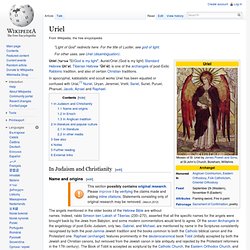
In Judaism and Christianity[edit] Name and origins[edit] Uriel is often identified as a cherub and angel of repentance.[4] He "stands at the Gate of Eden with a fiery sword",[5] or as the angel who "watches over thunder and terror".[6] In the Apocalypse of Peter he appears as the Angel of Repentance, who is graphically represented as being as pitiless as any demon.
In the Life of Adam and Eve, Uriel is regarded as the spirit (i.e., one of the cherubs) of the third chapter of Genesis. He is also identified as one of the angels who helped bury Adam and Abel in Paradise. He checked the doors of Egypt for lamb's blood during the plague. In Thomas Heywood's Hierarchy of Blessed Angels (1635), Uriel is described as an Angel of the Earth. Michael. Michael ("who is like God?
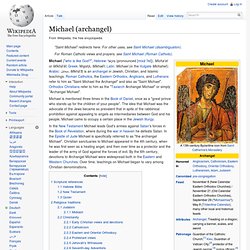
", Hebrew: מִיכָאֵל (pronounced [mixåˈʔel]), Micha'el or Mîkhā'ēl; Greek: Μιχαήλ, Mikhaḗl; Latin: Michael (in the Vulgate Michahel); Arabic: ميخائيل, Mīkhā'īl) is an archangel in Jewish, Christian, and Islamic teachings. Roman Catholics, the Eastern Orthodox, Anglicans, and Lutherans refer to him as "Saint Michael the Archangel" and also as "Saint Michael". Orthodox Christians refer to him as the "Taxiarch Archangel Michael" or simply "Archangel Michael".
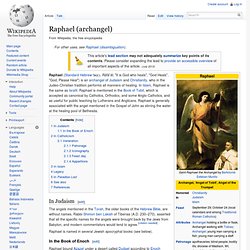
Michael is mentioned three times in the Book of Daniel, once as a "great prince who stands up for the children of your people". The idea that Michael was the advocate of the Jews became so prevalent that in spite of the rabbinical prohibition against appealing to angels as intermediaries between God and his people, Michael came to occupy a certain place in the Jewish liturgy. "At that time Michael, the great prince who protects your people, will arise. " "...there was war in heaven. Raphael. Raphael (Standard Hebrew רָפָאֵל, Rāfāʾēl, "It is God who heals", "God Heals", "God, Please Heal") is an archangel of Judaism and Christianity, who in the Judeo-Christian tradition performs all manners of healing.
In Islam, Raphael is the same as Israfil. Raphael is mentioned in the Book of Tobit, which is accepted as canonical by Catholics, Orthodox, and some Anglo-Catholics, and as useful for public teaching by Lutherans and Anglicans. Raphael is generally associated with the angel mentioned in the Gospel of John as stirring the water at the healing pool of Bethesda. The angels mentioned in the Torah, the older books of the Hebrew Bible, are without names.
Rabbi Shimon ben Lakish of Tiberias (A.D. 230–270), asserted that all the specific names for the angels were brought back by the Jews from Babylon, and modern commentators would tend to agree. Raphael is named in several Jewish apocryphal books (see below). Raphael bound Azazel under a desert called Dudael according to Enoch 10:4–6: