
Imperial Affront. It is apparent that the nation of Ecuador will now be in the frame for what American foreign policy elites like to call, in their dainty and delicate language, “the path of action.”
Ecuador granted political asylum to Julian Assange on Thursday for one reason only: the very real possibility that he would be “rendered” to the United States for condign punishment, including the possibility of execution. None of the freedom-loving democracies involved in the negotiations over his fate — Britain, Sweden, and the United States — could guarantee that this would not happen … even though Assange has not been charged with any crime under U.S. law. [And even though the sexual misconduct allegations he faces in Sweden would not be crimes under U.S. or UK law.] Www.fas.org/sgp/crs/row/RS21238.pdf. The Three Stooges Now Want Military Intervention in Syria. The Price of Screwing With America. Agent orange on okinawa - jon mitchell. U.S. Blocks Entry for Pakistani Lawyer, Outspoken Critic of Drone Attacks.
The U.S. government is preventing a Pakistani lawyer and outspoken critic of drone attacks from entering the country. Rights groups say the move further silences the U.S. drone program's impact on civilians across the world. The lawyer, Shahzad Akbar, has been invited to speak at the International Drone Summit this month organized by CODEPINK and the legal advocacy organizations Reprieve and the Center for Constitutional Rights.
But Akbar has not received the necessary visa nor any information regarding his application for the visa filed in May 2011. Shahzad Akbar: “The CIA, which operates the drones in Pakistan, does not want anyone challenging their killing spree. The "NGOs" that spooked Egypt - Egypt. Cairo and Washington breathed a sigh of relief last month when Secretary of State Hillary Clinton approved military aid to Egypt.
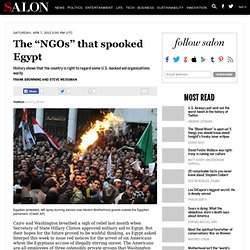
But their hopes for the future proved to be wishful thinking, as Egypt asked Interpol this week to issue red notices for the arrest of six Americans whom the Egyptians accuse of illegally stirring unrest. The Americans are all employees of three ostensibly private groups that Washington funds “to promote democracy” in Egypt and other countries. The State Department paid as much as $5 million in bail for the defendants, all of whom had to pledge to return for subsequent court proceedings.
On This Day: March 29. Updated March 29, 2014, 8:54 am Go to Index » On March 29, 1973, the last United States troops left South Vietnam, ending America's direct military involvement in the Vietnam War.
Go to article » On March 29, 1867, Cy Young, American professional baseball player, was born. Polish Ex-Official Charged With Aiding C.I.A. The daily newspaper Gazeta Wyborcza reported that the former intelligence chief, Zbigniew Siemiatkowski, told the paper that he faced charges of violating international law by “unlawfully depriving prisoners of their liberty,” in connection with the secret C.I.A. prison where Qaeda suspects were subjected to brutal .
When President Obama took office in 2009, he said he wanted to “look forward, as opposed to looking backward” and rejected calls for a broad investigation of and other Bush administration counterterrorism programs. In sharp contrast, the Poles see the case as a crucial test for rule of law and the investigation by prosecutors here has reached the highest levels of Polish politics. One of Poland’s prime ministers during the period when terrorism suspects were alleged to have been subjected to torture in Poland, Leszek Miller, could be charged before Poland’s State Tribunal, the newspaper said. The effect, Mr. Bodnar said, is not simply a matter of looking back, as Mr.
Mr. Listening Post – The dangers of reporting the ‘war on terror’ Why Is It Hard to Believe President Obama Would Want a Journalist in Prison? Jeremy Scahill's piece at the Nation website ("Why Is President Obama Keeping a Journalist in Prison in Yemen?
," 3/13/12) about imprisoned Yemeni journalist Abdulelah Haider Shaye is riveting and deeply reported. But to Mother Jones blogger Kevin Drum, the story doesn't quite add up…because Barack Obama seems like a decent guy. As Scahill reports, Shaye has "risked his life to travel to areas controlled by Al-Qaeda and to interview its leaders. " He argues that this reporting has not exactly won him friends in the U.S. or Yemeni governments: His collision course with the U.S. government appears to have been set in December 2009. Shaye was subsequently arrested and likely tortured by Yemeni authorities, who charged and convicted him on terrorism charges. Enter Barack Obama, who "expressed concern" over Shaye's release. Yemeni journalists, human rights activists and lawyers have said he remains in jail at the request of the White House.
Seems pretty straightforward. He adds: Democracy Now on the imprisoned Yemeni journalist - Glenn Greenwald. It’s very rare that I write primarily for the purpose of posting a video, but I’m going to make an exception today for this truly compelling, must-watch Democracy Now segment on the Jeremy Scahill article about imprisoned Yemeni journalist Abdulelah Haider Shaye which I wrote about yesterday.
This is political television as good as it gets: it not only has an in-depth discussion of Obama’s central role in Shaye’s imprisonment with Scahill and Mohamed Abdel Dayem of the Committee to Protect Journalists, but it also contains substantial video footage of the interviews in Yemen which Scahill conducted to write this story. I’m posting this segment below because I don’t think there’s anything I can write today that will be a better use of your time than this: if you can find 30 minutes or so to watch this segment, I assure you it will be time very well spent.
UPDATE: Drum’s Mother Jones colleague, Adam Serwer, has an excellent reply to Drum: Jeremy Scahill: Why is President Obama Keeping Yemeni Journalist Abdulelah Haider Shaye in Prison? This is a rush transcript.
Copy may not be in its final form. JUAN GONZALEZ: We’re going to turn now to Yemen. The Obama administration is coming under new scrutiny this week for its role in the imprisonment of a prominent Yemeni journalist who helped expose how the United States was behind a 2009 bombing in Yemen that killed 14 women and 21 children. In January 2011, a Yemeni state security court gave the journalist, Abdulelah Haider Shaye, a five-year jail sentence on terrorism-related charges following a disputed trial that was condemned by several human rights and press freedom groups.
Six Ways the Media Has Misreported Syria. As in the case of Libya, from NY Times to Fox News, from Guardian to National Post and from Le Monde to Le Figaro, the Western mainstream media’s coverage of the Syrian conflict has been mostly simplistic and black & white with a Hollywoodian good (opposition) and evil (Syrian government) story.
The basic storyline reported is: “The dictatorial Syrian government is torturing and killing Syrian protestors and civilians including women and children and that the Western counties and the Arab League want to protect these Syrian civilians”. These outlets use any information that supports their stance regardless of its source and quality, and dismiss or ignore any information that brings it to question. The bloody suppression of protestors by the Syrian government and also instability resulting from the armed insurgency aggravated by a complex set of foreign forces, each with its own set of vested interests, have resulted in significant suffering for the people of Syria. “Mistakes Were Made”: One-Time Object of Derision Now a Core Template of Our Social Behaviors. Though I was fairly young at the time, I will always remember the moment in the Spring of 1973 when Nixon’s Press Secretary, Ron Ziegler, tried to explain away his and his bosses previous lies about the fast-progressing Watergate scandal with the words, “mistakes were made”.
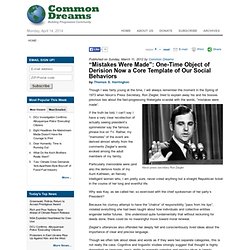
Nixon press secretary Ron Ziegler If the truth be told, I can’t say I have a very clear recollection of actually seeing president’s spinmeister say the famous phrase live on TV. Rather, my “memories” of the event are derived almost wholly from the comments Ziegler’s words evoked among the adult members of my family. Particularly memorable were (and are) the derisive hoots of my Aunt Kathleen, an fiercely intelligent women who, I am pretty sure, never voted anything but a straight Republican ticket in the course of her long and eventful life.
Why was Kay, as we called her, so exercised with the chief spokesman of her party’s President? Why Is President Obama Keeping a Journalist in Prison in Yemen? Abdulelah Haider Shaye.
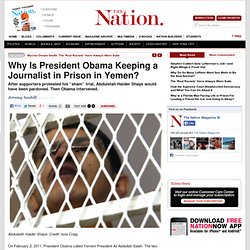
Credit: Iona Craig. On February 2, 2011, President Obama called Yemeni President Ali Abdullah Saleh. White House Releases Death Of Bin Laden Trailer. Arab Center for Research and Policy Studies publishes the preliminary findings of the Arab Opinion Index report. Unintended irony from the NYT. Imperial Death Mongers. So much for Pax Americana. We’ve had endless war as long as memory serves and now the big one: Iran and possibly World War 3. With Vladimir Putin’s decisive victory in Russia, the west had best heed Putin’s dire warnings concerning further escalation of the imperial aggression on Russia’s southern borders.
America and the imperialism of ignorance. Drone Strikes? What’s To Feel Bad About? “Three major investigations were under way on Wednesday into the Koran burning at Bagram Air Base by the American military last week, the event that plunged Afghanistan into days of deadly protests…” So begins a New York Times report. How Empires Fall (Including the American One) March 1, 2012 | Like this article? Join our email list: Stay up to date with the latest headlines via email. To stay on top of important articles like these, sign up to receive the latest updates from TomDispatch.com here. The Glorification of Our Secret Killers. American Decline in Perspective. The Predator Class (Part One) The Predator Class (Part Two)
Message Machine - Behind TV Analysts, Pentagon’s Hidden Hand - Series.