
Han Dynasty. Etymology According to the Records of the Grand Historian, after the collapse of the Qin Dynasty the hegemon Xiang Yu appointed Liu Bang as prince of the small fief of Hanzhong.
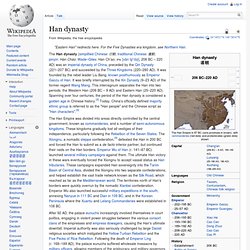
Following Liu Bang's victory in the Chu–Han Contention, the resulting Han dynasty was named after the Hanzhong fief.[6] History Western Han. China: Let them drink wine. Please support our site by enabling javascript to view ads.
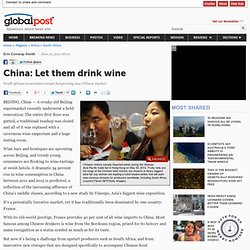
BEIJING, China — A creaky old Beijing supermarket recently underwent a bold renovation: The entire first floor was gutted, a traditional teashop was closed and all of it was replaced with a cavernous wine emporium and a huge tasting room. Wine bars and boutiques are sprouting across Beijing, and trendy young consumers are flocking to wine-tastings at swish hotels. Human Rights Record of United States in 2011. Shenlong ‘Divine Dragon’ Takes Flight: Is China developing its first spaceplane? Access full text reports, backup data, and more.
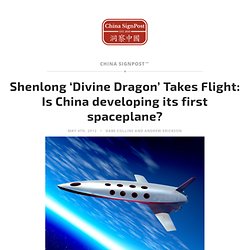
The age of the spaceplane upon us, and it is trans-Pacific, with the U.S. and China the only current active participants. Winged spaceplanes operate as spacecraft in space and aircraft in Earth’s atmosphere, and typically land on runways. They range from hypersonic cruise vehicles (HCV) capable of maneuvering at Mach 5 (3,840+ mph/6,150+ kmh) or more to reusable launch vehicles (RLV)s like the Space Shuttle designed primarily to ferry cargo to orbit and back. Defense Advanced Research Projects Agency (DARPA) has just released details on the 11 August 2011 test flight of the Force Application and Launch from the Continental U.S. (FALCON) Hypersonic Technology Vehicle 2 (HTV-2). - StumbleUpon. China’s Unique Economic Model Gets New Scrutiny.
Gilles Sabrie for The New York Times Central Chongqing this month.

The city has grown fast, fueled by infrastructure projects led by its now-ousted leader, Bo Xilai. But now, with the recent political upheavals, and a growing number of influential voices demanding a resurrection of freer economic policies, it appears that the sense of triumphalism was, at best, premature, and perhaps seriously misguided. Chinese leaders are grappling with a range of uncertainties, from the once-a-decade leadership transition this year that has been marred by a seismic political scandal, to a slowdown of growth in an economy in which deeply entrenched state-owned enterprises and their political patrons have hobbled market forces and private entrepreneurship.
On Thursday, China released data that showed its economy was continuing to weaken. Such changes would curb the state’s role, lessen corruption and encourage competition. We're Number ... 2? Are Americans in Denial About the Country's Decline? May 1, 2012 | Like this article? Join our email list: Stay up to date with the latest headlines via email. Politicians in the United States must ritualistically assert that the United States is and always will be the world's leading economic, military and political power.
This chant may help win elections in a country where respectable people deny global warming and evolution, but it has nothing to do with the real world. China’s Economy. Behind the political crisis that saw the recent fall of powerful Communist Party leader Bo Xiali is an internal battle over how to handle China’s slowing economy and growing income disparity, while shifting from a cheap labor export driven model to one built around internal consumption. China’s military rise: The dragon’s new teeth. AT A meeting of South-East Asian nations in 2010, China's foreign minister Yang Jiechi, facing a barrage of complaints about his country's behaviour in the region, blurted out the sort of thing polite leaders usually prefer to leave unsaid.
“China is a big country,” he pointed out, “and other countries are small countries and that is just a fact.” Indeed it is, and China is big not merely in terms of territory and population, but also military might. Its Communist Party is presiding over the world's largest military build-up. China’s Footage Of Its New Fighter Jet Revealed To Be Dubbed From ‘Top Gun’ The Chinese-African Union - An FP Slide Show. A Pragmatic Princeling Next In Line To Lead China. Hide captionChinese Vice President Xi Jinping, shown here in December 2011 waving to students during a visit to Bangkok, Thailand, is in line to become China's leader next year.
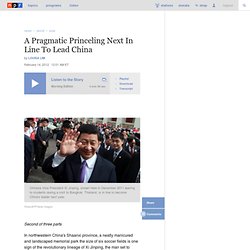
Pairoj/AFP/Getty Images Chinese Vice President Xi Jinping, shown here in December 2011 waving to students during a visit to Bangkok, Thailand, is in line to become China's leader next year. Second of three parts In northwestern China's Shaanxi province, a neatly manicured and landscaped memorial park the size of six soccer fields is one sign of the revolutionary lineage of Xi Jinping, the man set to become China's next leader. China Law Blog : China Law for Business - StumbleUpon.
How China Actually Gets the Internet to Censor Itself. The Most Censored Words On The Chinese Internet. Big Romney is watching you. The New York Times reported today that Bain Capital, the private equity firm started by GOP presidential candidate Mitt Romney, owns a Chinese company, Uniview, that supplies highly advanced surveillance equipment to the Chinese government.
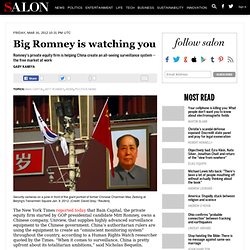
China’s authoritarian rulers are using the equipment to create an “omniscient monitoring system” throughout the country, according to a Human Rights Watch researcher quoted by the Times. “When it comes to surveillance, China is pretty upfront about its totalitarian ambitions,” said Nicholas Bequelin. China Steps Up in Syria. The conventional picture of US policy in the Middle East is of a hellbound train rushing toward war with Iran, pulling burning coaches filled with European passengers howling praise of Western values out the windows at horrified bystanders.
Actually, I think it’s more like a monster truck exhibition.