
Methuselahâs Children by Robert Heinlein : Robert Heinlein. <div style="padding:5px; font-size:80%; width:300px; background-color:white; margin-left:auto; margin-right:auto; border:1px dashed gray;"> Internet Archive's<!

--'--> in-browser audio player requires JavaScript to be enabled. It appears your browser does not have it turned on. Please see your browser settings for this feature. Brandon Sanderson: Sanderson's Second Law. A few years back, I wrote an essay on creating magic systems that I titled Sanderson’s First Law.
It had to do with the nature of foreshadowing as it relates to solving problems with magic. In that essay, I implied that I had other “laws” for magic systems that I’d someday talk about. Well, that time has come, as I’ve finally distilled my thoughts for the second law into an explanation that will work. I’ll start, however, by noting that none of these “laws” are absolute. Nor am I the only one to talk about them. These work for me. The Law. Brandon Sanderson: Sanderson's First Law. Introduction I like magic systems.
That’s probably evident to those of you who have read my work. A solid, interesting and innovative system of magic in a book is something that really appeals to me. True, characters are what make a story narratively powerful—but magic is a large part of what makes the fantasy genre distinctive. For a while now, I’ve been working on various theories regarding magic systems. I’d like to approach the concept of magic in several different essays, each detailing one of the ‘laws’ I’ve developed to explain what I think makes good magic systems. The Law. Dracula by Bram Stoker.
By: Bram Stoker (1847-1912) Bram Stoker did not invent the vampire story, but he popularized it with his classic 1897 novel.

In form Dracula is an epistolary novel, told through a series of journal entries, letters, newspaper articles, and telegrams. It begins with lawyer Jonathan Harker's perilous journey to Castle Dracula in Transylvania, and chronicles the vampire's invasion of England, where he preys upon the lovely Lucy Westenra and Harker's fiancee, Mina. Xa.yimg.com/kq/groups/23234416/960677031/name/franz__1997__-_archetypal_patterns_in_fairy_tales.pdf. Www.mlook.mobi/files/month_1203/80e49eb29e78d387d11eb2927ebb8b0dff842941.pdf. Old.fantasy.ir/files/public/bradbury_ray__the_martian_chronicles.pdf. Online Reader. Mosses From An Old Manse, by Nathaniel Hawthorne. The Online Literature Library. SurLaLune Fairy Tales: Annotated Fairy Tales, Fairy Tale Books and Illustrations.
Apotheosis. Apotheosis (from Greek ἀποθέωσις from ἀποθεοῦν, apotheoun "to deify"; in Latin deificatio "making divine"; also called divinization and deification) is the glorification of a subject to divine level.
The term has meanings in theology, where it refers to a belief, and in art, where it refers to a genre. In theology, the term apotheosis refers to the idea that an individual has been raised to godlike stature. In art, the term refers to the treatment of any subject (a figure, group, locale, motif, convention or melody) in a particularly grand or exalted manner. Antiquity[edit] Prior to the Hellenistic period, imperial cults were known in Ancient Egypt (pharaohs) and Mesopotamia (since Naram-Sin). Ancient Greece[edit] From at least the Geometric period of the ninth century BC, the long-deceased heroes linked with founding myths of Greek sites were accorded chthonic rites in their heroon, or "hero-temple".
Ancient Rome[edit] Ancient China[edit] Southeast Asia[edit] Christianity[edit] Generally[edit] H. G. Wells: free web books, online. H.G. Wells. H.

G. Wells (1866-1946), English author, futurist, essayist, historian, socialist, and teacher wrote The War of the Worlds (1898); Yet across the gulf of space, minds that are to our minds as ours are to those of the beasts that perish, intellects vast and cool and unsympathetic, regarded this earth with envious eyes, and slowly and surely drew their plans against us. And early in the twentieth century came the great disillusionment. —Ch. 1. The invasion of earth by aliens from Mars, tripods attacking with Heat Rays and Black Smoke and the evacuation of London while people were terrorised in the surrounding countryside became one of the first internationally read modern science fiction stories.
A Princess of Mars by Edgar Rice Burroughs. Herland, by Charlotte Perkins Gilman. Alice in Wonderland, by Lewis Carroll. Through the Looking Glass, by Lewis Carroll. Dracula, by Bram Stoker. The Project Gutenberg eBook of Household Stories, by Grimm. Brothers Grimm: Fairy Tales, History, Facts, and More. The real Brothers Grimm were stranger than fiction. Head over to Google's homepage on Thursday and you'll enjoy a scrollable comic strip telling the story of Little Red Riding Hood.
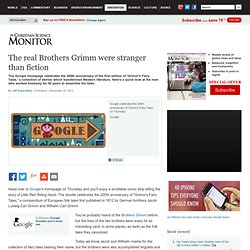
The doodle celebrates the 200th anniversary of "Grimm's Fairy Tales," a compendium of European folk tales first published in 1812 by German brothers Jacob Ludwig Carl Grimm and Wilhelm Carl Grimm. Skip to next paragraph Subscribe Today to the Monitor Click Here for your FREE 30 DAYS ofThe Christian Science MonitorWeekly Digital Edition You've probably heard of the Brothers Grimm before, but the lives of the two brothers were every bit as interesting (and, in some places, as dark) as the folk tales they canonized. Today we know Jacob and Wilhelm mainly for the collection of fairy tales bearing their name, but the brothers were also accomplished linguists and historians.