
Langage interprété. Un article de Wikipédia, l'encyclopédie libre.

Un interpréteur se distingue d’un compilateur par le fait que, pour exécuter un programme, les opérations d’analyse et de traductions sont réalisées à chaque exécution du programme (par un interpréteur) plutôt qu’une fois pour toutes (par un compilateur). L'interprétation repose sur l'exécution dynamique du programme par un autre programme (l'interprète), plutôt que sur sa conversion en un autre langage (par exemple le langage machine) ; elle évite la séparation du temps de conversion et du temps d'exécution, qui sont simultanés. Table des symboles. ANTLR 3.x Tutorial - Scott Stanchfield. Many folks have asked me to convert my ANTLR 2.x tutorial to ANTLR 3.x.

I started doing it and got reaaaaaaaaaalllly tired of typing. Being a bear of very little patience, I decided to go a different route, one which I think will prove even more effective. Go laziness! This version of the tutorial is video-based. Using Camtasia Studio (the best screen/video capture software in the world!) Note: I'm adding more videos as I get time. RSS feed to be notified. Videos I've uploaded the following videos to vimeo. Vimeo video group: Video License ANTLR 3.x Tutorial by Scott Stanchfield is licensed under a Creative Commons Attribution-Noncommercial-No Derivative Works 3.0 United States License. Feel free to watch the videos and point friends to them, but you cannot use them as part of any commercial product nor can you create derivative works. Concepts - What I should have recorded first but forgot until I was 6 steps in... Concepts: What is ANTLR, Lexing, Parsing, Trees etc - Compiler Basics. © James Alan Farrell, August 1995 This paper may be copied and distributed for non-profit educational purposes only.
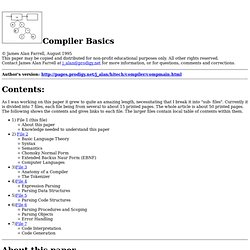
All other rights reserved. Contact James Alan Farrell at j_alan@prodigy.net for more information, or for questions, comments and corrections. Author's version: As I was working on this paper it grew to quite an amazing length, necessitating that I break it into "sub- files". Currently it is divided into 7 files, each file being from several to about 15 printed pages. This paper is intended to give an overview of basic compiler theory. I'm sure some Pascal purists, especially those who have worked on Pascal compilers, will find inaccuracies in this paper, especially in the section on parsing if statements, and generating stack frames for recursive block structured procedures.
Create a Language Compiler for the .NET Framework Using C# Roll Your Own Create a Language Compiler for the .NET Framework Joel Pobar Code download available at:CompilerWriting2008_02.exe(158 KB) Compiler hackers are celebrities in the world of computer science. I've seen Anders Hejlsberg deliver a presentation at the Professional Developers Conference and then walk off stage to a herd of men and women asking him to sign books and pose for photographs. There are hundreds of compilers for dozens of languages that target the .NET Framework. In this article, I will walk you through the code for a compiler written in C# (aptly called the "Good for Nothing" compiler), and along the way I will introduce you to the high-level architecture, theory, and .NET Framework APIs that are required to build your own .NET compiler.
Language Definition Software languages begin with a specific purpose. Once you've stated the purpose, you can design the language—think of this as the blueprint for the language. Language agnostic - Learning to Write a Compiler. Make Your Own Programming Language, Part 0. This is the intro to a 5-part tutorial on how to implement a programming language.

It is intended for people with some programming experience, who want to know how their compiler, interpreter or virtual machine works. Tutorial: Metacompilers Part 1. James M.

NeighborsJames.Neighbors@BayfrontTechnologies.com Bayfront Technologies, Inc. August 20, 2008 Tutorial in PDF Table of Contents. Let's Build a Compiler. How Many Passes? - Fabulous Adventures In Coding. Large bodies of code written in the C/C++ languages typically divide up the code into “header” files, which are just declarations of methods and types (and definitions of macros).

The actual bodies of those methods and types are in completely different files. People sometimes ask me why doesn’t C# need header files? Which is a bit of an odd way to phrase the question; I would have asked the equivalent question why does C++ need header files? Header files seem like a huge potential point of failure; all the time I edit C++ code and change the signature of a method; if I forget to update the header file, then the code doesn’t compile and often gives some cryptic error message. Hopefully this large cost actually buys you something. It buys the compiler writer one thing, and the user one thing. What it buys the user is that you can compile each individual “cpp” file into a “obj” file independently, provided that you have all the necessary headers.
The first “metadata” phase goes like this: Architecture - How do I create my own programming language and a compiler for it.