
Server-side scripting. Dynamic web page: example of server-side scripting (PHP and MySQL).
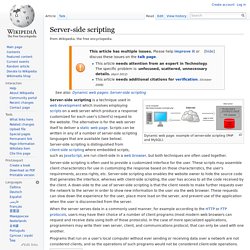
Server-side scripting is a technique used in web development which involves employing scripts on a web server which produce a response customized for each user's (client's) request to the website. The alternative is for the web server itself to deliver a static web page. Scripts can be written in any of a number of server-side scripting languages that are available (see below). Server-side scripting is distinguished from client-side scripting where embedded scripts, such as JavaScript, are run client-side in a web browser, but both techniques are often used together. Server-side scripting is often used to provide a customized interface for the user. Programs that run on a user's local computer without ever sending or receiving data over a network are not considered clients, and so the operations of such programs would not be considered client-side operations.
History[edit] Explanation[edit] Languages[edit] See also[edit]
SCRIBE. ELGG. Lovd By Less. Pligg. How Social Networking Works. January 07, 2010, 12:54 PM — I'm on a social network; you're on a social network, these days it seems we're all on at least one social network--like Facebook, Twitter, etc. etc--if not two, three, or even more.

To be exact, the Pew Internet & American Life Project’s December 2008 tracking survey found that 35% of adult internet users now have a profile on an online social network site. If you're a teenager, the numbers jump to 65%, but, it's the young adults who really are behind the social networks. 75% of them belong to at least one social network. Since then, the social networks have only continued to grow at an explosive rate. How do the social networks manage millions of users and hundreds of millions of updates? The answers lie in open-source software and thousands of servers. The first thing that jumps out at you is that they're almost all based on open-source software. The story is the same when it comes to Web servers. That's changing over time though. A Code of Their Own.
Nine Ways to Build Your Own Social Network. The news may overflow with stories about the social networking giants, such as Facebook and MySpace, but a horde of companies are doing their best to reduce the fundamental features of these websites to mere commodities.

These up-and-coming companies provide so-called “white label” social networking platforms that enable their customers to build their own social networks (often from scratch) and to tailor those networks to a range of purposes. The idea of white labeling a network is to make the platform provider as invisible as possible to the social network’s users and to brand the network with the builder’s identity or intent. While definitions of “social networking” may vary, social networks are primarily defined by member profiles and some sort of user generated content. There are roughly three types of companies that have emerged in the space of white label social networking.
More details on each are below. Ning KickApps KickApps’s advertising scheme is particularly unique. CrowdVine.