
How to Teach Commands to First Year Spanish Language Students. Written by: Heather Marie Kosur • edited by: Rebecca Scudder • updated: 3/2/2012 The following article describes a first year Spanish lesson plan for teaching basic commands in Spanish and includes examples to illustrate the Spanish imperative verb form. An optional refresher on the imperative mood in English is provided. Imperative Mood Lesson PlanThe following lesson plan can be used by Spanish teachers to introduce the imperative mood to English-speaking Spanish students. The first part introduces the imperative to students by explaining the use of the verb form in English. The second part describes how to form the imperative in Spanish and includes charts for each verb type and useful tips.The Imperative Mood in EnglishUse as much or little of this section for your students as you think the class needs.
Spanish. Spanish Pronouns. A Pronoun in Spanish as well as in English is like a shortcut to refer to a noun, a word that stands for or represents a noun or noun phrase, a pronoun is identified only in the context of the sentence in which they are used.
So you must have a prior idea about who "he or she" "él or ella" is. In English we find "me, her, what, that, his", In Spanish they're used pretty much the same way, the main difference is that in Spanish most pronouns have a gender, masculine or feminine and rarely neuter to unknown objects or ideas. Types of pronouns include personal pronouns (refer to the persons speaking, the persons spoken to, or the persons or things spoken about), indefinite pronouns, relative pronouns (connect parts of sentences) and reciprocal or reflexive pronouns (in which the object of a verb is being acted on by verb's subject).
Basic Spanish Exercises (with answers) Learn Spanish & Phrases & Vocabulary & Bars - StumbleUpon. Free Spanish exercises - TODO-CLARO.COM. Spanish Verb Conjugation Activities. Spanish Numbers - StumbleUpon. Home / Grammar / Topic Notes: The written lesson is below.Links to quizzes, tests, etc. are to the left.
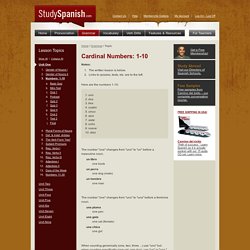
Here are the numbers 1-10: 1. uno 2. dos 3. tres 4. cuatro 5. cinco 6. seis 7. siete 8. ocho 9. nueve 10. diez.