
Design for the Mind. Have you ever stopped to wonder why much of the general guidance on access, seems to extend not much further than a brief mention of way-finding when access relates to people with neurological needs, and wondered whether there was more to the subject?
Yes there is more to the subject but, one usually has to hunt for it. Dementia Services Development Centre and the National Autistic Society are amongst those who have developed understanding of the subject but this isn’t general knowledge. Article Archive. CMYK Selected Color Codes. How to Deal with Images on the Web - Web Design Usability Guide. They say a picture is worth a thousand words.
True or not, images are an important part of any website we create. Since it is so easy to embed an image in a website (even the process of creating your own images is very easy), most websites are filled with them. There are some very good examples out there on how to deal with images in a website from different points of view, but most of the websites do not showcase positive examples. And while this is not entirely dangerous for a design, it might decrease your chances to sell, in case you have a call-to-action page, or the chances to create good reading flow. It is more a matter of details than a matter of important principles, but dealing with images should be something designers understand and apply better. Jakob Nielsen, the expert in webpage usability, together with his company NN/g, did an eye tracking study and concluded it with an article posted on their site, titled Photos as Web Content.
Quality and relevance. 10 Awesome Infographics for Graphic Designers. As a graphic designer, you’ve probably designed at least a few infographics for your clients – or even for fun.
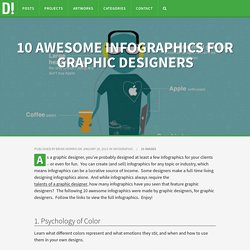
You can create (and sell) infographics for any topic or industry, which means infographics can be a lucrative source of income. Some designers make a full-time living designing infographics alone. And while infographics always require the talents of a graphic designer, how many infographics have you seen that feature graphic designers? The following 10 awesome infographics were made by graphic designers, for graphic designers. Follow the links to view the full infographics. Five Manifestos for the Creative Life. Arta prelucrarii lemnului. Assumption reversal : Creative Choices. The big idea Assumption reversal was developed by Stephen Grossman, a creativity consultant who wanted to find a way to overcome the paradoxes that are often inherent in many problems.
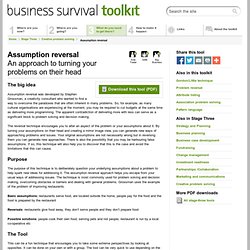
So, for example, as many cultural organisations are experiencing at the moment, you may be required to cut budgets at the same time as delivering more programming. The apparent contradiction of delivering more with less can serve as a significant block to problem solving and decision making. The reversal technique encourages you to alter an aspect of the problem or your assumptions about it. By turning your assumptions on their head and creating a mirror image view, you can generate new ways of approaching problems and issues. Purpose The purpose of this technique is to deliberately question your underlying assumptions about a problem to help spark new ideas for addressing it. Reversals: restaurants give food away, they don’t serve people and they don’t prepare food The Tool. Conceptual Conversations For Creative Ideas. 15 TED Talks Every Web Designer Should Watch. 507 Shares Share Tweet Share Pin It Share Design inspiration can come from almost anywhere.
Designing type systems. I remember a conversation from back in my student days where my typophile friends and I debated what the ultimate typeface of the twentieth century was, a typeface that summed up all of the era’s advancements and knowledge into a coherent whole, one that would be a reference for years to come.
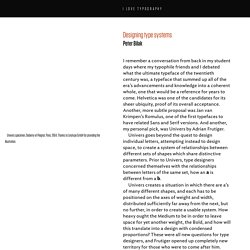
Helvetica was one of the candidates for its sheer ubiquity, proof of its overall acceptance. Another, more subtle proposal was Jan van Krimpen’s Romulus, one of the first typefaces to have related Sans and Serif versions. Simple Design Solutions: Learn a Thing or Two from IKEA - Designer Blog Designer Blog. Design is about thinking on your feet — coming up with simple design solutions to problems that are often very complicated.
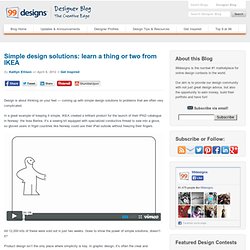
In a great example of keeping it simple, IKEA created a brilliant product for the launch of their iPAD catalogue in Norway: the Ikea Beröra. It’s a sewing kit equipped with specialized conductive thread to sew into a glove, so gloved users in frigid countries like Norway could use their iPad outside without freezing their fingers. All 12,000 kits of these were sold out in just two weeks. Goes to show the power of simple solutions, doesn’t it? Product design isn’t the only place where simplicity is key. Irisz & Josz Logo by RotRed. Reader (60) Graphic Design, Referenced by Bryony Gomez-Palacio and Armin Vit. Graphic Design, Referenced is a visual and informational guide to the most commonly referenced terms, historical moments, landmark projects, and influential practitioners in the field of graphic design.
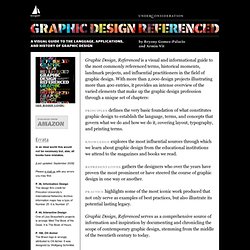
With more than 2,000 design projects illustrating more than 400 entries, it provides an intense overview of the varied elements that make up the graphic design profession through a unique set of chapters: principles defines the very basic foundation of what constitutes graphic design to establish the language, terms, and concepts that govern what we do and how we do it, covering layout, typography, and printing terms. knowledge explores the most influential sources through which we learn about graphic design from the educational institutions we attend to the magazines and books we read. Productivity Future Vision (2011)
How do you build a country brand? You can’t really, but you have to start somewhere.
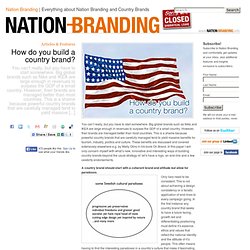
Big global brands such as Nike and IKEA are large enough in revenues to surpass the GDP of a small country. However, their brands are managed better than most countries. This is a shame because powerful country brands that are carefully managed tend to yield massive benefits for tourism, industry, politics and culture. 10 Unmissable TED Videos For Designers. TED (Technology, Entertainment, Design) has been existed since 1984 with the primary objective to spread some really great ideas and experience related with technology, entertainment and design.
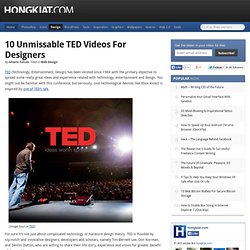
You might not be familiar with this conference, but seriously, cool technological devices like Xbox Kinect is inspired by one of TED’s talk. (Image Source: TED) Color Theory for the Color Blind. Color blindness is a mild disability through which the affected experience a decreased ability to distinguish colors from others. This can be a real drawback for anyone in the design field since color theory is an integral feature in successful design, and a lot of decisions are based on the feeling and emotion derived from design decisions, rather than a generic set of guidelines and taxonomies. You've probably heard a lot about accessibility in web design already; it's important to cater for the widest audience, who could potentially have problems with your website if not designed in the right way.
A Guide to Creating Professional Quality Logo Designs. Logo design is often seen as a quick and easy job; you create a small graphic, stick it next to some text and the job is done! What makes a great product design? From thoughts to reality. The Elements Of Design Part I: Introduction. Last week I walked through some definitions of visual grammar. We talked about objects and structures, both abstract and concrete, as well as activities and relations. Points, Dots, And Lines: The Elements Of Design Part II. When it comes to working with elements in a design we have two basic classes to work with. We have positive forms and negative space. The most basic form we can use is the abstract point or it’s concrete sibling the dot. Forms: Surfaces And Planes, Volumes And Mass: The Elements Of Design Part III. Last week we looked at zero and one dimensional elements, namely the point or dot and the line.
This week we’ll add a couple of dimensions and talk about surfaces and planes (2D) and then move on to volumes (3D). Throughout we’ll consider the ideas of visual mass and weight. Before getting to any of the above I want to start with a discussion of form. Let me apologize in advance for bouncing back and forth between names throughout this post. Form, surface, plane, shape, volume, mass, weight. What is Form? Structures As Patterns and Textures: The Elements Of Design Part IV. Visual Grammar: How To Communicate Without Words. The Meaning Of Shapes: Developing Visual Grammar. The Meaning of Lines: Developing A Visual Grammar. If you moved to another country (where they don’t speak the same language as you), one of the first things you’d probably do is start learning the language. The Inverted Pyramid Of Visual Design. In one second the user should understand generally where they are —largely driven by visuals and functionality.
Design Criticism and the Creative Process. At a project’s start, the possibilities are endless. Symmetry in Design: Concepts, Tips and Examples. Do You Know When To Communicate Verbally And When To Communicate Visually? Is a picture really worth 1,000 words or are there times when a few words communicate more effectively? The truth is each is better at communicating certain concepts than the other. Consider the following the directions. Go north on 30th. If the light at Diagonal is green make a right on the Diagonal, but if the light is red make a right one block earlier on Old Iris, then a left on 34th, and finally a right on 119.
The Principles of Design: For the Web. Good design: Dieter Rams. Printing Techniques. In college in Waterford, Ireland, one of our class projects was called “Techniques.” The brief was to become familiar with every printing technique we could and show them through physical pieces.