
Geometry Gym. Aranda\Lasch. MathSurf v2.0 for 3ds Max. Previous version was a bit slow, there are few items that has fixed in new version to improve the performance: Mesh had being generated several times when you choose a surface type from drop down menu or after editing explicit presentation.

This fact delays the process and force user to wait until viewport redraws. In new version this bug has been fixed and the script runs the process only once. Mathsurf 2.0 makes permanent objects. You can save and load scenes include Mathsuf objects and program will generate objects automatically after a Mathsurf object has been detected. Mathsurf 2.0 gives you opportunity to save explicit presentation in text format as an external file. Algorithm has been improved to run faster. In Mathsurf 2.0 data structure has been changed to conserve the memory and speed up the progress. Mathsurf 2.0 increases the memory using by max-script to avoid halting program.
DS 13. Mathrioshka. Grasshooper component Attractor. Eat-a-bug. Dumo. Organicités Piraeus Tower. Design Reform. In this video, we cover the Spring Force within Kangaroo in a simple case.
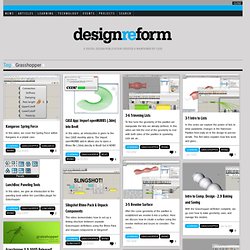
In this video, we give an introduction to the paneling tools within the LunchBox plugin for Grasshopper. ______________________________________________________________________________________________________________________ A new version of Grasshopper has been released. It has been over 6 months since...
In this video, we give an introduction of Kangaroo, a plugin for Grasshopper developed by Daniel Piker. Kangaroo can be downloaded at www.food4rhino.com/project/kangaroo. In this video, the Baking component in the LunchBox plugin is deomonstrated. Grasshopper « Attitude Geometries. Cellular Automata Building Propotional studies of a building facade.
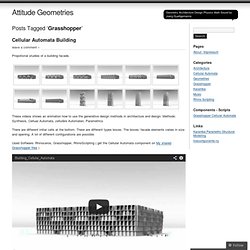
These videos shows an animation how to use the generative design methods in architecture and design. Methods: Synthesis, Celluar Automata, zelluläre Automaten, Parametrics There are different initial cells at the bottom. There are different types boxes. Used Software: Rhinoceros, Grasshopper, RhinoScripting ( get the Cellular Automata component on My shared Grasshopper files ) BFXlog. ModeLab. The disContinuum. MORPHOCODE. ModeLab. MansWorks. Hoopsnake: Iteration in Grasshopper, Volatile Prototypes. Update: Hoopsnake is now Opensource!
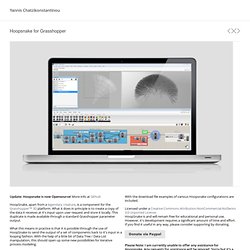
More info at Github HoopSnake, apart from a legendary creature, is a component for the Grasshopper™ 3D platform. What it does in principle is to create a copy of the data it receives at it's input upon user request and store it locally. This duplicate is made available through a standard Grasshopper parameter output. What this means in practice is that it is possible through the use of HoopSnake to send the output of a set of components back to it's input in a looping fashion. The loop can be stopped at any point either by the user or automatically by setting a termination condition (the third input of the component) to false. With the download file examples of various Hoopsnake configurations are included. Licensed under a Creative Commons Attribution-NonCommercial-NoDerivs 3.0 Unported License.
Please Note: I am currently unable to offer any assistance for Hoopsnake. ParaMod.net. Archive » Pneumatic Panels “Revised” [rhinoscript] Toni Österlund an architecture student at University of Oulu (Finland) ,revised my code and made some improvements,the script now supports non planar polygons for creating the cushion cladding system, the problem that the code originally had, was that I used a “planar surface” command to create the primary surface to extract the centroid point ,needed to create the cushion surfaces , these new version instead uses a “patch” command , that makes possible working with non planar polygons, the whole code has also been cleaned up and simplified.
![Archive » Pneumatic Panels “Revised” [rhinoscript]](http://cdn.pearltrees.com/s/pic/th/designplaygrounds-rhinoscript-13079985)
I also included here a simple Grasshopper definition that creates a honeycomb cladding which can be used to create the polygons for the panels, just one of the many tools you can use for design testing and integration into your workflow. Have fun and don´t forget to send your feed back. Peer produced space. Experiments. FANCYWIRES. SketchyGrid » SketchyGrid. Параметрическая архитектура. Grasshopper « un didi. Follow Get every new post delivered to your Inbox.

Join 50 other followers Powered by WordPress.com. MADEinCALIFORNIA ///Co.De. The Geometry of Bending. Computational Design Italy.