
GNU Project. The GNU logo, by Etienne Suvasa The GNU Project i/ɡnuː/[1] is a free software, mass collaboration project, announced on 27 September 1983, by Richard Stallman at MIT.
Its aim is to give computer users freedom and control in their use of their computers and computing devices, by collaboratively developing and providing software that is based on the following freedom rights: users are free to run the software, share it (copy, distribute), study it and modify it. GNU software guarantees these freedom-rights legally (via its license), and is therefore free software; the use of the word "free" always being taken to refer to freedom.
In order to ensure that the entire software of a computer grants its users all freedom rights (use, share, study, modify), even the most fundamental and important part, the operating system (including all its numerous utility programs), needed to be written. Linux. Linux ( History[edit] Antecedents[edit] With AT&T being required to license the operating system's source code to anyone who asked (due to an earlier antitrust case forbidding them from entering the computer business),[23] Unix grew quickly and became widely adopted by academic institutions and businesses.
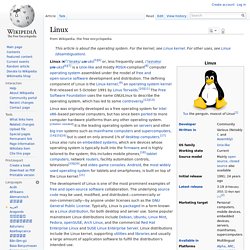
Linux distribution. A Linux distribution (often called distro for short) is an operating system built on top of the Linux kernel and often around a package management system.
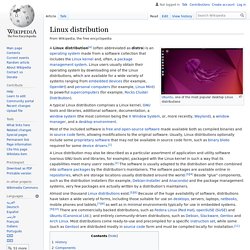
Linux distributions are usually targeted at common hardware like personal computers, but are available for a wide variety of systems up to the most powerful supercomputers (for example, Rocks Cluster Distribution distribution), or down to small embedded systems (for example, OpenWrt distribution). Most distributions come ready to use and pre-compiled for a specific instruction set, while others (such as Gentoo) are distributed in source code form and compiled locally during installation.