
2013 Global 100: The Definitive Corporate Sustainability Benchmark. Conscious Capitalism. Prof.
Raj Sisodia, Founder of the Conscious Capitalism Institute, with publisher Bettina Gordon on the principles of Conscious Capitalism With Passion and Purpose toward Profit Nobel Peace Prize recipient Muhammad Yunus introduced the term to society, now it is on business leaders’ lips around the country: Conscious Capitalism. Bettina Gordon met the founder of the Conscious Capitalism Institute, Prof. Rajendra S. By Bettina M. Prof. Givers take all: The hidden dimension of corporate culture - McKinsey Quarterly - Organization - Talent. After the tragic events of 9/11, a team of Harvard psychologists quietly “invaded” the US intelligence system.
The team, led by Richard Hackman, wanted to determine what makes intelligence units effective. By surveying, interviewing, and observing hundreds of analysts across 64 different intelligence groups, the researchers ranked those units from best to worst. Then they identified what they thought was a comprehensive list of factors that drive a unit’s effectiveness—only to discover, after parsing the data, that the most important factor wasn’t on their list.
Global Impact Investing Network. Measuring Impact Measuring Impact and the Guidelines for Good Impact Practice were developed by the Impact Measurement Working Group of the Social Impact Investment Taskforce established by the UK’S presidency of the G8.
It was co-chaired by the GIIN and New Philanthropy Capital (NPC). GIIN Webinar Series on the Social Impact Investment Taskforce and Working Groups Introducing the Impact Investing Benchmark The GIIN and Cambridge Associates launch the Impact Investing Benchmark, the first comprehensive analysis of the financial performance of market rate private equity and venture capital impact investing funds. New J.P. Thegiin. Leaders-everywhere-cheatsheet. Orange Report - Part 1. Sustainability Indexes - Corporate Sustainability. Corporate Sustainability is a business approach that creates long-term shareholder value by embracing opportunities and managing risks deriving from economic, environmental and social developments.
Corporate sustainability leaders achieve long-term shareholder value by gearing their strategies and management to harness the market's potential for sustainability products and services while at the same time successfully reducing and avoiding sustainability costs and risks. The quality of a company's strategy and management and its performance in dealing with opportunities and risks deriving from economic, environmental and social developments can be quantified and used to identify and select leading companies for investment purposes.
Leading sustainability companies display high levels of competence in addressing global and industry challenges in a variety of areas: Corporate sustainability performance is an investable concept. Sustainability, Innovation and Profits. Sustainia100 2013. The B Team. The Evolution of Social Business: Six Stages of Social Business Transformation. Research Report: The Evolution of Social Business: Six Stages of Social Business Transformation Author: Charlene Li and Brian Solis, with Alan Webber and Jaimy Szymanski Publication Date: March 6, 2013 Webinars: Six Stages of Social Business, with Charlene Li & Brian Solis, June 26, 2013; and The Seven Success Factors of Social Business Strategy, with Charlene Li & Brian Solis, August 15, 2013 Companies are not created equal when it comes to social media maturity.
In this report, Altimeter Group’s Charlene Li and Brian Solis uncovered a distinct gap between organizations that execute social media strategies and those that are truly a “social business.” In fact, Altimeter’s survey of nearly 700 social media professionals and executives found that only 34% of businesses felt that their social strategy was connected to business outcomes. Clearly aligned with strategic business goals of an organizationHas organizational alignment and support that enables execution of that strategy. The Global Transition. The New ABCs of Selling and Persuading. The nature of sales and persuasion is changing, according to author Daniel H.
Pink, and extroversion and aggressiveness aren’t the answers anymore. Pink, whose new book is To Sell is Human: The Surprising Truth about Moving Others, spoke at the closing session of the recent annual conference of the American Society of Association Executives. While his presentation was directed at association professionals in particular, he included a number of insightful ideas and examples of use to fundraisers. Pink began by recalling a scene from the movie Glengarry Glen Ross, where actor Alec Baldwin reminds a group of real estate salesmen that they should follow the ABCs of selling: Always Be Closing. Toward zero unemployment. A dozen generations ago, there was no unemployment, largely because there were no real jobs to speak of.
Value Creation vs. Value Capture. What Would a Down-to-Earth Economy Look Like? How did we end up with Wall Street when models for a healthy economy are all around us?

Posted Jan 17, 2013 With proper care and respect, Earth can provide a high quality of life for all people in perpetuity. Yet we devastate productive lands and waters for a quick profit, a few temporary jobs, or a one-time resource fix. Our current expansion of tar sands oil extraction, deep-sea oil drilling, hydraulic fracturing natural gas extraction, and mountaintop-removal coal mining are but examples of this insanity. These highly profitable choices deepen our economic dependence on rapidly diminishing, nonrenewable fossil-energy reserves, disrupt the generative capacity of Earth’s living systems, and accelerate climate disruption. A global economy dependent on this nonsense is already failing and its ultimate collapse is only a matter of time. Our Original Instructions Some indigenous people speak of the “original instructions.”
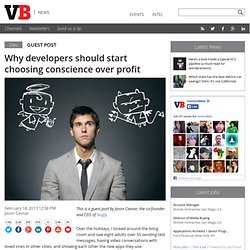
So how would nature design an economy? Why developers should start choosing conscience over profit. This is a guest post by Jason Cavnar, the co-founder and CEO of Singly.
Over the holidays, I looked around the living room and saw eight adults over 55 sending text messages, having video conversations with loved ones in other cities, and showing each other the new apps they use. In our living rooms, at the office, in our classrooms, in our cars, and in our pockets, innovation in software has radically changed the world we know. With this has come a shift in what society celebrates and what we value in the technology world. “Geek” is definitely the new cool. Do you know what is cool? Why Everyone Will Have to Become an Entrepreneur.