
Untitled. Welcome to our Store, We proudly accept Paypal!
All prices INCLUDE SHIPPING! Please choose your shipping option with the drop-down menu; either domestic US or international shipping. PLEASE allow up to 7 working days for me to get your order out to you! Thanks! When Items are SOLD OUT, please be advised if you are still able to order them (if they sit in your paypal cart for example) please know they will be subject to back order. Nixie Clock QTC With IN-8-2 Tubes Included [QTC82TU] - £129.95 : Nixie Tube Clock Kits. What is Nixie QTC?
![Nixie Clock QTC With IN-8-2 Tubes Included [QTC82TU] - £129.95 : Nixie Tube Clock Kits](http://cdn.pearltrees.com/s/pic/th/nixie-clock-included-qtc82tu-91579078)
Nixie QTC takes a new path for Nixie Clocks for mid-sized solder-in tubes. Learning from our past experiences of thousands of kits sold, we recognise a major customer concern and possibly the biggest drawback with solder-in tubes: They are soldered in! Previously, a failed tube always meant a treacherous operation to delicately remove the tube whilst trying to preserve all traces intact. Whilst this was certainly possible, It was never easy, and made it uncomfortable to give a Nixe Clock as a gift in case a tube ever failed. With Nixie QTC (‘Quick Tube Change’), each tube is soldered only to its own mini ‘tube cell’ PCB.
Software But at such a major change in direction, we have also taken the opportunity to build on the solid software foundations of the predecessor ‘Frank 2’ format and add some truly useful and productive software features. Drive Mode The former K155ID1 / 74141 nixie driver IC is now replaced by a modern HV5812 High Voltage Driver IC by Supertex. Chad's Killer Wood Fired Pizza Oven Design - The Year of Mud: Cob & Natural Building. Chad slides a pizza out of the wood-fired cob oven Our friend and neighbor Chad at Red Earth Farms recently constructed a beast of a wood fired pizza oven.
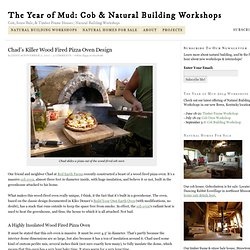
It’s a massive cob oven, almost three feet in diameter inside, with huge insulation, and believe it or not, built in the greenhouse attached to his home. What makes this wood-fired oven really unique, I think, it the fact that it’s built in a greenhouse. The oven, based on the classic design documented in Kiko Denzer’s Build Your Own Earth Oven (with modifications, no doubt), has a stack that runs outside to keep the space free from smoke. In effect, the cob oven‘s radiant heat is used to heat the greenhouse, and thus, the house to which it is all attached. Build Your Own $20 Outdoor Cob Oven for Great Bread and Pizza - The Year of Mud: Cob & Natural Building. (The following entry is all about making a cob oven, a lovely and inexpensive outdoor pizza oven.
The construction details have been trimmed back a bit, but this article should still give you a full idea of necessary materials and the building process for making your own oven!) Plaster Mold Casting. Plaster mold casting is a manufacturing process having a similar technique to sand casting.
Plaster of Paris is used to form the mold for the casting, instead of sand. In industry parts such as valves, tooling, gears, and lock components may be manufactured by plaster mold casting. The Process Initially plaster of Paris is mixed with water just like in the first step of the formation of any plaster part. In the next step of the manufacture of a plaster casting mold, the plaster of Paris and water are then mixed with various additives such as talc and silica flour.
Melting metal in a home foundry, backyard metalcasting, metal casting. The Elementary School Teacher, Vol. 7, No. 3 (Nov., 1906), pp. 164-168. The Kiln Book: Materials, Specifications & Construction (9780873419109): Frederick L. Olsen. Kiln plans. Welcome to our pottery blog!
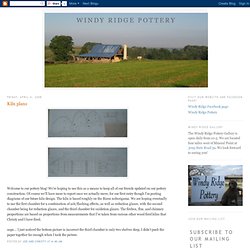
We're hoping to use this as a means to keep all of our friends updated on our pottery construction. Of course we'll have more to report once we actually move, for our first entry though I'm posting diagrams of our future kiln design. Kiln Building Plans. HomeProducts ServicesEducation NewsClay | Glaze | Firing | Toxicity | Materials | Books | People | Events | Glossary Are you a kiln building expert?
Can we link to your website or promote your design on this page? Building My Dream Kiln. Fuel Efficient Kiln Design. How different is this kiln?
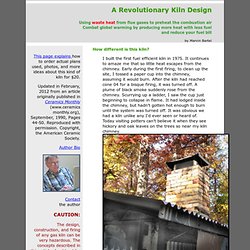
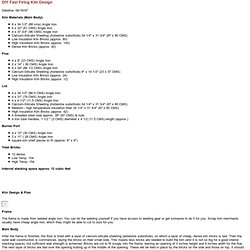
I built the first fuel efficient kiln in 1975. It continues to amaze me that so little heat escapes from the chimney. Early during the first firing, to clean up the site, I tossed a paper cup into the chimney, assuming it would burn. After the kiln had reached cone 04 for a bisque firing, it was turned off. A plume of black smoke suddenly rose from the chimney. How to Build and Maintain Ceramic Studio Equipment, Links and Resources. Building my New Kiln. Ceramics Kiln Design. DIY Fast Firing Kiln Design Dateline: 06/16/97 Kiln Materials (Main Body): Total Bricks:
» Kiln Building Video: From the Ground Up - Laying the Foundation for Building a Ceramic Kiln. This clip is packed with great advice such as, build your kiln around the shelves you plan to use rather than trying to fit shelves after you’ve built the kiln.
We get lots of emails here at Ceramic Arts Daily from potters and ceramic artists who have interest in building their own kilns. In fact, after Monday’s post on the high-school anagama, we received a couple of requests for more, more, more, articles on kiln building. So, I thought I would continue the kiln-building theme and close out the week with a video on the topic. » Hugh Jenkins’ Volcano Kiln: Recuperating Waste Heat for Efficient Firing.
As a studio artist, it is often hard to spend large sums of money, even if doing so would pay off in the long run, so glass artist Hugh Jenkins set out to determine just how well he could do with a home-built heat recuperator. After several improvements, he discovered that, depending on how much fuel he used, recuperating hot air in a closed system can reduce fuel consumption by up to 80%. He then applied what he learned when helping a friend build a kiln for ceramics. One of the biggest factors in the performance of these units is a very tight-fitting door. Any gaps can significantly cut the efficiency of the heat exchanger. This article originally appeared in the December 2007 issue of Ceramics Monthly magazine. » An Experienced Wood Firer Shares Kiln Plans for a Small Instructional Wood Kiln.
I set out to build a very versatile and efficient wood-firing kiln that could be used by students who had interest in a complete hands-on experience, from the preparation, loading, firing and unloading to the final clean-up phase. I didn’t want to interfere with the successful larger firings, in which students can get a large volume of wood-fired pots without the in-depth hands-on experience. The new kiln would allow me to cut down on the extensive labor, fuel and overhead costs of my larger kiln. I named the new kiln “Manabigama” at the suggestion of my friend Phil Berneburg, former technical editor for CM. In Japanese, mana means educational or learning, bi means a thing of beauty, and gama means kiln. The overall interior dimensions are 24 inches in width, 7 feet in depth, 40 inches in height. There is approximately 24 cubic feet of ware space, more than enough for teaching purposes.
DIY: Pottery Kilns.