
Personality Junkie. By Dr.
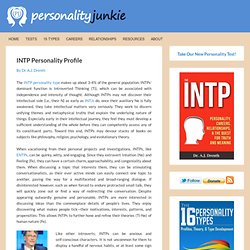
A.J. Drenth The INTP personality type makes up about 3-4% of the general population. INTPs’ dominant function is Introverted Thinking (Ti), which can be associated with independence and intensity of thought. Although INTPs may not discover their intellectual side (i.e., their N) as early as INTJs do, once their auxiliary Ne is fully awakened, they take intellectual matters very seriously. When vacationing from their personal projects and investigations, INTPs, like ENTPs, can be quirky, witty, and engaging. Bill Gates, INTP Like other introverts, INTPs can be anxious and self-conscious characters. Because of their reluctance to freely display the rational dimension of their personality, as well as the scattered nature of their Ne expressions, INTPs often feel their true level of knowledge and competence goes unnoticed by others.
When it comes to relationships, INTPs can also have a rough go of things. INTP Personality Type Development & Functional Stack Phase I (Childhood) Understanding the Inferior Function. By Dr.
A.J. Drenth The inferior function is a more advanced topic in typology. This is not because it is necessarily difficult to understand, but because it requires a certain background knowledge of the functions (Typology 201) as well as the functional stack (Typology 301). Hence, I have opted to classify our studies of the inferior function as “Typology 401.” The Nature of the Inferior Function The inferior function represents the ultimate goal or attractor point for each personality type’s personal growth and development. For instance, a dominant Thinker, such as an INTP, who suddenly experiences feelings (F) of love or infatuation may report feeling intoxicated and enraptured, as if he’s been transported to a new and beautiful world.
The inferior function not only holds the potential for a renewed sense of life and vitality, but also for evil and destruction. The Dominant-Inferior Function Tug-of-War A common example of an inferior-related “high” is the experience of infatuation. INFJ, INFP, INTP, INTJ Relationships, Compatibility, & the Inferior Function. By Dr.
A.J. Drenth Like other personality types, Intuitive Introverts can struggle with finding strong matches in their relationships, often wondering if true love and compatibility will ever find them. In this post, I will explore some key factors that contribute to the success (or breakdown) of INTJ, INTP, INFP, and INFJ relationships. Depending on their type, Intuitive Introverts will use different methods and standards for evaluating prospective partners. In my view, all types are best paired with mates who align with the needs and values of their dominant and/or auxiliary functions.
The Inferior Function as Mischief Maker Unfortunately, what makes sense on paper (i.e., matchmaking according to the top two functions) does not always play out in the real world. The influence of the inferior, which is particularly potent early in life, helps to explain why people often pair with their typological opposite. INTJ/INFJ Relationships INTP/ISTP Relationships INFP/ISFP Relationships. Intj: Type Interactions #5: INTJ-INTP [archived] While it is wonderful to sit around and discuss how amazing we INTJs are, there are other types in the world and we generally have to deal with them more than with fellow INTJs.
![intj: Type Interactions #5: INTJ-INTP [archived]](http://cdn.pearltrees.com/s/pic/th/intj-interactions-archived-32786853)
As a result I will be making weekly posts (as long as there is a good response) about how INTJs interact with others to get feedback on the experiences we INTJs have had with other types and how we've learned to deal with them successfully. I'll be posting this series every Monday featuring a new quasi-randomly-selected personality type.
Today's interaction was requested by space_marine. (Yes, I do take requests.) Type Interactions #5: INTJ-INTP I really like INTPs. A few tricks I've learned: 1) They tie compentancy to their self image and hence insulting (or implying an insult to) their competancy is the equivalent to telling an INTJ that her judgement can't be trusted and an NF that they are worthless and a discrace to their ideal. 3) Tell them what you want.