
The Water Cycle. [in Spanish] © Contributed by Leanne Guenther Run and get a glass of water and put it on the table next to you.
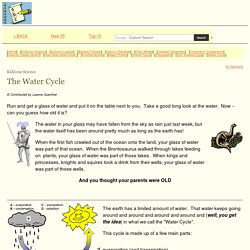
Take a good long look at the water. Now -- can you guess how old it is? The water in your glass may have fallen from the sky as rain just last week, but the water itself has been around pretty much as long as the earth has! When the first fish crawled out of the ocean onto the land, your glass of water was part of that ocean. And you thought your parents were OLD The earth has a limited amount of water. This cycle is made up of a few main parts: evaporation (and transpiration) condensation precipitation collection Evaporation: Evaporation is when the sun heats up water in rivers or lakes or the ocean and turns it into vapor or steam. Do plants sweat? Well, sort of.... Condensation: Water vapor in the air gets cold and changes back into liquid, forming clouds. You can see the same sort of thing at home...
Precipitation: Collection: Water Cycle Activity Pages. Sheet 1 - (color) or (B&W) Bill Nye the Science Guy episodes 47: Water Cycle. Revolution: The Lifecycle of Water Told in a Stop Motion Pop-Up Book. This blog has seen it’s fair share of pop-up books, and animation using paper, but this might be the first where everything comes together in a single piece.
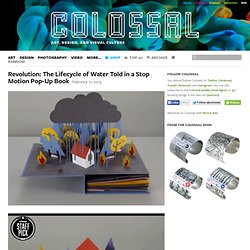
Revolution is an animated short by photographer Chris Turner, paper engineer Helen Friel and animator Jess Deacon that explores the life cycle of a single drop of water through the pages of an elaborate pop-up book. The book contains nine scenes that were animated using 1,000 photographic stills shot over the course of a year. (via faith is torment) The Water Cycle. Home The Earth is the water planet.
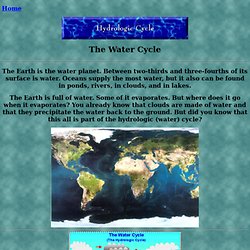
Between two-thirds and three-fourths of its surface is water. Oceans supply the most water, but it also can be found in ponds, rivers, in clouds, and in lakes. The Earth is full of water. Some of it evaporates. The water cycle is made up of four main parts: Evaporation and Transpiration, Condensation, Precipitation, and Accumulation. Evaporation is when the heat from the sun warms up water and turns it into water vapor. The Water Cycle. The water cycle, U.S. Geological Survey (USGS) Water Science School. Earth's water is always in movement, and the natural water cycle, also known as the hydrologic cycle, describes the continuous movement of water on, above, and below the surface of the Earth.

Water is always changing states between liquid, vapor, and ice, with these processes happening in the blink of an eye and over millions of years. Global water distribution For an estimated explanation of where Earth's water exists, look at the chart below. By now, you know that the water cycle describes the movement of Earth's water, so realize that the chart and table below represent the presence of Earth's water at a single point in time.
If you check back in a thousand or million years, no doubt these numbers will be different! Notice how of the world's total water supply of about 332.5 million cubic miles of water, over 96 percent is saline. Source: Igor Shiklomanov's chapter "World fresh water resources" in Peter H. Earth Floor: Cycles. The Water Cycle Water on Earth is always changing.
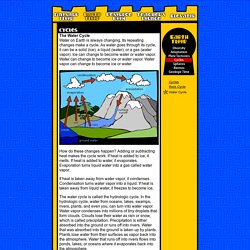
Its repeating changes make a cycle. As water goes through its cycle, it can be a solid (ice), a liquid (water), or a gas (water vapor). Ice can change to become water or water vapor. Water can change to become ice or water vapor. Water vapor can change to become ice or water. How do these changes happen? If heat is taken away from water vapor, it condenses.